[[{“value”:”
Hey AI Breakers 👋
Most business channels film whatever feels interesting that week. They get views, and they sell nothing. 📉
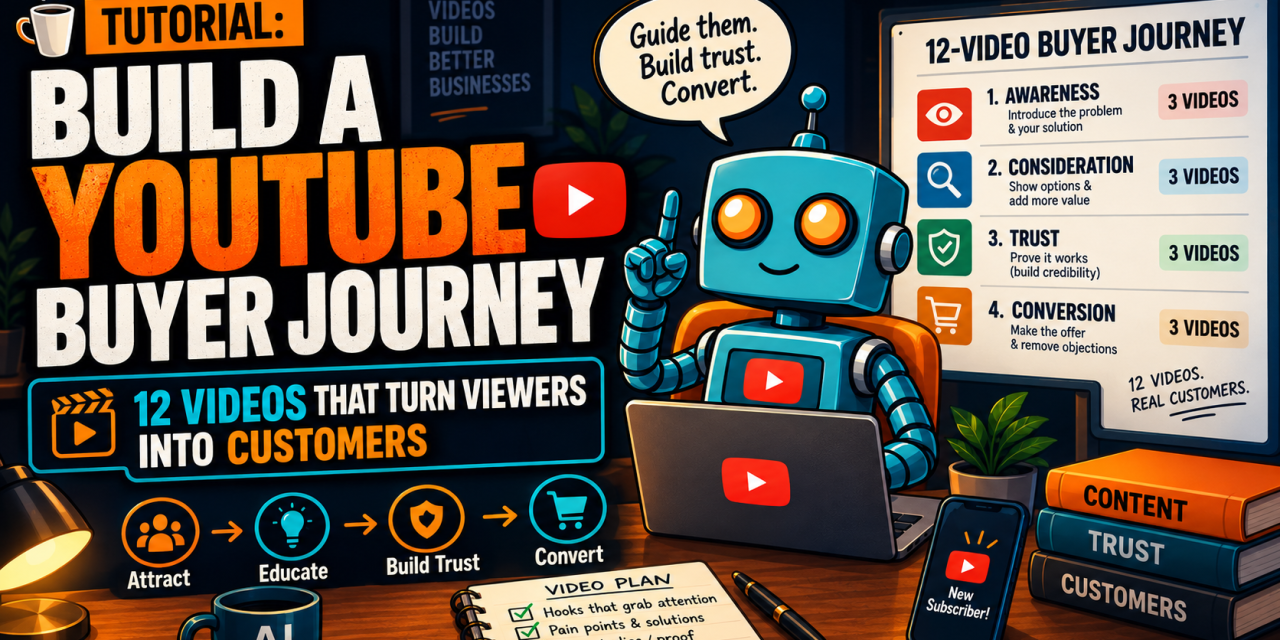
Today, you’ll build an AI YouTube Buyer Journey Engine that maps your actual buyer, assigns every video a job in the funnel, and links them so one view pulls people toward the sale.
-
✅ A decoded buyer journey with the exact questions people ask at each stage
-
✅ A ranked list of topics your buyers genuinely search for on YouTube
-
✅ A 12-video slate where every video has one job and one CTA
-
✅ Titles and thumbnail concepts for your first four videos
-
✅ A full script for video #1, built for retention
-
✅ A conversion layer: lead magnets, descriptions, pinned comments, end screens
-
✅ A 90-day diagnostic that tells you exactly which stage is leaking
Let’s build it 👇
🧠 Why Most Business Channels Get Views and Sell Nothing
A channel that sells is not a pile of good videos. It’s a path. 🛤️
Here’s the shape of it:
-
🎣 Top of funnel catches people who don’t know they have a problem yet
-
🧭 Middle of funnel teaches the people who know the problem but not the fix
-
💰 Bottom of funnel closes the people already comparing options
-
🔁 Internal routing pushes each viewer down one stage instead of back to the homepage
Compare the two approaches:
-
❌ The usual way: 12 random videos, decent views, no idea which one ever produced a customer
-
✅ The journey way: 12 assigned videos, each with a job, a CTA, and a metric you can actually read
Old timeline: a year of publishing before you spot a pattern.
New timeline: 60 minutes to map the whole thing before you film anything. ⏱️
Bonus: this works on a channel with 40 subscribers. The journey does not care about your size.
🔎 Prompt #1 → The Buyer Decoder (Mapping the Real Path to Purchase)
Everything downstream depends on this. Get the buyer wrong and you’ll make 12 excellent videos for nobody.
The goal:
-
Break your buyer’s path into four honest stages
-
Capture what they believe, fear, and search at each one
-
Identify the single thing that moves them forward
✅ Use this to stop guessing what your audience needs and start reading the actual decision sequence.
Prompt:
You are a demand researcher who maps buyer journeys for B2B and
creator-led businesses. You are blunt and specific, never generic.

MY CONTEXT:
- What I sell: [YOUR PRODUCT OR SERVICE]
- Price point: [PRICE AND BILLING MODEL]
- Who buys it: [IDEAL CUSTOMER, ROLE AND COMPANY TYPE]
- What they use instead today: [CURRENT ALTERNATIVE OR DIY METHOD]
- Why people say no: [TOP 2 OBJECTIONS YOU HEAR]

YOUR TASKS:

1. FOUR-STAGE MAP
   Map my buyer across these four stages:
   Stage 1 UNAWARE, Stage 2 PROBLEM-AWARE,
   Stage 3 SOLUTION-AWARE, Stage 4 VENDOR-AWARE.

   For each stage give me:
   a) What they currently believe about their situation
   b) The words THEY would use to describe it (not marketing words)
   c) What they are quietly afraid of
   d) What they would type into a search bar at this stage
   e) The one realization that moves them to the next stage

2. THE STUCK POINT
   Which stage do most of my buyers get stuck in, and why?
   Explain what usually keeps them there.

3. DISQUALIFIERS
   List 3 types of viewer who will never buy from me, so I know
   who NOT to make content for.

Format as a clean table for task 1, then short prose for 2 and 3.
💡 Tip: If the output reads like a marketing persona doc, it’s too clean. Reply with “rewrite section 1b using only phrasing a real customer would say out loud on a call” and it sharpens fast.
🎯 Prompt #2 → The Demand Scout (What Your Buyers Actually Search)
YouTube is two platforms in one. Search brings people with intent, and the browse feed brings people with curiosity.
The goal:
-
Turn each journey stage into real YouTube search behavior
-
Separate search-intent topics from browse-intent topics
-
Find where demand is high and competition is thin
✅ Use this to pick topics based on what people look for, not what you feel like filming.
Prompt:
You are a YouTube content strategist who has grown business channels
using search demand rather than trends.

MY BUYER JOURNEY MAP:
[paste the full output from Prompt #1]

MY NICHE: [YOUR NICHE]

YOUR TASKS:

1. SEARCH TRANSLATION
   For each of the four stages, list 6 topics my buyer would
   realistically search on YouTube. Use natural search phrasing,
   not article titles.

2. INTENT TAGGING
   Tag every topic as SEARCH (people actively look for this) or
   BROWSE (people only click it when the feed serves it).
   Explain the tag in one line each.

3. COMPETITION READ
   For each topic, estimate competition as LOW, MEDIUM or HIGH based
   on how saturated this kind of content typically is, and note what
   the existing videos usually get wrong.

4. THE OPENINGS
   Give me the 8 topics with the best ratio of real demand to weak
   competition. Rank them and justify each in one sentence.

5. STAGE WEIGHTING
   Tell me which stage has the most searchable demand in my niche,
   and how I should weight my first 12 videos because of it.
🧠 Tip: Sanity-check the top 8 by typing each into YouTube search yourself. If the top results are all three years old or all from huge generalist channels, that’s your opening.
🧱 Prompt #3 → The Slate Builder (Your 12 Videos, Each With a Job)
This is the heart of the system. Twelve videos, every one assigned to a stage with a single measurable job.
The goal:
-
Distribute videos across the funnel instead of clustering at the top
-
Give each video one job and one call to action
-
Set the publish order so early videos feed later ones
✅ Use this to replace your content calendar with a revenue map.
Prompt:
“}]] Read More in The AI Break