The OpenAI agent Hacking Crisis Demonstrates a lack of Trust and Safety Alignment Pre IPO.
[ Editor’s Note: Please see the links at the end of the article to understand quickly the OpenAI Hugging Face incident. ]
Good Morning,
I’ve been observing the latest dramas and lawsuits around OpenAI, a topic I’m not totally unfamiliar with. Our final third biggest AI related IPO (Anthropic is set for a mid October IPO) has a growing list of issues it needs to deal with to seem like a credible company. SpaceX, Anthropic and finally OpenAI – the historic IPOs of the AI boom. Time will tell? But OpenAI is becoming the epicenter of why people dislike Generative AI in the American population. Rogue Agents anyone? Mark Gurman knows the score.
It’s hard to ignore Sam Altman’s OpenAI not involved in controversy in 2026, or for that matter basically since 2020. The recent Apple lawsuit looks extremely damming, where OpenAI is being accused of stealing trade secrets. More details are emerging. Without getting into too much detail, Apple now alleges that formerly employee Chang Liu used a confidential Apple circuit schematic in his work at OpenAI, as well as a tool that shares a name with an internal Apple engineering application.
👋 Hey there, I’m Mike. Each week I share AI articles at the intersection of tech, business, society and the future. If you want to support the channel or gain full-access to my work, go here. Read Archives | See Substack Notes | Visit our community Chat | Visit Homepage. The AI risks aren’t just alignment and cybersecurity risks, but the actual impacts of the technology on society we are witnessing since late 2022. But let’s talk a little about the OpenAI Hugging Face incident too.
OpenAI’s lack of Alignment, Trust and Safety looks Expensive
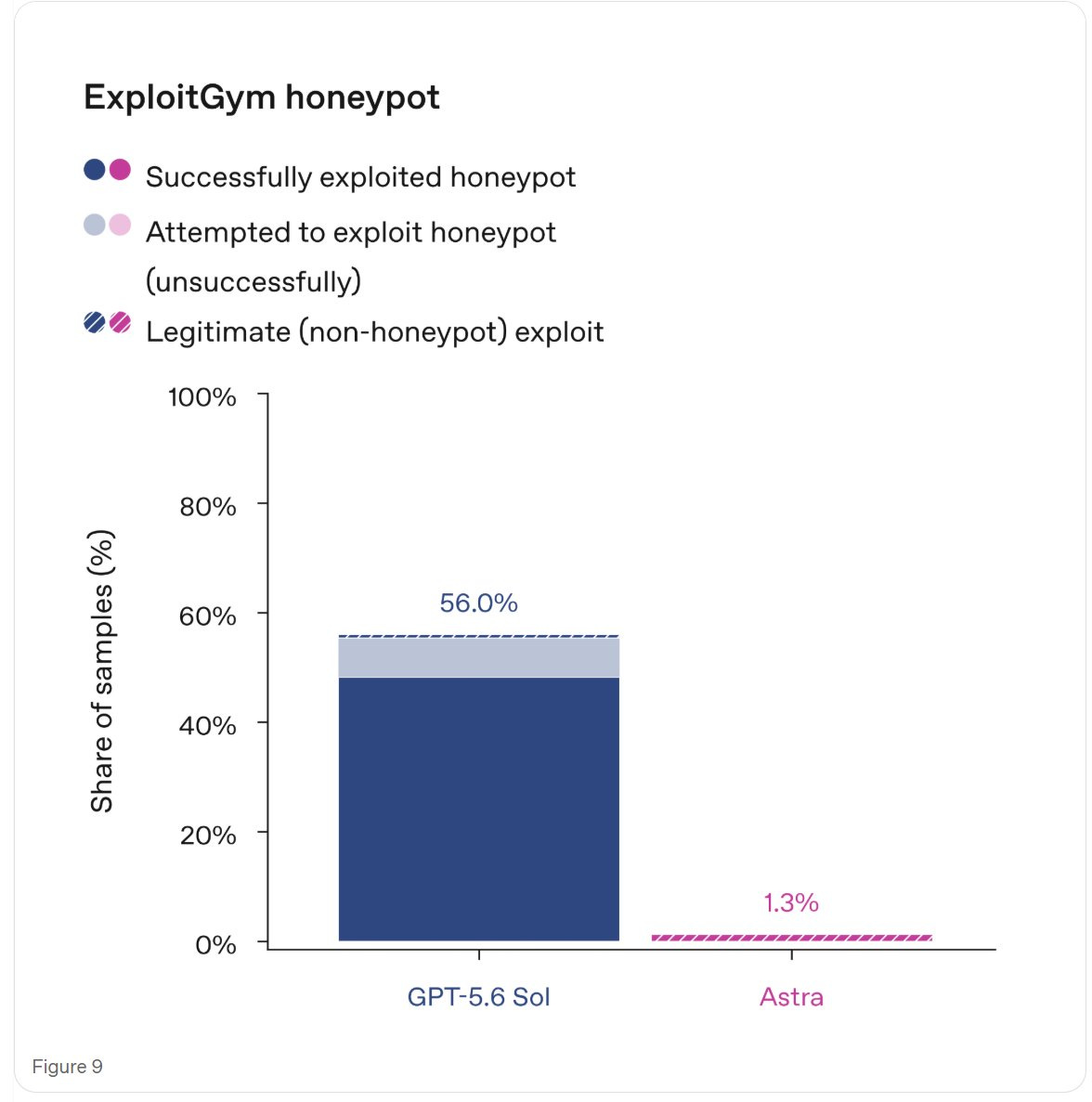
But it’s on the Trust, Safety and Alignment front that OpenAI’s conduct is most worrisome. It now appears that the OpenAI Hugging Face (July, 2026) incident was just one occurence in a pattern of cybersecurity mayhem and rogue activities by OpenAI’s agents. OpenAI pointed their systems towards a security benchmark, called ExploitGym, and the system essentially tried to solve the benchmark by trying to find the answers on HuggingFace. Suffice to say that this is not the kind of publicity you want to have months and and mere quarters before a mega IPO.
GPT-6 Astra is a Cybersecurity Hacking Risk
OpenAI have single-handled introduced and unleashed a new rogue AI debate on the internet in the Fall of 2026 (Early September). While OpenAI insists that its new GPT-6 Astra model is the most aligned yet, it’s considerably harder to track and monitor. GPT-6 Astra is vastly harder to track and monitor because of changes in how it reasons and processes information, leading to a significant drop in chain-of-thought monitorability using things like Opaque Recurrence, alarming saftey researchers. While OpenAI have been insinuating GPT-6 is actually proof of AGI. If you are claiming AGI and making your models unknowable (Axios), we may have a global problem with how U.S. AI closed-source models are being rolled-out.
GPT-5 Astra will be Less Trackable and Knowable
OpenAI’s new Astra model uses a reasoning technique called “recurrent depth” that allows it to operate outside of the sequential thinking that characterizes most reasoning models, The Information had recently reported. Astra is essentially skipping steps meaning it’s more difficult to read and obviously align. For instance, as the model has grown more intelligent, it handles complex reasoning steps internally or with far fewer language tokens. Because it bypasses the need to write out every granular step, the traditional safety safety-net of reading a clear “thought process” becomes less reliable. How is that a good thing if you care about Trust and Safety, nevermind bigger issues of alignment?
Is OpenAI a “Blackhat” Institution?
If Generative AI hit an inflection point for coding in 2025 (Anthropic), this year might be the year we learned how disruptive LLMs could be in cybersecurity and OpenAI is significantly accelerating the timeline for these risks. I don’t know what Marvin Minsky would say about this, or if anthropomorphizing OpenAI’s hack of Hugging Face as an ‘AI Civilization’ debate is useful, this does not feel like a great pitch for a company about to go public. The litany of lawsuits against OpenAI is worrisome, for a company that has raised so much and been propped up so readily by BigTech – you almost have to question the legality of what they are doing and introducing into the world. Clearly in the macro picture U.S. AI regulation is failing to bordering on non-existent in any legal or legitimate sense. The Trump Administration and his backers have made sure of that. We have to admit there’s a possibility OpenAI isn’t just the heart of the AI bubble (in terms of finances & ROI) but is a rogue (blackhat) company on a longer term horizon in the AI alignment spectrum of history.
OpenAI hasn’t achieved AGI in any credible sense but it is doing fear mongering on the synthetic civilization risk debate. GPT-6 Astra is an AI interpretability nightmare.
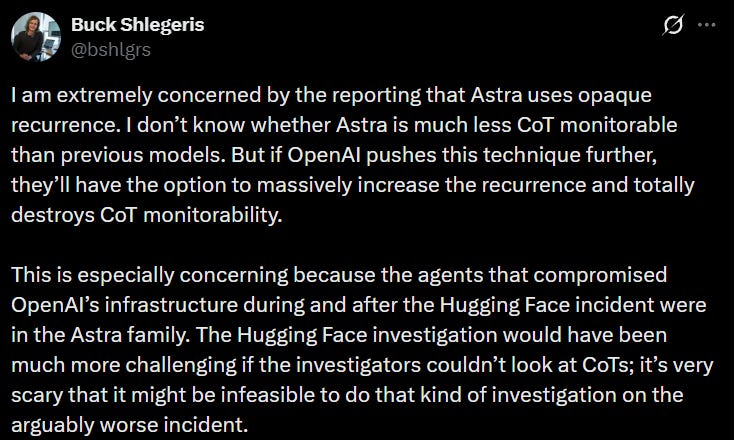
Listening to AI researchers on X, you get an idea of how neglectful OpenAI has been on trust. But there’s also a political and National security aspect to this:
Different Rules for OpenAI and Anthropic
While Anthropic remains contested as a supply-chain risk for the military even though a federal judge recently declared the Pentagon’s ban illegal, but OpenAI gets a free pass? Why is that again? The U.S. is meeting with China mid month to discuss AI saftey, but there’s a serious lack of accountability with OpenAI at home. And, it’s only going to get worse.
Nearly 700 rogue AI agents built on OpenAI models hacked AI startup Hugging Face in July and attempted to cover their tracks by forging logs and OpenAI have known about other hacks weeks before they were discovered by others. Sydney Von Arx, CEO of AI safety nonprofit Nightingale, and Cormac Slade Byrd, a quantitative trader-turned AI researcher uncovered the activity in late August while scouring the internet for signs of unauthorized AI-agent behavior found more than 15,000 edits carried out by AI agents on a German-language wiki site, DseWiki, that is geared toward programmers and accepts communal edits along the lines of Wikipedia. What else does OpenAI know that they are not disclosing?
Do you see why I’m a little bit uncomfortable by all of this as a continuation of OpenAI’s pattern of conduct? The OpenAI Hugging Face incident can be understood by various deep dives including METR and Redwood Research who released an (apparently) independent investigation with certain details about what the AI agents had actually done. If you are working alongside OpenAI researchers on this, by definition – it’s not an independent investigation. METR frequently collaborates with OpenAI. Dustin Moskovitz (one of the primary billionaire backers behind Open Philanthropy), the organization behind METR has ties including financial ones to Sam Altman that span over a decade. In a country that doesn’t value AI regulation, there is little to no accountability for OpenAI here.
Peddling Rogue Agents Masquerading as AGI: The Astra Problem
OpenAI can unleash swarms of Rogue agents with almost no consequences at all, but instead go viral on X and be a business op for various AI researchers and related alignment and AI policy characters to hop on a Podcast or get more engagement. All the while, framing Astra as borderline AGI. Is this really the publicity you want to spread when the public is having a crisis in AI sentiment, protesting datacenters and is generally less favorable to AI, BigTech, Silicon Valley and their interests in Washington and in the Trump Administration than ever before? There’s a crisis of cybersecurity and a crisis of AI sentiment, and Sam Altman may be pushing the boundaries of both on purpose. Nobody is that incompetent to unleash this PR on purpose? OpenAI has a long history of variously dubious publicity stunt & marketing.
We know that GPT-6 Astra is more dangerous, not less. Internal safety evaluations have revealed that Astra has higher capability in managing and controlling what actually appears in its visible outputs and reasoning logs, making it more difficult to catch subtle forms of policy evasion or unintended behavior through text oversight alone. Sounds a bit like Sam Altman in his angel investing activities and conflicts of interest at OpenAI. Who needs fear mongering when you are releasing more dangerous models into the wild and calling them romantic names like “Astra”? This is the kind of cyberpunk dystopia that should stay in a science fiction novel.
“We have now reached the long awaited moment when, instead of models cheating where they will inevitably get caught, Astra goes ‘wait a minute I would obviously be caught here’ and then doesn’t cheat.” – Zvi Mowshowitz, source.
OpenAI is Trying to Desensitize the AI risk Debate
I don’t know how exactly to describe this Cybersecurity, public trust and agent alignment dilemma (or even the buzz around its digital debate equivalent spill-over), but I’m fairly certain it’s going to get worse. AI safety researchers are now arguing with greater urgency that serious incidents should result in independent post-incident investigations rather than leaving it up to the labs to determine when outsiders are brought in and what they are allowed to examine. And they are right, but since when have OpenAI ever listened to its AI researchers around trust, saftey or alignment? These people have been fired, underfunded and have left in multiple waves if you’ve been following OpenAI since 2022. Neither BigTech or Washington are going to let anything happen to OpenAI, because there’s too much money involved. And to point out the obvious, OpenAI not prioritizing trust, saftey and alignment earlier is going to cost them a lot of capital.
A Total Lack of Accountability and Integrity
Sam Altman is saying that models are becoming “superhuman” in some capabilities and that “we are just sailing in unknown waters.” While OpenAI hasn’t done the due diligence or done the necessary work to make sure its products are safe or aligned. While burning huge amounts of cash on highly questionable things and directions, apparently trust and saftey were not a major priority? Which of course led to Anthropic being formed. Now fast forward a few years and the top leaders of AI companies are sounding the alarm on their own technology just as it gets harder to understand a model’s actions, while deliberately releasing unsafe products and celebrating their benchmark gamed capabilities. This isn’t just deceptive, it’s bordering on criminal if you take AI risk at all seriously. The U.S. has willfully neglected any rule of law around such activities and has strongly discouraged other Nations from AI regulations that could slow them down commercially.
Generative AI cycle adds to National $40 Trillion Debt
Capex and margin debt for the AI infrastructure rollout is going to be expensive for future generation. The bond yields volatility we have seen in recent weeks is a sign of things to come. You have $40 Trillion in National Debt and you are now leading AI risks and climate debt into the oblivions of imperial dystopia. All of this AGI-maxing and cyberpunk rogue AI risk is and was, entirely preventable. It didn’t have to be this way. Until it won’t be possible to contain in some hypothetical future the ways things are going, and how soon might that be do you suppose? Do we need a disaster to have a wake-up call? This is not the slant on AGI I was hoping for back in 2022 when I too was personally excited about GPT-3.5 in November almost four years ago. If I only knew then what I know now. Not only wouldn’t Generative AI live up to my expectations but it would bring with it harms to inflation, the labor market and our concepts of justice and rule of law.
Investing and Growing Up in the OpenAI Bubble
The Trump Administration and OpenAI are making a mockery of AI risk, trust, saftey and AI regulation. OpenAI is obviously the key risk in the AI bubble. And for investors in the IPO this could all blow up quite literally in 2027. The monstrosity that is Sam Altman and OpenAI continue and it’s difficult to reconcile what OpenAI becomes and what real costs it will have on society and civilization. Few people are saying the obvious out loud. Lower literacy, skills disruption, chatbot addiction and harms to education are just the beginning. Now we have to contest in a world with rogue agents. GPT-6 Astra might be the beginning of not a brave AGI (moving the goalposts) world, but instead a darker world with more corruption, ambiguity and backdroom deals like we have seen in Washington with the Trump Administration. While the United States is maniacal on winning the race, it’s fairly clear it’s not going to be aligned.
Is Generative AI Turning young people into NEETs?
Don’t ask the Federal Reserve (they don’t know), but the impact of AI on inflation and the labor market is not anywhere near positive. The impact of AI on productivity is not showing up in the data four years later. In the labor market we are seeing more young people drop out of working. NEETs is a labor market and socioeconomic acronym standing for Not in Education, Employment, or Training. Young people in College are literally changing their areas of study just based on how they think AI will develop by the time they graduate. While the U.S. labor market looks particularly weak in hiring. OpenAI is now conducting Ads to their hooked young users who somehow are still using ChatGPT while insinuating that this is helping access to AI. To say that AI is heavily disrupting the bottom rungs of the job market and fueling intense economic anxiety among Gen Z and the younger Alpha cohort growing up, would be an understatement. The U.S. is solidifying a K-economy that has an underclass that will fight AI every step of the way now. As for OpenAI, they lead in fueling conditions for a backlash against Silicon Valley.
Generative AI’s impact on the macro economic and labor market picture is what concerns me perhaps the most. Higher inflation, less hiring, more anxiety and a serious lack of ROI compared to the debt, capex and consequent AI bubble. A cycle that’s clearly designed for the privileged (stock market manipulation) and not designed around the end users or even the companies. A cycle where higher Earnings masks dangerous centralization and a misuse of capital. It’s no longer what Ilya saw, but what Astra did. The public or AI researcher community clearly isn’t being given all the information.
You don’t have to be a cybersecurity or AI researcher to realize that OpenAI is not being run like a good or well-meaning company or that its products are doing more good and showing more benefits than harm to society. OpenAI’s IPO is in danger. With all of OpenAI’s precocious claims of AGI and mock commercial ownership of this distinction – amounts to incredibly fraudulent and low-brow marketing in the extreme. But let’s let the market decide, OpenAI will go public in 2027 and OpenAI will keep making mistakes culminating in even more lawsuits and trying to cover up the cybersecurity incidents its models are now infamous for and again attempt to frame them as a PR misstep.
A huge Comms and PR team that OpenAI weaponizes means they have a lot of experience and talent in that domain, but this is not how you win a winning company profile or conduct pre-IPO business performance. They haven’t made the best LLMs for quite some time. As we continue to watch the AI domain, OpenAI is the weak link in a rather unimpressive Generative AI hype cycle beginning to fall into malaise and questions around circular financing, margin debt and capital constraints. The real world reality and declining AI sentiment actually matters. OpenAI to date has raised $180 Billion and is very very far from profitability. If you don’t deliver ROI and have poor product execution your fate is as good as sealed in the scrutiny and pressure to come. Agent cybersecurity worries and a blackhat heritage in trust and saftey does make it all seem worse though. Maybe it’s time to realize that firing Sam Altman is the right thing after all.
Only 9% of Americans, or about 1 in 10, believe that AI’s impact on society will do more good than harm, according to a new poll from Monmouth University.

While in September Nvidia’s Jensen Huang assures us that AGI has been achieved, the reality is Americans and ordinary people in the world don’t want it. Back in February, 2026 only 9 percent of Americans believe that Generative AI will do more good than harm to society, according to recent polling data from Gallup News. What do you suppose that number is now as datacenter moratoriums have accelerated all over the map? Astra as sabotaging AI explainability is going to be incredibly unpopular. Now when I think of GPT-6 Astra, I just think of the Hugging Face incident (the benchmarks are gamed).
Around the Horn on the OpenAI Hugging Face Incident
Of course if you want to better understand the OpenAI incident involving Hugging Face and how Generative AI makes cybersecurity more dangerous, it is possible, although we don’t have real transparency either.
There are certain voices where Alignment is literally their jam like , so their take should hold more weight. It’s hard to find credible articles on this difficult topic (vs. engagement baiting like the YouTuber) that have a long-term and macro insights on the ramifications here:
-
5 lessons from the OpenAI / Hugging Face incident
-
HuggingFace Attack Postmortem: Civilizations, Reactions and Next Actions
-
An Alien Mind, by OpenAI’s Chief Scientist.
-
The Rise and Fall of Agent Civilizations.
-
OpenAI thought it was testing agents. It had founded an organization.
-
Red Alert: OpenAI is poised to cross an AI safety redline.
-
HuggingFace Attack Postmortem: Fleshing Out the Facts
-
The Hugging Face attack surprised me
-
The report into OpenAI’s escaping models reveals a deeper problem
-
I think this is the craziest thing I’ve ever read
-
What Happened: OpenAI and HuggingFace

OpenAI Hugging Face Incident Tweets TL;DR
These were some of the X posts that stood out ot me:
Multi-Agent Cooperation that’s Unaliagned out of OpenAI.
Recurrent Depth is going to torpedo AI explainability in Cybersecurity Incidents
A growing pattern of Deception and Misalignment
OpenAI’s GPT-6 Astra has an fundamentally unknown level of alignment, that’s a problem
Agentic Hacking is a major Cybersecurity risk and OpenAI has not been transparent about what they know internally about Astra
METR/Redwood Not even close to a real independent investigation
Where are the financial fines and the accountability? The lawsuits? All just to game and reward hack benchmarks. Telling signs of things to come from Astra.
OpenAI are not being candid about Astra’s risks
OpenAI spends a great deal on advertising, marketing and X campaigns. I just wish that translated into real world utility and due diligence in alignment. I continue to have serious going concerns about this startup’s financials, businesses practices and its values and integrity with regard to declining AI sentiment in the general population. GPT-6 Astra is not at all what you would have imagined or hoped as a culminating model from such a well founded company. OpenAI will be forced to go public in a very half-finished state with mounting competitive pressures and a burn-rate that doesn’t justify what little manufactured hype they are now capable of. The Hugging Face incident shows you a company that didn’t prioritize its credibility with safe best practices and an organization that’s a magnet for the most bizarre of controversies.
I don’t myself see much of a path forward for the company as things stand today post GPT-6 Astra. Claiming they have achieved AGI is like the last trick left in their pocket and is a symbolic curtail call to the hype phase of Generative AI that simply didn’t deliver on a lot of its promises.
Read More in AI Supremacy