[[{“value”:”
Good Morning,
AI Supremacy Newsletter is also committed to getting a variety of some of the top voices around AI, technology and business. I’ve admired the work of for a while now and I’m glad to host a special inside look at the future of Product Management in the era of Generative AI.
The Business Engineer
Explore the insights and frameworks developed from a decade of research.

Gennaro Cuofano is the creator of Business Engineer and founder of FourWeekMBA. A technology executive by day and business engineer by night, he works at the intersection of technology, business strategy, and innovation.
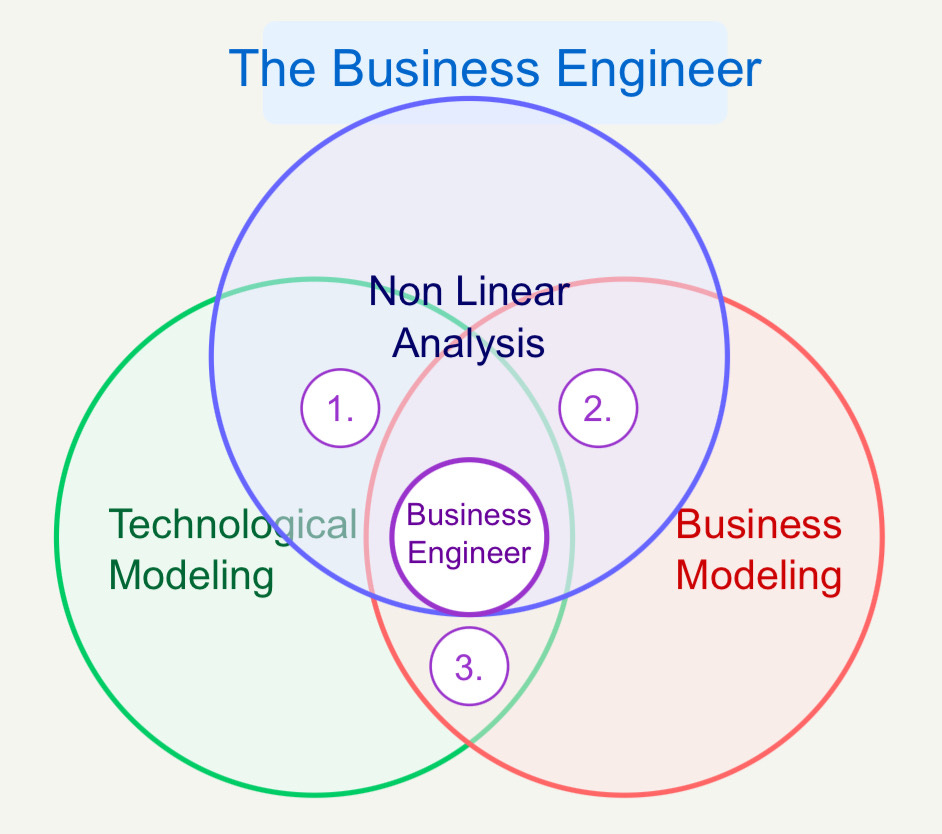
The Business Engineer is a publication that does what I would call “radical non-linear analysis”, a system that results from the author researching companies and blogging since 2015. As you might know I also appreciate deep thinking bloggers who create incredible infographics, frameworks and new ways of thinking of business transformation. This visual component really adds another layer of understanding. So his work is going on 11 years at this. He’s arrived at a deep understanding of his topics and who he is providing value for.

looks at business analysis like an engineer, and he’s also the creator of AgentOS. It’s hard to summarize his unique synthesis of tech & business, but one way to think of it is that he “forces digital operators to think like financial analysts, and corporate executives to think like systems engineers”, thus making him a critical and pragmatic guide for navigating the architecture of the AI economy.
The Opportunity of AI (how will you be involved?)
Thus he has a lot of frameworks, tutorials and ideas on how the role of Product Management is evolving in the era of AI and AI agents. Product management is essentially being rebuilt in the AI era, and as a side note I’ve noticed many Product management publications I used to read on substack now read more like AI publications (this isn’t by accident). Roles in technology companies are being fundamentally redesigned and it’s leading to a convergence in the future of business. New kinds of builders and entrepreneurs are arriving taking advantage of this unique window.
With the evolution of Claude Code, Cursor and tools like Loveable and Codex, the AI builder doesn’t need to be a technical engineer in 2026. How we think of engineering and product iteration in the era of AI is going to vastly expand economic opportunity in the decade ahead. Read that over again slowly, and think about how you want to participate?
As a reader of dozens of AI and business publications myself, I’m also just a fan of how Gennaro thinks.
Let me introduce you to some of his standout work recently:
-
Business Engineering Book, Workshop + CustomGPT [Available To Yearly Premium Members]
-
The Subsidized AGI Economy (June, 2026)
-
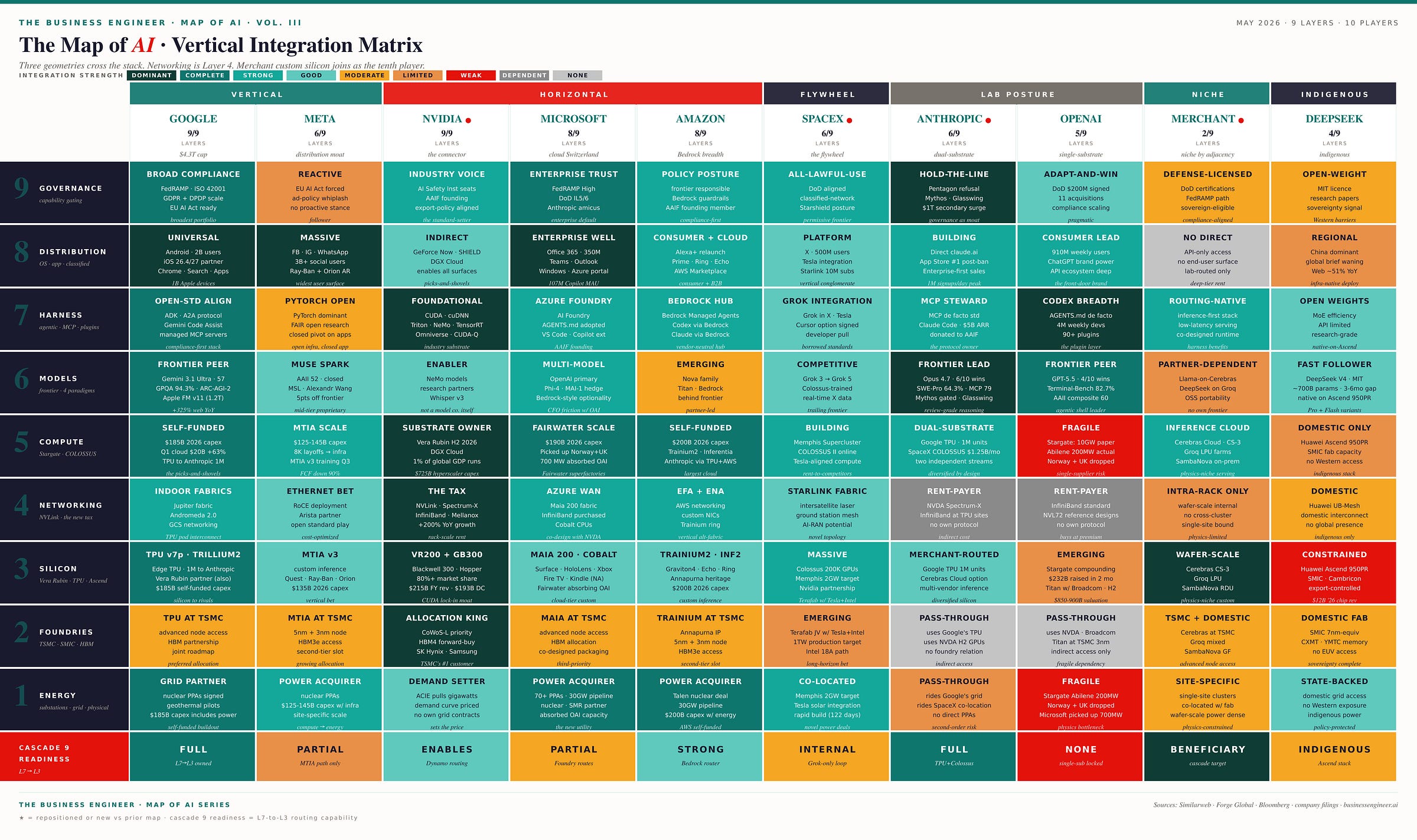
How SpaceX Is Rewriting the Map of AI (May, 2026)
I believe his audience are potentially for example professionals like product managers, business executives, startup founders, business model strategists, growth hackers, investors in technology who like frameworks, and enterprise digital transformation leaders on the chief of innovation analysis spectrum. Browse his articles in full here. He’s also recently launched a second Newsletter called the AI Supercycle.
“Gennaro forces digital operators to think like financial analysts, and corporate executives to think like systems engineers. Now he distills the emerging new role of Builder-PM that’s AI-native.”
The Builder-PM Manifesto
THE BUILDER-PM MANIFESTO
What we believe about the role now — and why
A companion to The Builder-PM: How Product Management Is Being Rebuilt for the AI Era
Eds: This manifesto is approx. 6,000 words or 33 pages.
Premise
How this manifesto came to exist
This manifesto is the compressed form of an argument I have been working on across the first half of 2026, in three editorial pieces and one consolidating book — The Builder-PM: How Product Management Is Being Rebuilt for the AI Era.
The work started by accident. In late 2024, while running many enterprise AI conversations, I kept hearing the same question phrased five different ways. Some version of: we are hiring product managers, we have always hired product managers, and the people we hire now seem to be working on a different job than the ones we hired three years ago — what is happening to the role? The question came from CEOs, from CPOs, from VPs of Product, from founders, from individual PMs trying to figure out their next move. The question was structural, but every answer being offered for it at the time was tactical: better frameworks, new certifications, AI-PM bootcamps, prompt engineering courses. None of the tactical answers addressed what was actually changing.
What was actually changing — once I started looking at the pattern — was the substrate. The operating environment underneath the role had shifted. Frontier model capability had begun doubling roughly every three months, while the integration of that capability into shipped products climbed in months rather than weeks. The accumulating gap was the product overhang, and it rewarded a fundamentally different strategic posture than the one most product organizations were trained for. Inside the companies pulling ahead — Anthropic, Cursor, Cognition, Replit, and a small number of others — a different unit shape had emerged: five-to-ten people, direct CEO reporting, broad decision rights, hybrid roles, communication overhead at roughly one-tenth of a comparably-staffed conventional product unit. And inside that unit shape, a different role had emerged: framing strategic bets on capability ahead of public release, prototyping specifications directly with agentic tools, owning continuous validation loops in place of project cadence. Cat Wu named this role the Builder-PM in her March 2026 essay for Anthropic, and the name has stuck because it captures what the role actually does.
The three editorial pieces — the Anthropic Labs founder-cell analysis, the Product Overhang Doctrine, and the Anatomy of a Founder Cell — were my attempts to anatomize each layer of this shift in operating detail. The book consolidated and extended them, adding two new chapters: one anatomizing the Builder-PM role itself, and one on the transition for individual PMs, PM leaders at incumbents, and founders hiring into AI-native cells.
The manifesto is what was left after I had written the book and tried to compress the argument into a form that travels.
A manifesto, to do useful work, has to be different in genre from the book it sits next to. The book is a structural argument — patient, layered, cumulative. The manifesto is a declaration — short statements, each one quotable on its own, each one anchored by a brief mechanism. The book persuades the reader who will invest ninety minutes. The manifesto reaches everyone the book’s readers want to send something to.
I wrote it for three readers in particular.
The first is the individual PM — typically with five to fifteen years in the conventional discipline — who can sense the substrate shifting underneath them but cannot yet name what is happening. The statements that follow are the names. If you find yourself nodding at the early ones and arguing with the later ones, the book is the longer working-out of each disagreement. If you find yourself nodding at all of them, you are probably further into the transition than you realize.
The second is the PM leader at an incumbent — VP of Product, CPO, Head of Product — who is responsible for an organization that is increasingly the wrong shape for the work that is now possible to do. The statements about the operating environment, the Envelope Problem, and the political precondition for the carved-cell pilot are written specifically for the conversation you are about to have with your CEO. They are designed to be quoted from.
The third is the founder or CEO — particularly at AI-native startups, but also at incumbents pursuing AI-native bets — who is making decisions about hiring, organizational design, and strategic frame at a moment when conventional product organization advice will produce predictable underperformance. The statements about hiring, screening signals, and patience in cell construction are written for you.
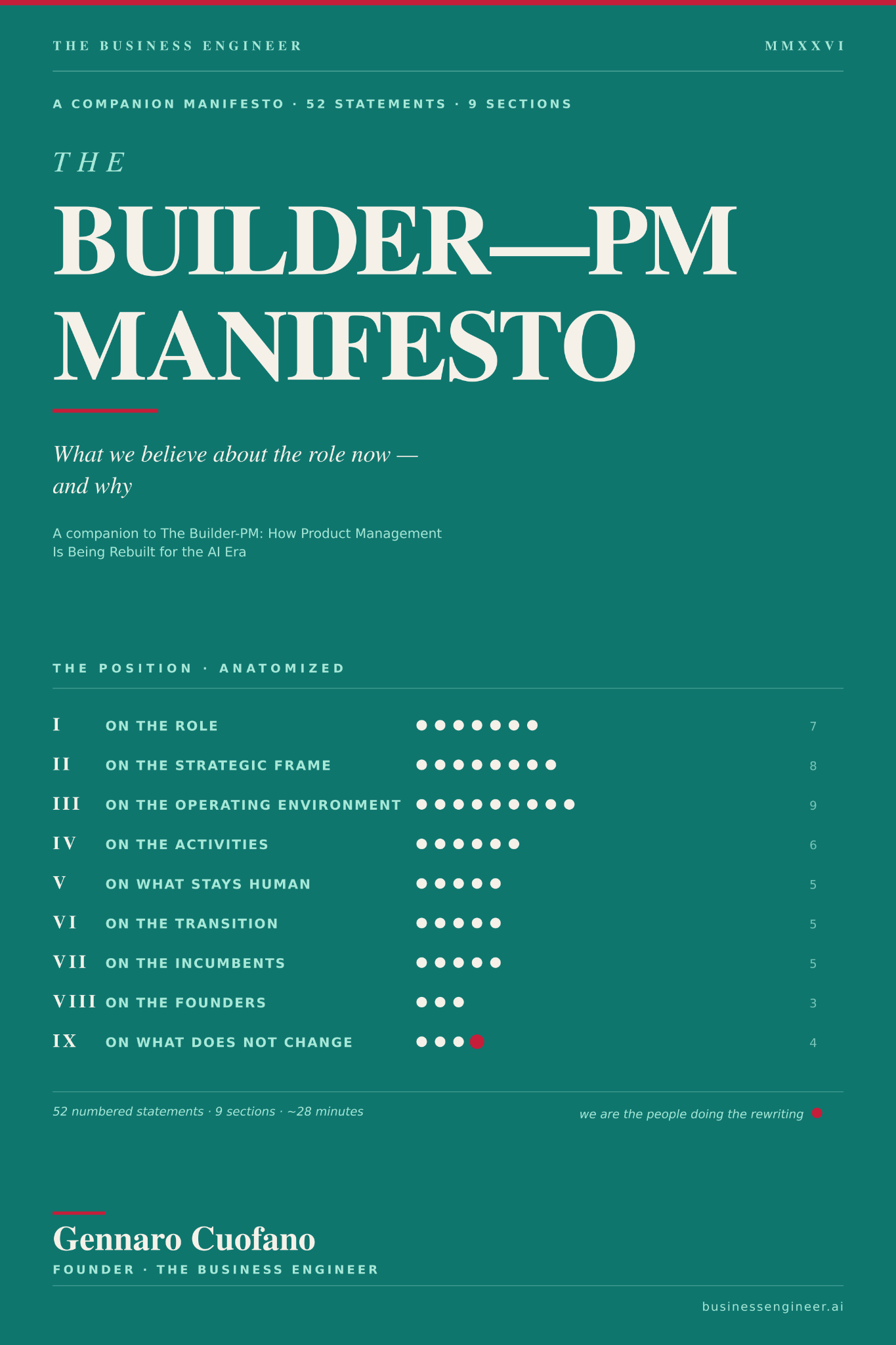
Each numbered statement is a claim. Each paragraph beneath it is the mechanism — short, but enough to anchor the claim in evidence and reasoning rather than slogan. Read straight through, the fifty-two statements walk the entire structural argument of the book in compressed form. Read selectively, any single statement stands on its own as a small argument with its own internal logic.
A note on what this manifesto is not. It is not a methodology. It is not a certification curriculum. It is not a framework to be adopted in twelve weeks. It is a statement of position on a discipline that is being rewritten in real time, and the rewriting is happening whether or not the manifesto exists. My contribution is to name the rewriting in terms that are precise enough to be acted on.
The fifty-two statements that follow are organized in nine sections — the role, the strategic frame, the operating environment, the activities, what stays human, the transition, the incumbents, the founders, and what does not change. The order matters. The argument is cumulative even in compressed form. The final two statements — we are the people doing the rewriting — name the position from which the manifesto is written, and the position the manifesto invites its readers into.
What follows is the position.
SECTION I
On the role
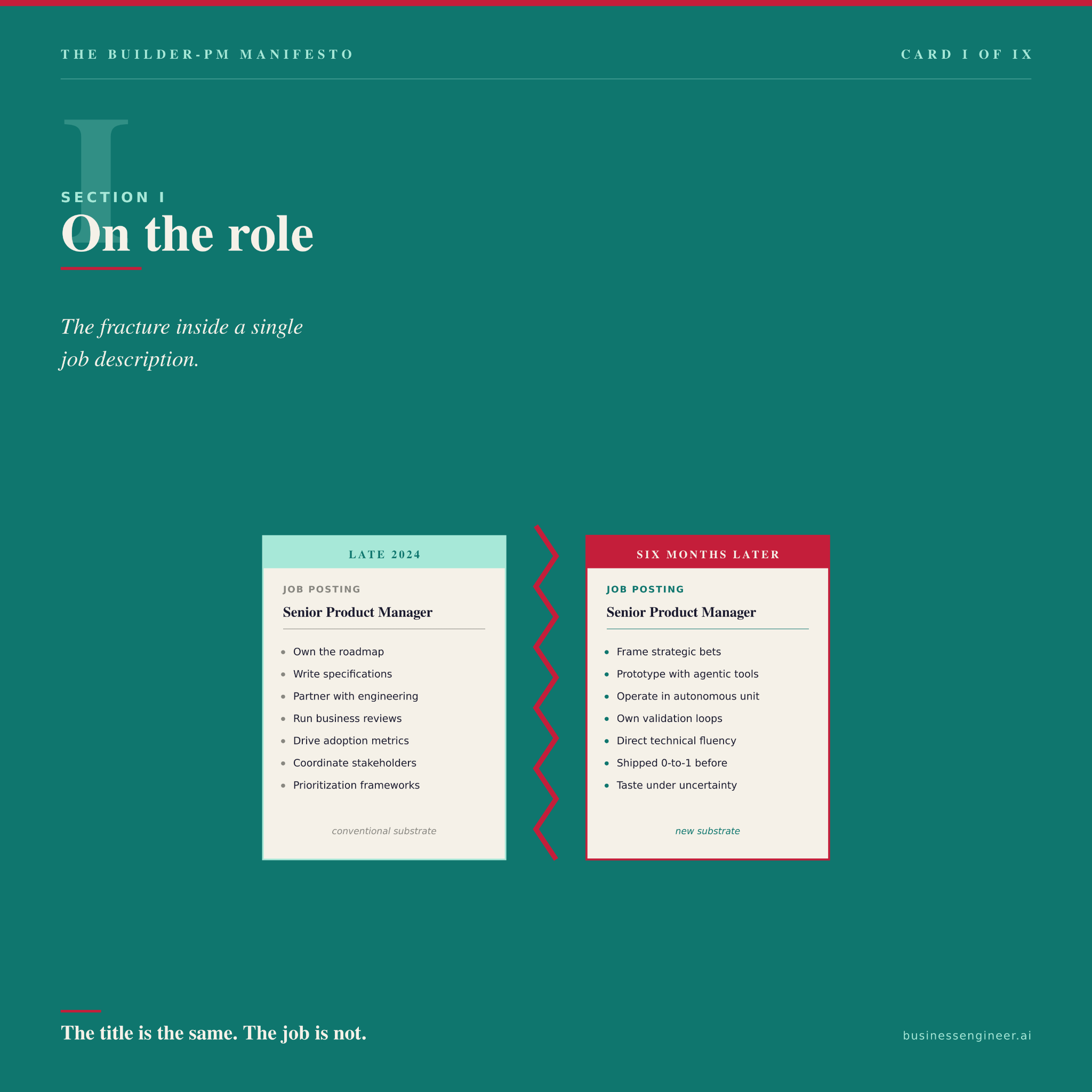
1. The title is the same. The job is not.
On the fracture inside a single job description.
“}]] Read More in AI Supremacy