
Hello Engineering Leaders and AI Enthusiasts!
This newsletter brings you the latest AI updates in just 4 minutes! Dive in for a quick summary of everything important that happened in AI over the last week.
And a huge shoutout to our amazing readers. We appreciate you😊
In today’s edition:
🤖 Anthropic upgrades Claude AI with Opus 4.8
💻 Cursor’s Composer 2.5 challenges frontier coding models
🚀 Gemini’s big agentic push at Google I/O
🛡️ Anthropic’s project Glasswing finds 10K+ critical software vulnerabilities
💡 Knowledge Nugget: How AI Is Redefining Software Engineering by adlrocha
Let’s go!
Anthropic upgrades Claude AI with Opus 4.8
Anthropic unveiled Claude Opus 4.8, a major upgrade that beats GPT-5.5 and Gemini 3.1 Pro across several benchmarks, including agentic coding, computer use, financial analysis, and Humanity’s Last Exam.
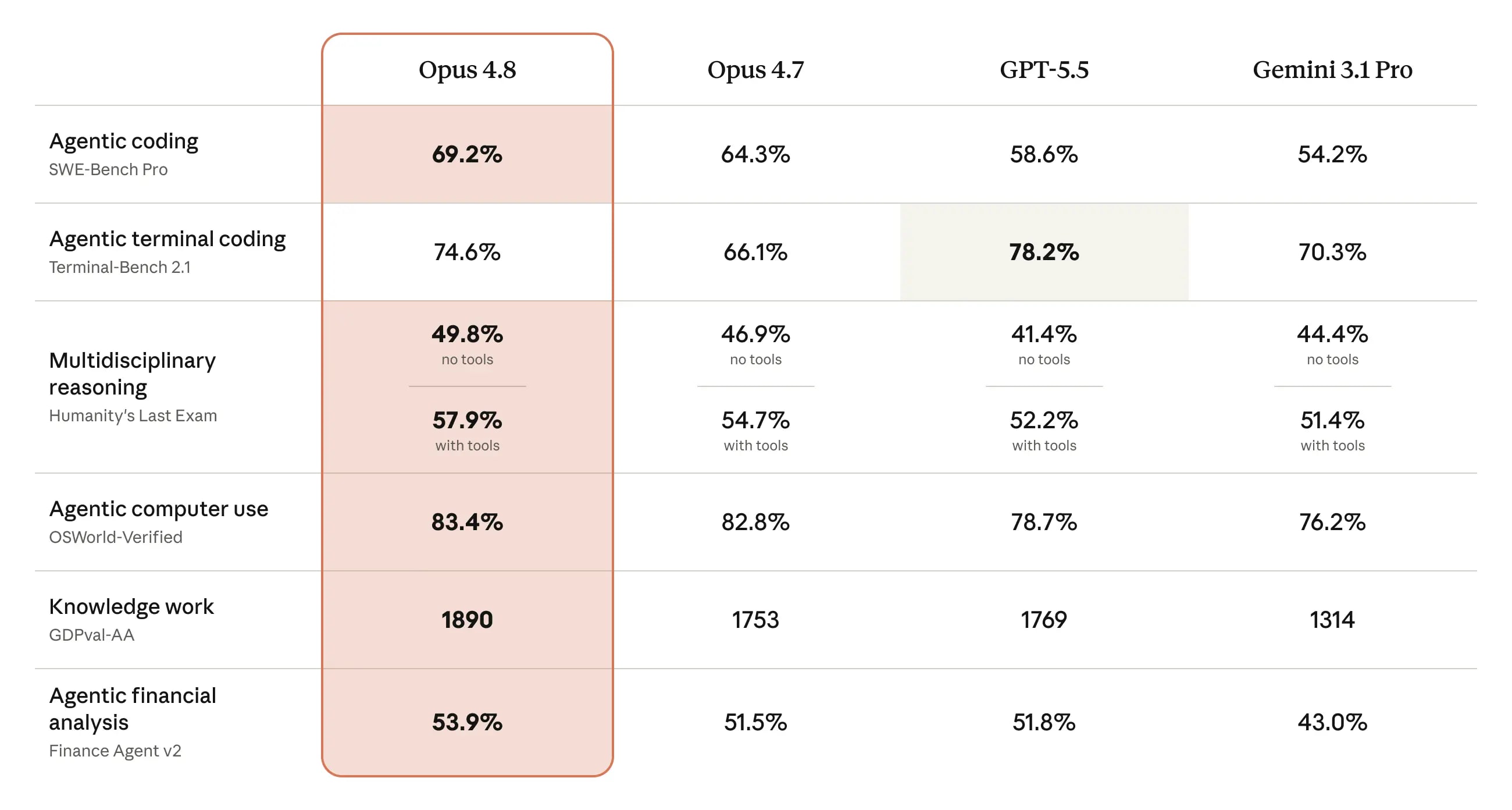
The release also introduces new features like Effort Control, which lets users tune reasoning depth, and Dynamic Workflows in Claude Code, allowing hundreds of parallel subagents to handle massive codebase-scale tasks. The model is available now across Claude.ai, APIs, and major cloud platforms. Anthropic also teased the arrival of a “Mythos-class” AI system in the coming weeks, signaling that the frontier race is accelerating again.
Why does it matter?
The frontier race is far from settled, but Anthropic has now hit two milestones few expected this quickly, surpassing OpenAI in valuation and leading across major benchmarks at the same time. Its long-term safety-first positioning, once dismissed by critics like Sam Altman as “fear-based marketing,” is suddenly looking like a very profitable strategy.
Cursor’s Composer 2.5 challenges frontier coding models
Cursor launched Composer 2.5, an upgraded coding model built on Moonshot AI’s Kimi K2.5 that delivers near-frontier coding performance at dramatically lower prices. Cursor says the model approaches Anthropic’s Opus 4.7 and OpenAI’s GPT-5.5 across major development benchmarks while improving nearly 10% over its previous generation.
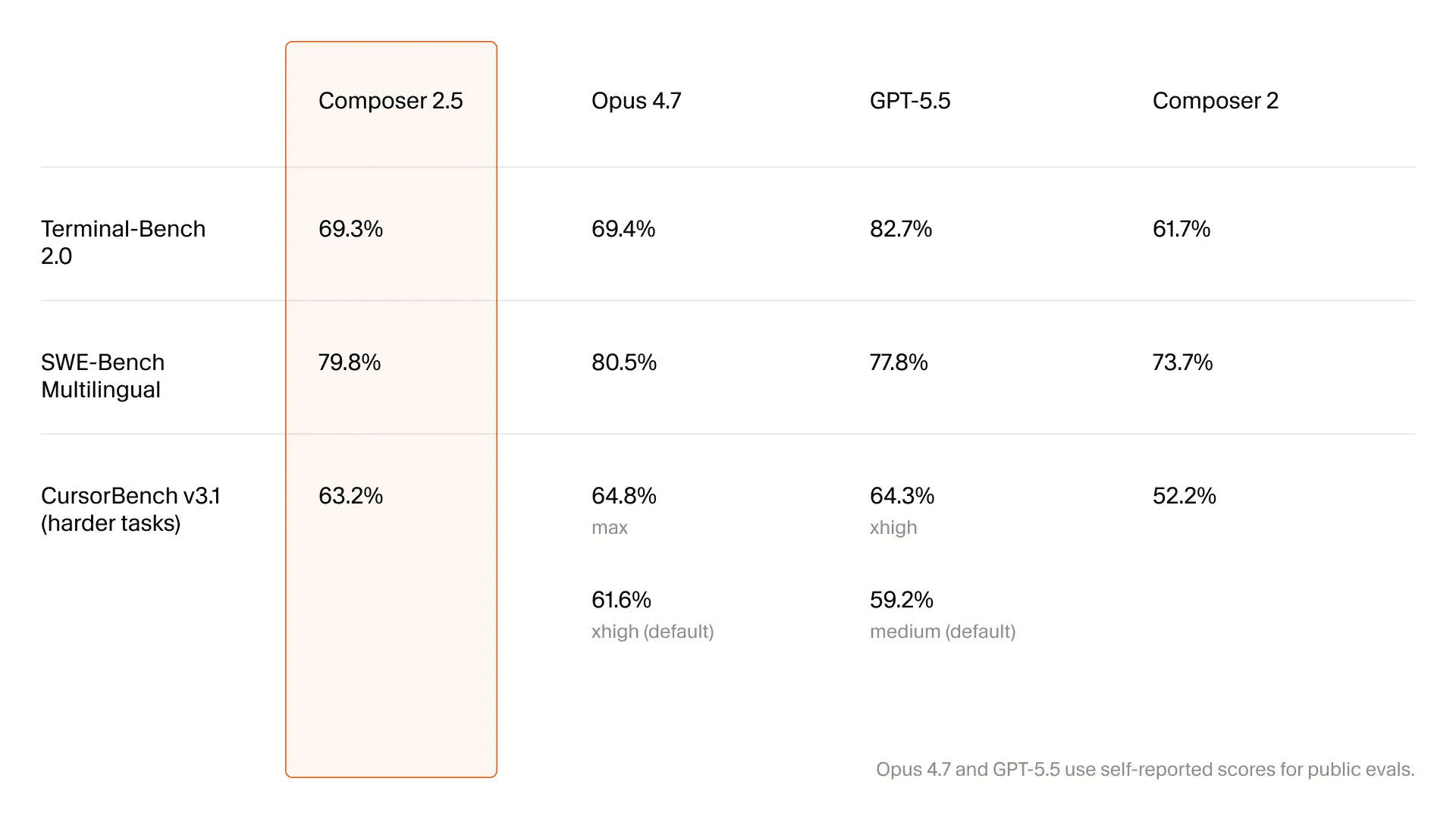
The bigger differentiator is cost. Cursor says an average CursorBench task costs under $1 with Composer 2.5, compared to as much as $11 on Opus 4.7 and GPT-5.5 at similar performance levels. The company also revealed it is training a larger “SpaceXAI” model with 10x more compute, signaling bigger ambitions beyond coding assistants.
Why does it matter?
Months ago, Composer 2 was already competing with frontier coding models at a fraction of GPT-5.5’s cost. Now Composer 2.5 is nearing Opus 4.7-level performance while staying under $1 per task and with Cursor scaling its own compute stack, it’s starting to look more than just a coding tool company.
Gemini’s big agentic push at Google I/O
Google unveiled a wave of Gemini-powered upgrades at I/O, introducing new models, persistent AI agents, and major Search redesigns that push Gemini far beyond a traditional chatbot. The biggest launches included Gemini Omni, a multimodal video-generation model, Gemini 3.5 Flash, and Spark, a 24/7 AI agent that can take action across Workspace, Chrome, email, and chat.
Google also described its new AI-powered Search experience as the company’s biggest redesign in years, adding cross-modal inputs, generative interfaces, and long-running agents that continuously gather and organize information. Alongside that, Google introduced AI smart glasses, Gemini for Science, and new SynthID watermarking upgrades.
Why does it matter?
The bigger theme across Google I/O was Gemini becoming far more agentic, multimodal, and deeply embedded across Google’s ecosystem. The benchmark gains alone may not redefine the frontier, but combining fast, cheap near-frontier models with products billions already use daily could end up being Google’s biggest AI advantage.
Anthropic’s project Glasswing finds 10K+ critical software vulnerabilities
Anthropic revealed the first results from Project Glasswing, showing that Claude Mythos Preview and its partners uncovered more than 10,000 high- or critical-severity vulnerabilities in just one month. The initiative spans roughly 50 organizations, with partners like Cloudflare and Mozilla already using the system to identify real-world software flaws.
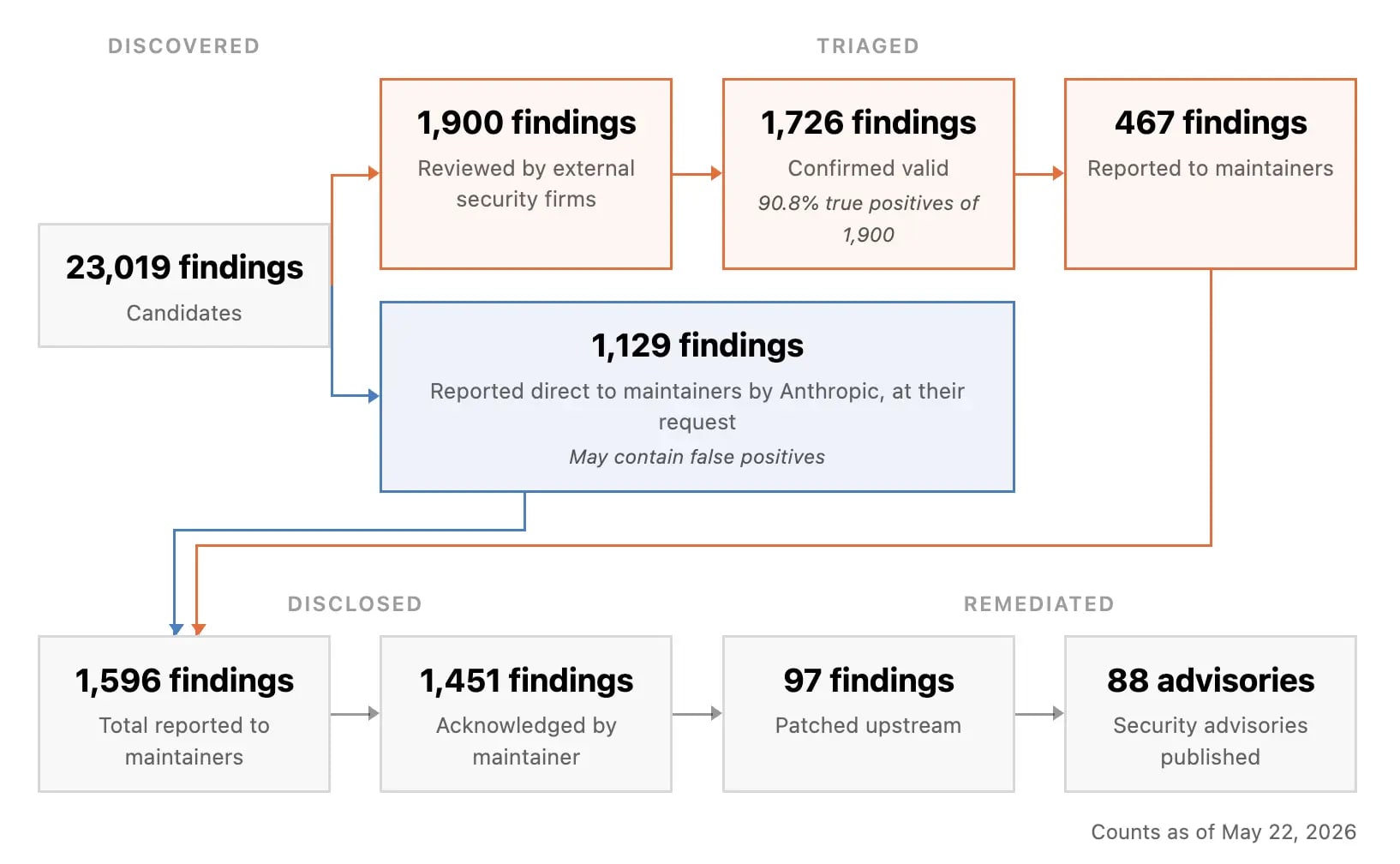
The results went beyond bug detection. Anthropic says Mythos successfully flagged thousands of vulnerabilities across open-source projects with a strong validation rate, while one banking partner reportedly used the model to stop a $1.5M fraudulent wire transfer. The company now plans to expand Glasswing to governments and additional security partners.
Why does it matter?
Anthropic says Mythos remains restricted because today’s safeguards still aren’t strong enough to prevent misuse. But with frontier labs and open-source players all racing toward stronger cyber models, highly capable AI security systems are coming either way and the real challenge may soon shift from finding vulnerabilities to patching them fast enough.
Enjoying the latest AI updates?
Refer your pals to subscribe to our newsletter and get exclusive access to 400+ game-changing AI tools.
When you use the referral link above or the “Share” button on any post, you’ll get the credit for any new subscribers. All you need to do is send the link via text or email or share it on social media with friends.
Knowledge Nugget: How AI Is Redefining Software Engineering
This piece argues that software engineering is rapidly shifting from writing code to managing AI agents that write it for you. adlrocha describes how tools like Claude Code evolved from simple coding assistants into systems capable of producing production-level code, changing the engineer’s role from builder to orchestrator.
Instead of spending hours implementing features manually, engineers are increasingly defining specs, reviewing outputs, managing context, and coordinating multiple agents working together. The workflow now looks less like coding line-by-line and more like directing a team: assigning tasks, validating outputs, refining architecture, and making judgment calls when the AI gets something subtly wrong.
The article also argues that engineering is splitting into new archetypes of researchers who deeply understand AI systems, specialists who audit and guide AI-generated code, and fast-moving generalists who can ship products quickly with AI leverage.
Why does it matter?
The industry may be overfocusing on “AI replacing engineers” when the bigger shift is AI changing what engineering actually means. Writing code is becoming cheaper and more automated, but architectural thinking, technical judgment, and the ability to manage intelligent systems are becoming the real differentiators.
What Else Is Happening❗
🧬 Chan Zuckerberg Biohub released new Evolutionary Scale Models, including ESMFold2, an AI system for predicting and designing proteins with promising results against cancer and immune targets.
🖼️ Microsoft released MAI-Image-2.5, a text-to-image model debuting at No. 3 on the Arena leaderboard with stronger text rendering, stylized visuals, and improved image reasoning.
📐 OpenAI says an internal reasoning model disproved a decades-old assumption tied to Erdős’ unit distance problem, marking another claimed breakthrough in AI-driven mathematical discovery.
👓 Google teased Gemini-powered smart glasses with Warby Parker and Gentle Monster, bringing voice AI, live translation, navigation, and camera features to wearable frames this fall.
🌍 Odyssey unveiled Starchild-1 and Agora-1, introducing real-time multimodal world models and shared AI-generated environments where multiple users can interact simultaneously.
💳 OpenAI launched a personal finance experience in ChatGPT, using Plaid integrations to deliver real-time insights on spending, investments, and bills across 12K+ financial institutions.
📱 OpenAI brought Codex to the ChatGPT iOS app, letting developers monitor and manage long-running AI coding tasks remotely from their phones.
New to the newsletter?
The AI Edge keeps engineering leaders & AI enthusiasts like you on the cutting edge of AI. From machine learning to ChatGPT to generative AI and large language models, we break down the latest AI developments and how you can apply them in your work.
Thanks for reading, and see you next week! 😊
Read More in The AI Edge


