[[{“value”:”
Hey AI Breakers 👋
Your happiest customers would refer you in a heartbeat if you ever asked.
You never ask. And when you do, there’s no incentive, no script, no tracking. So nothing happens.
Today, you’ll build an AI Referral Program Architect that designs the incentives, scripts the asks, onboards referrers, and runs a 30-day launch plan you can ship this week.
Here’s what you’ll walk away with:
-
✅ A profile of who in your customer base will actually refer you
-
✅ An incentive structure with unit economics that defends it
-
✅ A 5-moment ask schedule with scripts for each channel
-
✅ A Referrer Toolkit (intro scripts, 1-pager, FAQ) that handles objections
-
✅ A lightweight tracking + nudging system that runs in one Google Sheet
-
✅ A 30-day launch plan with all the copy ready to ship
Let’s build it 👇

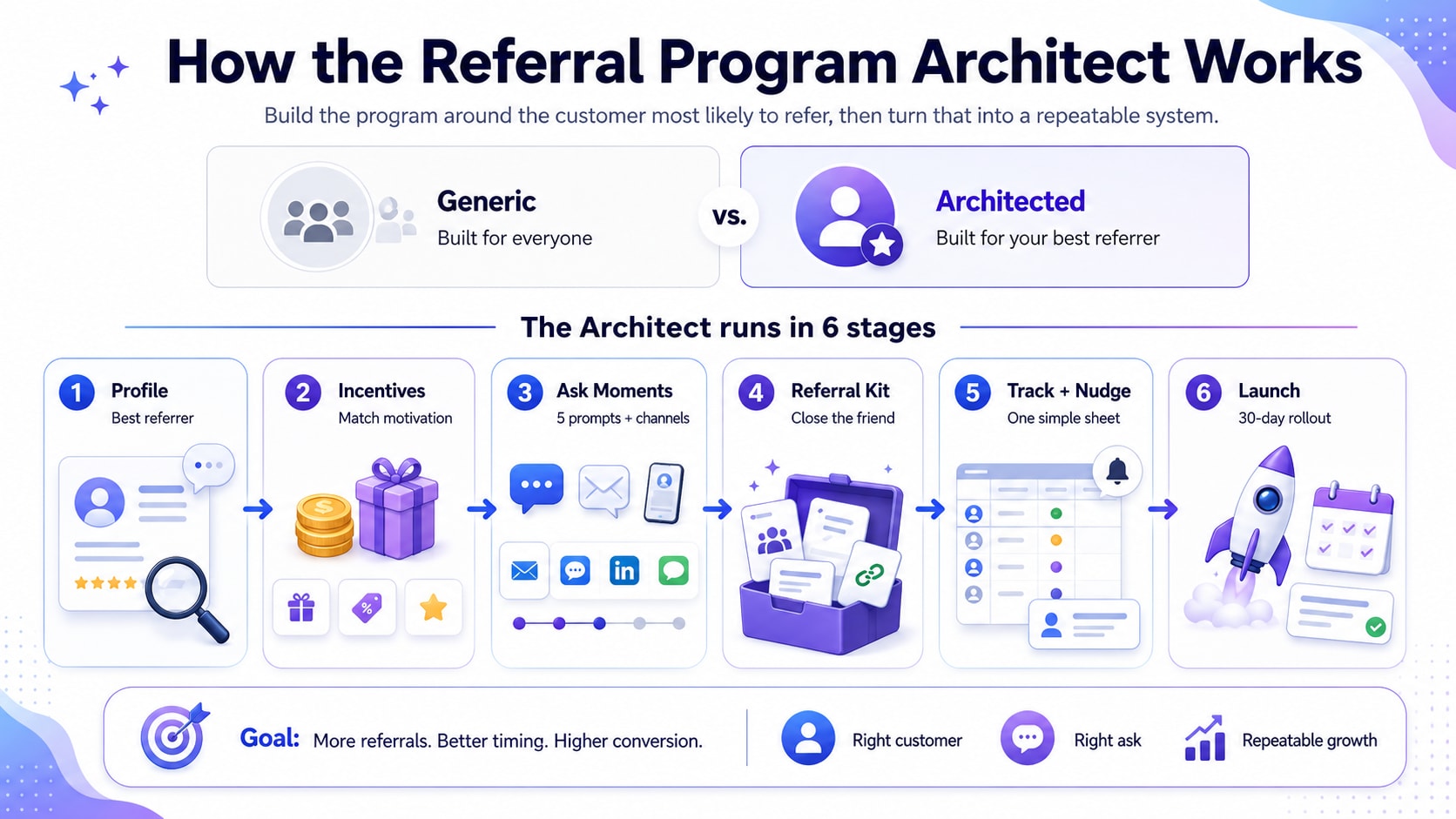
🧠 How the Referral Program Architect Works
Most referral programs fail for one reason. They’re built generically when they need to be built for one specific type of customer who’s actually motivated to refer.
This system reverse-engineers your program from your best potential referrer. Get that person right and everything else cascades.
The Architect runs in 6 stages:
-
🔍 Profile the customer most likely to refer (and what they’d say)
-
💰 Design the incentive structure that fits their motivation
-
📣 Script the 5 moments and channels to ask
-
🎁 Onboard referrers with a kit that closes the friend
-
📊 Track + nudge in one sheet, not a dashboard
-
🚀 Launch with a 30-day plan and ready-to-ship copy
Old way: hire a consultant, set up Tolt or Rewardful, write 40 emails, hope it sticks.
AI way: 60 minutes of chained prompts and you’re live by Friday.
🔍 Prompt #1 → The Referrer Profiler (Find Who Will Actually Refer You)
Programs built for “everyone” convert zero. Programs built for one specific persona compound.
The goal of this prompt:
-
Surface the 3 most likely referrer personas in your customer base
-
Understand each one’s real motivation
-
Pick the single highest-leverage persona to design around
✅ Use this to: lock the audience your entire program is built for.
Prompt:
You are a referral program strategist who profiles which customers are most likely to refer and what they would say about a business.

I'm building a referral program. Here are the inputs:

Business: [YOUR BUSINESS]
Product/service: [WHAT YOU SELL]
Target buyer: [YOUR ICP]
Pricing: [PRICE POINT]
Top 3 customer outcomes I've seen: [LIST 3 SPECIFIC WINS]
Examples of organic referrals I've already received (if any): [LIST OR "NONE YET"]
Customer feedback themes (from reviews, NPS, support): [WHAT CUSTOMERS SAY]

Your job:
1. Identify the 3 most likely "referrer personas" in my customer base (e.g., "the early adopter who loves showing off", "the cost-conscious operator", "the time-starved manager who got their evenings back").
2. For each persona, describe their referral motivation (status, money, helping a friend, professional reputation, mix).
3. Predict what each persona would actually say when introducing me to a peer.
4. Score the persona's referral potential 1-10 (how many warm intros they'd realistically make in 90 days).
5. Pick the single highest-leverage persona to design the program around, with reasoning.

Output as a table:
Persona | Motivation | What They'd Say | Referral Potential | Priority
Recommended Persona: [pick one] because [reason]
💡 Tip: Pick the persona with the highest score, not the broadest one. A program that works for one persona will compound. One that tries to please everyone won’t move.
💰 Prompt #2 → The Incentive Designer (Build the Reward That Actually Motivates)
Cash isn’t always the answer. Sometimes it’s the worst answer.
The goal:
-
3 incentive structures tailored to your persona’s motivation
-
Unit economics that prove the program won’t bleed money
-
A recommendation with landing page copy ready to ship
✅ Use this to: avoid the “give $50 get $50” default that’s killed thousands of B2B referral programs.
Prompt:
You are a behavioral economist who designs referral incentives that actually drive action.

Inputs:
Primary referrer persona: [paste from Prompt #1 — the highest-priority persona]
Their motivation: [paste motivation]
Product price point: [PRICE]
Average customer LTV: [LTV OR ESTIMATE]
Acceptable CAC (customer acquisition cost): [CAC OR ESTIMATE]

Your job:
1. Design 3 incentive structures that fit this persona's motivation. Options to consider: cash, account credit, exclusive access, status reward, charitable donation, double-rewards, milestone-based ladder.
2. Calculate the unit economics for each option (cost per referral vs. expected LTV).
3. For each, design the "double-sided" version (what the referred friend gets + what the referrer gets).
4. Pick the single recommended structure with reasoning.
5. Write the exact incentive copy as it would appear on a landing page: headline, sub, and the "how it works" section in 3 bullets.

Output:
Option | Referrer Reward | Friend Reward | Cost Per Referral | Why It Fits
Recommendation: [option] because [reason]
Landing Page Copy: headline + sub + 3-bullet "how it works"
🧠 Tip: Status and access often beat cash for B2B referrals. Founders, operators, and senior managers refer for reputation, not $25 Amazon gift cards.
📣 Prompt #3 → The Ask Architect (Build the Moments, Channels, and Scripts)
The right ask at the wrong moment converts at zero. The right ask at the right moment converts at 30%+.
The goal:
-
The 5 highest-leverage moments to make the ask
-
The right channel and tone for each
-
Word-for-word scripts you can copy and ship
✅ Use this to: stop guessing when and how to ask, and start running a system.
Prompt:
“}]] Read More in The AI Break