[[{“value”:”
Hey AI Breakers 👋
You are paying every month for a list that is still half wrong.
Apollo, Clay, Sales Navigator, a verifier on top, and the data ages the second you export it.
Today, you will build an AI Lead Machine that sources, enriches, scores, and maintains your own prospect list from public data.
No credits. No seats. No renewal email.
Let’s build it 👇

🧠 How the AI Lead Machine Works
A lead database sells you four things: a list, some fields, a contact route, and freshness. You can build all four yourself.
Here is what you are currently renting:
-
● Apollo Professional: about $99 per seat per month
-
● Clay Starter: about $149 per month
-
● LinkedIn Sales Navigator: about $99 per month
-
● An email verifier: about $50 per month
That is roughly $397 per month, or $4,764 a year for one person. Add a second seat or a bigger Clay plan, and you are past $6,000.
ZoomInfo small team bundles start north of $15,000.
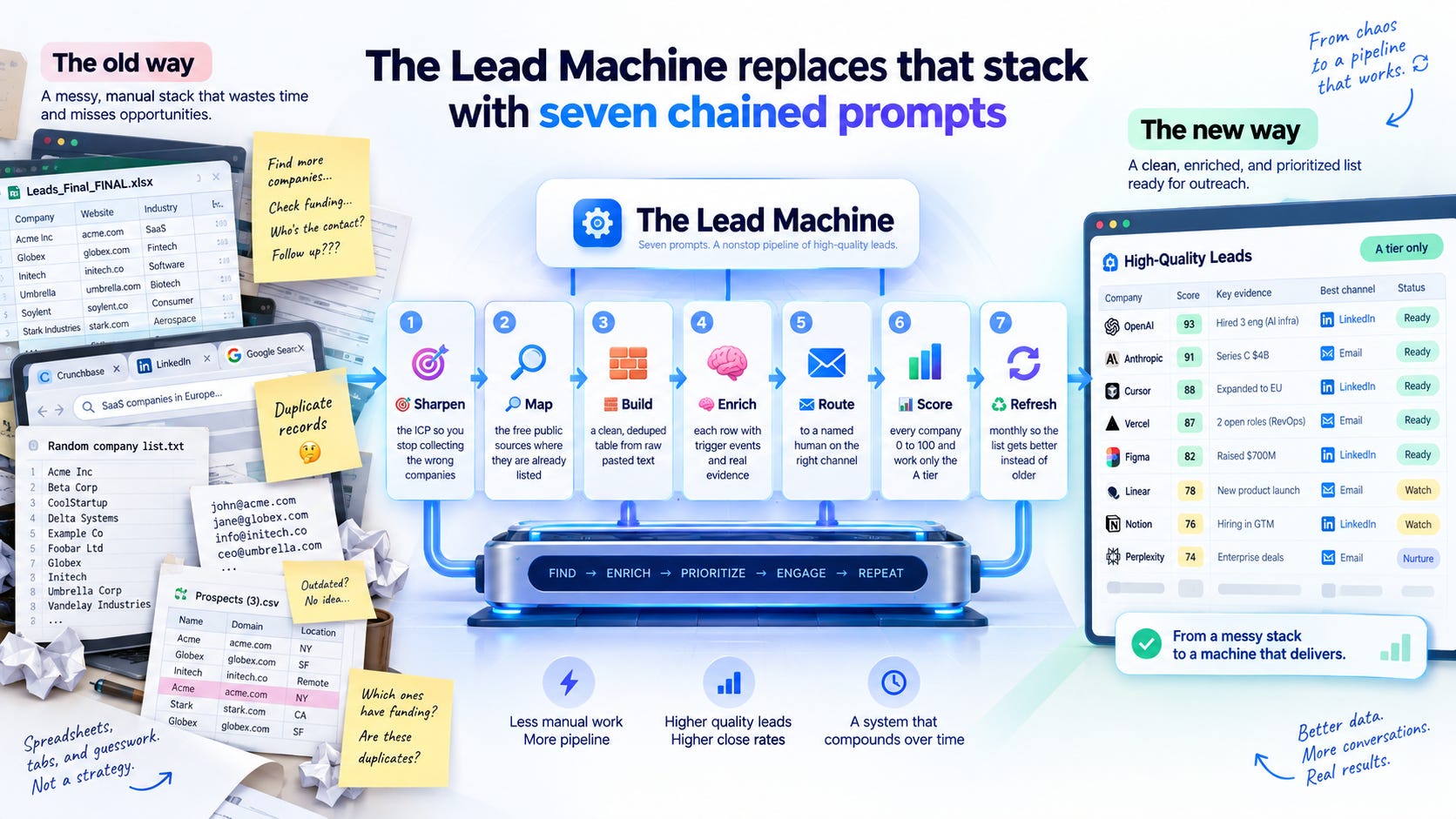
The Lead Machine replaces that stack with seven chained prompts:
-
🎯 Sharpen the ICP so you stop collecting the wrong companies
-
🔎 Map the free public sources where they are already listed
-
🧱 Build a clean, deduped table from raw pasted text
-
🧠 Enrich each row with trigger events and real evidence
-
📧 Route to a named human on the right channel
-
📊 Score every company 0 to 100 and work only the A tier
-
♻️ Refresh monthly so the list gets better instead of older
The old way: $400+ a month, forever, for data you still have to re-qualify.
The Foundry way: one 60 minute build, then 30 minutes a month.
You need one AI tool with web access. ChatGPT, Claude, or Gemini all work.
🎯 Prompt #1 → The ICP Sharpener (Stop Collecting the Wrong Companies)
Most bad lists are not a data problem. They are a definition problem.
The goal:
-
Turn your ICP into a filter with actual values, not a vague description
-
Get a disqualifier list so you can delete rows fast
-
Get the observable buying triggers that mean someone is in market
✅ Use this to define exactly who goes on the list before you build any of it.
Prompt:
You are a B2B demand generation strategist who has built target
lists for over 200 companies.

I sell: [WHAT YOU SELL, IN ONE SENTENCE]
My price point: [PRICE OR TYPICAL DEAL SIZE]
My 3 best customers so far: [TYPE 1], [TYPE 2], [TYPE 3]
Why they bought: [THE TRIGGER OR PAIN THAT MADE THEM BUY]
Customers who were a bad fit: [WHO CHURNED, COMPLAINED, OR NEVER ACTIVATED]
My market: [COUNTRY OR REGION]

Do the following:

1. Write my Ideal Customer Profile as a FILTER, not a description.
   Give me exact values for:
   - Industry and sub-industry
   - Company size (employee band) and revenue band
   - Geography
   - Business model (SaaS, agency, ecommerce, services, B2C)
   - Growth stage and any funding signals
   - Tools or platforms they likely already use

2. Write a DISQUALIFIER list: 6 specific traits that mean I should
   never add a company to my list, even if it matches everything else.

3. Identify the 3 BUYING TRIGGERS that move my ICP from "not thinking
   about this" to "actively looking". Each one must be observable from
   the outside by someone with no inside information.

4. Give me 10 ready-to-paste Google search strings that surface
   companies matching this ICP. Use advanced operators (site:,
   intitle:, inurl:, quoted phrases, minus terms). Mix directory
   searches, job-post searches, and press-release searches.

5. Rate your confidence in this ICP from 1 to 10 and tell me exactly
   what extra information from me would raise it.

Format as clean sections with headers. No fluff.
💡 Tip: If the confidence score comes back under 7, give it three real customer names and let it look them up. Ten extra minutes here saves you two hours at the enrichment stage.
🔎 Prompt #2 → The Source Mapper (Where Your List Already Exists, Free)
Your buyers are already listed somewhere in bulk. Usually in several places nobody on your team has checked.
The goal:
-
Find 12+ public sources full of ICP-matching companies
-
Rank them by yield per hour, not by how impressive they sound
-
Get a step-by-step extraction method for the best three
✅ Use this to replace the “search” half of what Apollo charges you for.
Prompt:
You are a lead research specialist who builds prospect lists without
paid databases.

Here is my ICP:
[PASTE THE FULL OUTPUT FROM PROMPT #1]

Find me the free and public places where companies matching this ICP
are already listed in bulk.

For each source, give me:
1. Source name and exact URL
2. Source type (directory, award list, conference exhibitor list,
   job board, funding announcement, review site, association
   membership, marketplace, podcast guest list, subreddit,
   newsletter sponsor list)
3. Estimated number of ICP-matching companies on it
4. Freshness (updated daily, monthly, annually, or one-off)
5. Exactly which fields I can extract (company name, domain, size,
   location, description)
6. A 1 to 10 YIELD score: usable leads per hour of manual effort

Rules:
- At least 12 sources
- Nothing that requires a paid subscription
- Rank by yield score, highest first
- Include at least 2 sources my competitors are unlikely to be using
- For the top 3, write the exact step-by-step extraction method a
  non-technical person can follow

Finish with: the 3 sources I should start with today, and why.
🧠 Tip: Conference exhibitor lists and award shortlists are the highest yield sources almost nobody works. A company that paid for a booth has budget, a decision maker, and a reason to care this quarter.
🧱 Prompt #3 → The List Builder (Raw Text Into a Clean Table)
Now you copy the raw page content and let AI do the boring structuring.
The goal:
-
Extract every company into a consistent, sheet-ready table
-
Apply your disqualifiers automatically
-
Kill duplicates before they pollute the list
✅ Use this to turn a messy directory page into 60 clean rows in about two minutes.
Prompt:
“}]] Read More in The AI Break