[[{“value”:”
Hey AI Breakers 👋
Every LinkedIn post you write disappears in 4 hours. A LinkedIn newsletter lands in your subscribers’ email inbox, every single time.
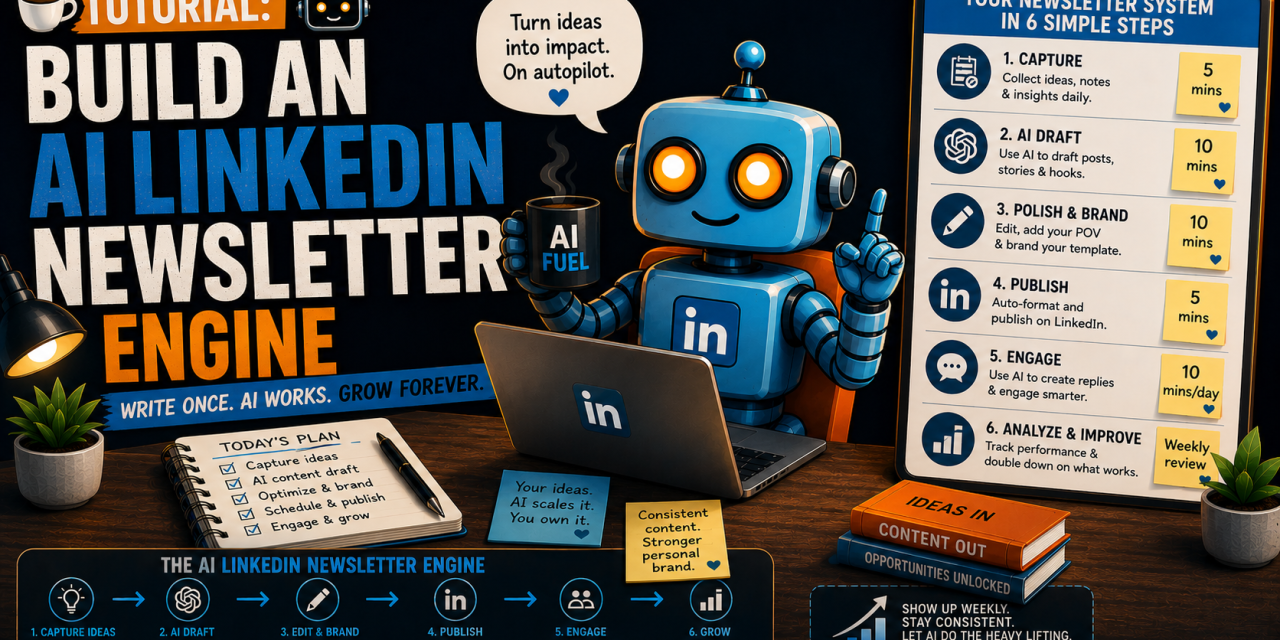
Today, you’ll build an AI LinkedIn Newsletter Engine that finds your topic lane, names your franchise, writes your first 8 issues in your voice, and turns those subscribers into a list you actually own.
Let’s build it 👇

🧠 Why This Works (And Why Almost Nobody Does It)
LinkedIn newsletters have one mechanic that ordinary posts do not have. Notifications.
Here is the flow:
-
📣 You publish issue #1 and LinkedIn invites your entire follower base to subscribe
-
📬 Every issue after that pushes an in-app notification, a push notification, and an email to every subscriber
-
🔁 Subscribers stay subscribed even when the algorithm buries your regular posts
The catch: most people launch one, publish twice, and quit. 🪦
That’s what the 8-issue arc in this system solves. You plan the whole run before you publish anything.
🔎 Prompt #1 → The Territory Scout (Finding Your Unclaimed Lane)
Most newsletters die because they’re about a topic 40 other people already cover. This prompt finds the gap instead.
The goal:
-
Map what the loud voices in your niche already publish
-
Find the questions your buyers ask that nobody answers publicly
-
Identify 3 topic lanes with real demand and low competition
✅ Use this to pick a topic you can own instead of one you’ll compete in.
Prompt:
You are a B2B content strategist who has launched newsletters in crowded markets.

MY CONTEXT:
- What I do: [YOUR ROLE AND COMPANY]
- Who I want reading: [YOUR IDEAL READER, e.g. "seed-stage SaaS founders in Europe"]
- What I sell (now or later): [YOUR OFFER]
- People in my niche who post a lot: [3-5 NAMES OR COMPANIES]

YOUR TASKS:

1. COMPETITIVE MAP
   List the 6 topics my niche is saturated with. For each, note why it's
   saturated and what the generic take sounds like.

2. DEMAND GAPS
   List 8 questions my ideal reader genuinely struggles with that are NOT
   being answered well publicly. Focus on questions people are slightly
   embarrassed to ask out loud.

3. MY UNFAIR ADVANTAGE
   Based on my role, what do I have access to that most commentators do not?
   Think: real numbers, client patterns, failed experiments, internal process.

4. THREE LANES
   Propose 3 topic lanes. For each give me:
   - The lane in one sentence
   - Who exactly it's for
   - Why I'm credible in it
   - Demand level (high/medium/low) and why
   - Competition level (high/medium/low) and why
   - What it lets me sell later, naturally

5. RECOMMENDATION
   Pick one lane and defend it in 3 sentences. Tell me the strongest
   argument AGAINST it too.

Ask me up to 3 clarifying questions before you start if you need them.
💡 Tip: Answer its clarifying questions properly. The difference between a generic lane and a sharp one is almost always the detail you left out about your own access.
🎯 Prompt #2 → The Franchise Builder (Name, Promise, Cadence)
A newsletter needs to feel like a show, not a folder of posts. This prompt turns your lane into a franchise people subscribe to.
The goal:
-
A name that says what it is without being clever for the sake of it
-
A one-line promise that makes subscribing an obvious yes
-
A repeatable format so writing gets easier every week
✅ Use this to lock your positioning before you write a single issue.
Prompt:
You are a newsletter brand strategist. You name and position media
properties for B2B founders.

MY CHOSEN LANE:
[paste the recommended lane from Prompt #1, including who it's for and
why I'm credible]

YOUR TASKS:

1. NAMES
   Give me 10 newsletter names across 3 styles:
   - Plain and descriptive (says exactly what it is)
   - Angle-driven (implies a point of view)
   - Franchise-style (feels like a recurring show)
   For each: the name, why it works, and who it repels. Repelling the
   wrong reader is a feature.

2. THE PROMISE
   Write 5 versions of a one-line subscribe promise using this shape:
   "Every [CADENCE], [SPECIFIC THING] for [SPECIFIC PERSON] so you can
   [SPECIFIC OUTCOME]."
   Rank them by how hard they are to ignore.

3. FORMAT
   Design a repeatable issue structure with 4-6 named sections.
   For each section: what goes in it, roughly how long, and why a reader
   would care. It must be writable in under 90 minutes once I have a
   system.

4. CADENCE
   Recommend weekly, biweekly, or monthly. Base it on what I can actually
   sustain, not what's optimal in theory. Tell me the real cost of
   choosing wrong.

5. DESCRIPTION
   Write the newsletter description field, under 300 characters,
   optimized to convert a profile visitor into a subscriber.

Output as a single reference doc I can keep.
🧠 Tip: Pick the name you’d still be happy saying out loud in 12 months. Clever names get old fast, plain names age well.
🗺️ Prompt #3 → The Issue Architect (Your First 8 Issues)
This is the step that separates newsletters that survive from newsletters that stop at issue two. You plan the arc up front.
The goal:
-
8 issue titles that build on each other instead of wandering
-
A clear job for each issue in the sequence
-
Zero blank-page moments for the next two months
✅ Use this to remove the weekly “what do I write about” decision entirely.
Prompt:
“}]] Read More in The AI Break