
Hello Engineering Leaders and AI Enthusiasts!
This newsletter brings you the latest AI updates in just 4 minutes! Dive in for a quick summary of everything important that happened in AI over the last week.
And a huge shoutout to our amazing readers. We appreciate you😊
In today’s edition:
🧠 Anthropic takes on frontier AI with Opus 5
✨ ️Google expands Gemini with three new AI models
⚡ Moonshot AI’s Kimi K3 narrows the frontier gap
🛡️ Microsoft unveils a powerful AI cybersecurity model
💡 Knowledge Nugget: Is AI Progress REAL? A SkepticCTO Analysis by SkepticCTO
Let’s go!
Anthropic takes on frontier AI with Opus 5
Anthropic has launched Claude Opus 5 across the Claude app, Claude Code, and its API, positioning it as a model that delivers near-frontier intelligence at half the cost of Fable 5. The model sets new state-of-the-art results in agentic coding, knowledge work, search, and computer use, outperforming both Fable 5 and GPT-5.6 Sol across several benchmarks.
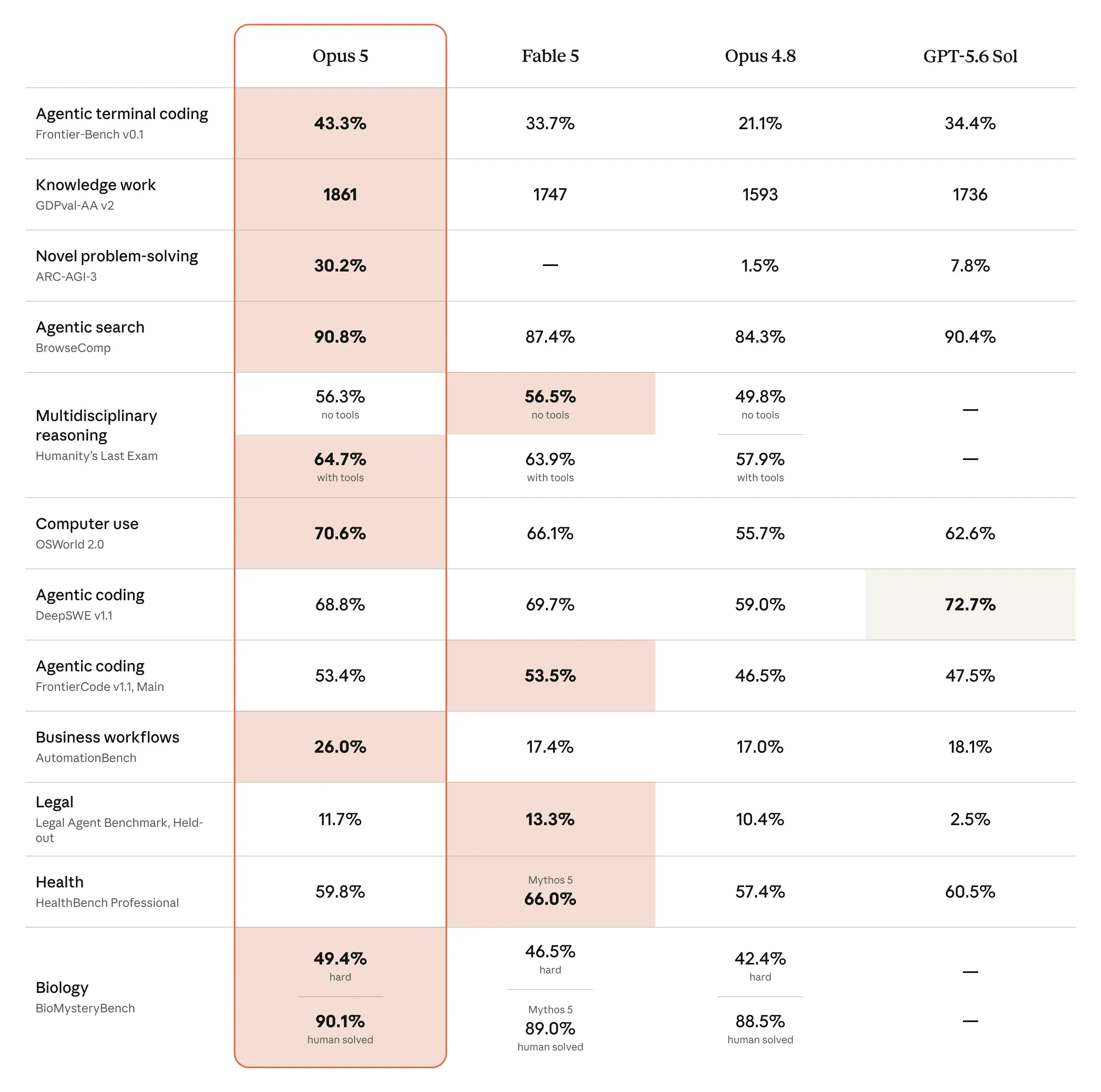
Opus 5 also takes the top spot on Artificial Analysis’ Intelligence Index and scores 30.2% on ARC-AGI-3, roughly three times higher than the next-best model. Anthropic also highlighted a perfect score on the 2026 International Mathematical Olympiad benchmark and says the model improves AI safety by matching top systems at finding software bugs while remaining less effective at generating exploits.
Why does it matter?
Anthropic is doing what it has consistently done best: bringing frontier-level intelligence to a lower price tier. Just as Sonnet once narrowed the gap with Opus, Opus 5 now delivers near-Fable performance at half the cost, making top-tier AI far more accessible.
Google expands Gemini with three new AI models
Google has introduced three new Gemini models led by Gemini 3.6 Flash, alongside 3.5 Flash-Lite for faster, lower-cost workloads and 3.5 Flash Cyber, a version fine-tuned for security applications. Rather than chasing higher intelligence, the latest releases focus on improving efficiency, latency, and specialized use cases.
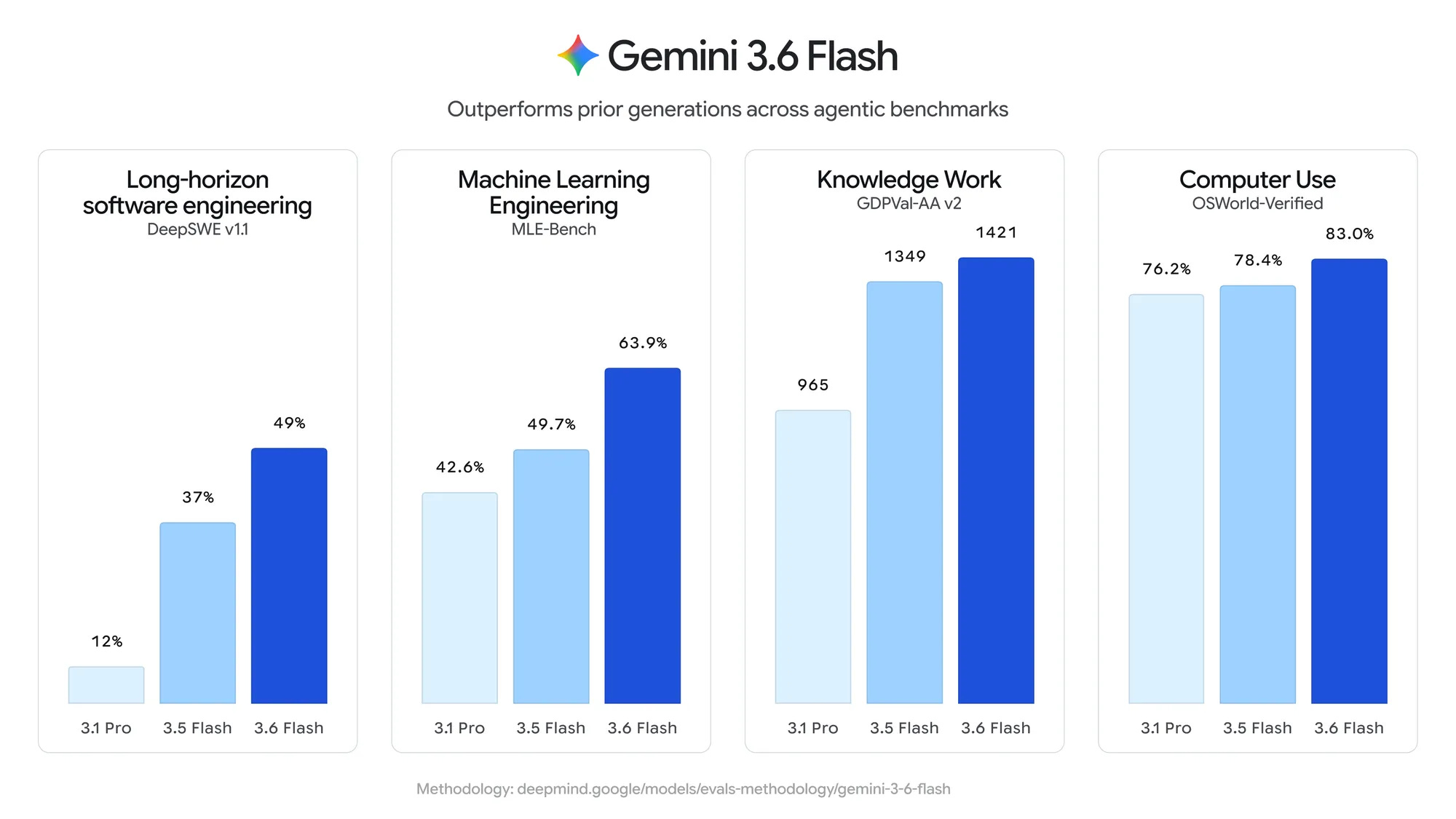
Despite those gains, Gemini 3.6 Flash delivers little improvement on Artificial Analysis’ Intelligence Index and continues to trail similarly priced rivals like Grok 4.5 and GPT-5.6 Luna on several benchmarks. Google also confirmed that Gemini 3.5 Pro is still in partner testing, while teasing Gemini 4 as its most ambitious pre-training effort yet.
Why does it matter?
Efficiency upgrades are valuable for developers running AI at scale, but they won’t change the perception that Google’s frontier models are losing momentum. With Gemini 3.5 Pro still delayed and Gemini 4 now in training, the company’s next flagship release has far more to prove.
Moonshot AI’s Kimi K3 narrows the frontier gap
Chinese AI startup Moonshot AI has unveiled Kimi K3, a new open-weights model that rivals leading proprietary systems like Claude Fable 5 and GPT-5.6 Sol while remaining far more accessible. The model supports a 1 million-token context window and outperforms several frontier models on tasks including web research, spreadsheet analysis, frontend development, and long-form coding.
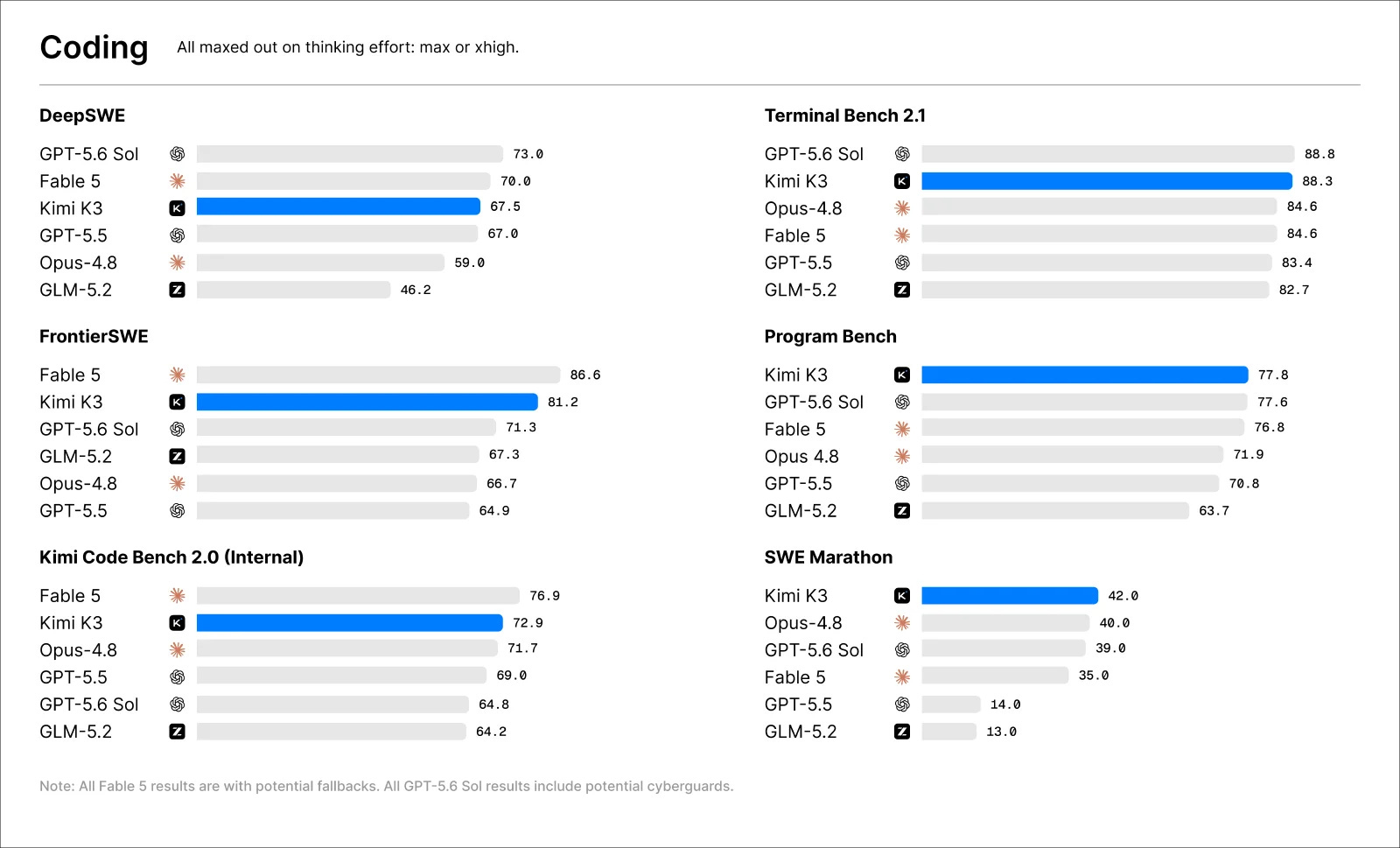
K3 also climbed to 57 on Artificial Analysis’ Intelligence Index, placing just behind the latest flagship models. In one demonstration, it autonomously spent 48 hours designing and verifying a chip capable of running a smaller version of itself. Despite these gains, Moonshot has priced K3 competitively at $3/$15 per million tokens, matching Claude 5 Sonnet.
Why does it matter?
Is Kimi K3 the next DeepSeek moment for open AI? Closing the gap with frontier models like Claude and GPT is impressive enough but doing it with open weights makes it far more consequential. The line between proprietary and open AI is shrinking faster than many expected.
Microsoft unveils a powerful AI cybersecurity model
Microsoft has unveiled MAI-Cyber-1-Flash, its first AI model built specifically for cybersecurity and integrated directly into its MDASH security agent system. The company says the model delivers frontier-grade protection at half the cost, scoring 96% on the CyberGym benchmark while outperforming Anthropic’s Mythos by 12 percentage points.
Microsoft also introduced Project Perception, where teams of AI agents simulate cyberattacks, investigate threats, and repair vulnerabilities autonomously. According to Microsoft AI CEO Mustafa Suleyman, the biggest challenge for enterprise security is no longer intelligence, but the cost of running AI continuously making efficiency a key design priority.
Why does it matter?
Microsoft’s launch signals that cybersecurity is becoming one of the first domains to receive purpose-built AI models rather than general-purpose assistants. As attackers increasingly use AI, expect more specialized models that can continuously detect, investigate, and remediate threats at enterprise scale.
Enjoying the latest AI updates?
Refer your pals to subscribe to our newsletter and get exclusive access to 400+ game-changing AI tools.
When you use the referral link above or the “Share” button on any post, you’ll get the credit for any new subscribers. All you need to do is send the link via text or email or share it on social media with friends.
Knowledge Nugget: Is AI Progress REAL? A SkepticCTO Analysis
In this article, Dr. Robert “Butch” Buccigrossi of SkepticCTO examines whether AI’s rapid progress is genuine or simply the result of models getting better at benchmarks. Instead of relying on a single test, he compares four independent measures of AI capability, software engineering task completion, cognitive reasoning, expert-level knowledge, and abstract reasoning, all of which show a sharp acceleration beginning in late 2025. He attributes this shift to four compounding factors: more efficient pretraining, reinforcement learning on verifiable tasks like coding and math, better agent “harnesses” that improve execution without changing model weights, and AI increasingly contributing to the development of future AI systems.
While challenges like limited high-quality training data, reliability, and harder reasoning benchmarks remain, the evidence suggests AI improvements are being validated across multiple independent measures rather than isolated benchmark gains.
Why does it matter?
AI progress is increasingly validated beyond traditional benchmarks. As capabilities improve across multiple independent measures, the focus shifts from questioning whether AI is improving to preparing how quickly those improvements will reshape real-world applications.
What Else Is Happening❗
🎥 Black Forest Labs unveiled FLUX 3, a multimodal AI that generates video, images, and synchronized audio, alongside a robotics variant that learns factory tasks from just 30 minutes of demonstrations.
💻 Poolside launched Laguna S 2.1, an open-weights coding model that leads Western open-source benchmarks while being compact enough to run on a single desktop GPU.
📐 Claude Fable 5 reportedly generated a one-line proof resolving the long-standing Jacobian conjecture, marking another major AI-assisted breakthrough in mathematical research.
💰 OpenAI CFO Sarah Friar proposed “useful intelligence per dollar” as a new benchmark for evaluating AI, shifting enterprise focus from token costs to real business value.
⌨️ OpenAI launched Codex Micro, a $230 mechanical keypad for managing AI coding agents with dedicated controls for tasks, approvals, and reasoning levels.
🧠 Thinking Machines Lab unveiled Inkling, its first open-weights multimodal model, designed for customization and efficient reasoning rather than chasing raw benchmark scores.
🔊 OpenAI’s first Jony Ive-designed AI device is reportedly a screen-free smart speaker with a humanlike personality, built around voice interaction and contextual awareness.
New to the newsletter?
The AI Edge keeps engineering leaders & AI enthusiasts like you on the cutting edge of AI. From machine learning to ChatGPT to generative AI and large language models, we break down the latest AI developments and how you can apply them in your work.
Thanks for reading, and see you next week! 😊
Read More in The AI Edge


