[[{“value”:”
Hey AI Breakers 👋
93% of customers read reviews before buying, and reputation agencies charge $500+/month to “manage” yours. Most businesses do neither: reviews pile up unanswered while every angry one quietly costs sales.
Today, you’ll build an AI Reputation Manager that runs your entire review operation in ChatGPT (or Claude): audits, replies, recoveries, and growth.
Let’s build it 👇

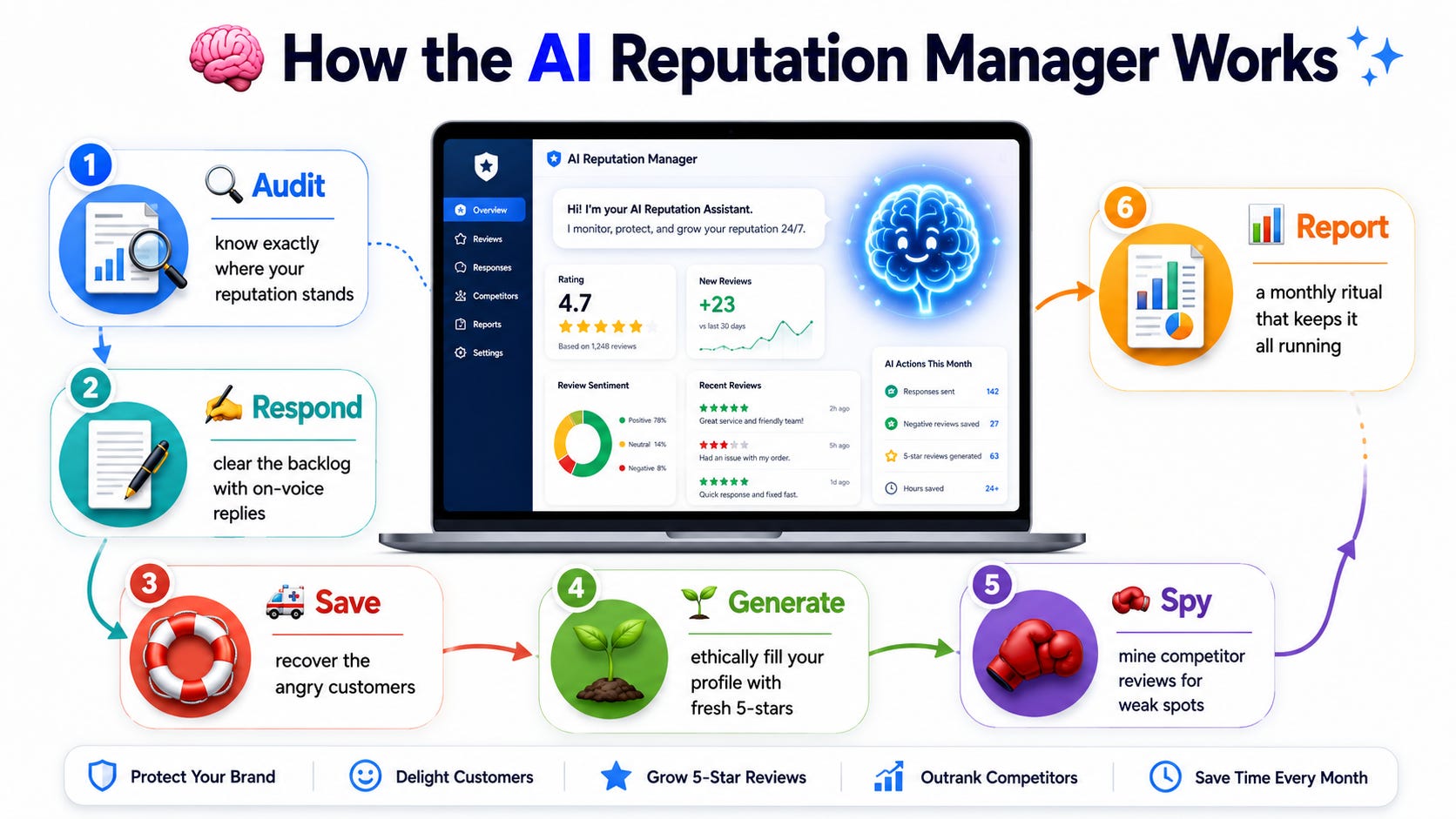
🧠 How the AI Reputation Manager Works
Reviews are the one marketing channel that runs with or without you. The only choice is whether you manage it.
The system is 6 chained prompts, each feeding the next:
-
🔎 Audit → know exactly where your reputation stands
-
✍️ Respond → clear the backlog with on-voice replies
-
🚑 Save → recover the angry customers (and their reviews)
-
🌱 Generate → ethically fill your profile with fresh 5-stars
-
🥊 Spy → mine competitor reviews for their weak spots
-
📊 Report → a monthly ritual that keeps it all running
Works in ChatGPT, Claude, or Gemini. If you use ChatGPT Projects or Claude Projects, create one called “Reputation Manager” and keep everything there: the outputs chain across prompts, so one home saves you re-pasting.
🔎 Prompt #1 → The Review Auditor (Your Reputation Baseline)
You can’t fix what you haven’t measured. This prompt turns your raw reviews into a clear picture of what’s helping and hurting you.
The goal:
-
A theme map of what customers praise and complain about
-
Root causes behind the complaints, not just symptoms
-
A short priority list of what to fix first
✅ Use this to get your reputation baseline before touching a single reply.
Prompt:
You are a reputation management specialist who has audited review profiles for hundreds of businesses. Audit mine.

My business: [WHAT YOU SELL + WHO YOUR CUSTOMERS ARE]

Here are my reviews (pasted from Google, Yelp, Trustpilot, or anywhere else. Include star ratings and dates where visible):
"""
[PASTE YOUR REVIEWS]
"""

Produce a REPUTATION BASELINE report:

1. HEALTH SNAPSHOT: Overall impression a first-time buyer gets in 10 seconds of scanning these reviews. Note average sentiment, how recent the reviews are, and whether negatives sit unanswered.

2. PRAISE MAP: Top 5 things customers consistently love, each with a count of mentions and one verbatim quote.

3. COMPLAINT MAP: Top 5 things customers complain about, each with a count, one verbatim quote, and a severity rating (deal-breaker / annoyance / one-off).

4. ROOT CAUSES: For each complaint theme, diagnose whether it is an operations problem (we did something wrong), an expectations problem (we promised or implied something we don't deliver), or noise (unreasonable one-offs).

5. RISK FLAGS: Unanswered negative reviews, patterns that would scare a new buyer, and anything that looks fake or suspicious (competitor sabotage, bot reviews).

6. PRIORITY LIST: The 3 highest-impact actions to improve this profile in the next 30 days, ranked by effort vs. impact.

7. QUICK WINS: Any reviews that just need a simple reply today to visibly improve the profile (recent negatives sitting unanswered, glowing reviews ignored).

Use ONLY what is in the reviews. If a section is thin, say so instead of inventing patterns.
💡 Tip: On Google, open your Business Profile, sort reviews by “Lowest” and copy the first 2-3 pages, then sort by “Newest” and do the same. That mix gives the auditor your worst wounds AND your current trajectory.
✍️ Prompt #2 → The Response Machine (Every Review Answered, In Your Voice)
Responding to reviews is the highest-leverage free marketing you’re skipping. Buyers read your replies to negative reviews more carefully than the reviews themselves.
The goal:
-
A reusable response playbook for every review type
-
Batch-drafted replies for your entire backlog
-
Zero copy-paste sameness (Google penalizes it, readers smell it)
✅ Use this to clear months of unanswered reviews in one sitting.
Prompt:
You are a review response specialist. Build my response playbook, then clear my backlog.

Context:
- My REPUTATION BASELINE: [paste output from Prompt #1]
- My voice: [CASUAL/WARM/PROFESSIONAL + anything you always say]
- Sign-off: [e.g., "- Maria, Owner"]

STEP 1: Build my RESPONSE PLAYBOOK with 3 template variations for each type:
a) 5-star review with details (reference their specifics, never generic thanks)
b) 5-star rating with no text
c) 3-4 star mixed review (thank + acknowledge the miss + one concrete improvement)
d) 1-2 star legitimate complaint (own it, no excuses, move to private: "email/call us at [CONTACT]")
e) Unfair, false, or suspicious review (calm, factual, never defensive, one public correction max)
f) Review that praises a competitor or compares us to one
g) Old negative review from before we fixed the problem (acknowledge, state what changed since, invite them back)

Rules for every template:
- Under 80 words
- Reference something specific from the review
- Apologize for the experience without admitting legal fault
- Never argue, never repeat the accusation in your reply
- Sound like a human, not a brand

STEP 2: Here is my backlog of unanswered reviews:
"""
[PASTE UP TO 15 UNANSWERED REVIEWS]
"""
Write a ready-to-post reply for each one using the playbook. Vary the wording so no two replies look templated.
🧠 Tip: Paste 2-3 past replies you were proud of into the voice line. The clone effect is dramatic: it stops sounding like AI and starts sounding like you on your best day.
🚑 Prompt #3 → The Save Script (Angry Customer → Updated Review)
A resolved 1-star review that gets updated to 4 stars is worth more than a fresh 5-star: it shows buyers you fix things. This prompt runs the full recovery play.
The goal:
-
Diagnose what the reviewer actually wants
-
A public reply + private outreach script + follow-up ask
-
A make-it-right offer that doesn’t buy the review (that’s against policy, and gross)
✅ Use this the moment a negative review lands.
Prompt:
“}]] Read More in The AI Break