[[{“value”:”
Hey AI Breakers 👋
You ask Claude Code to research five competitors. It does them one by one. Twenty minutes later, you’re still waiting for competitor number three. Meanwhile, your context window is stuffed with research you haven’t even used yet.
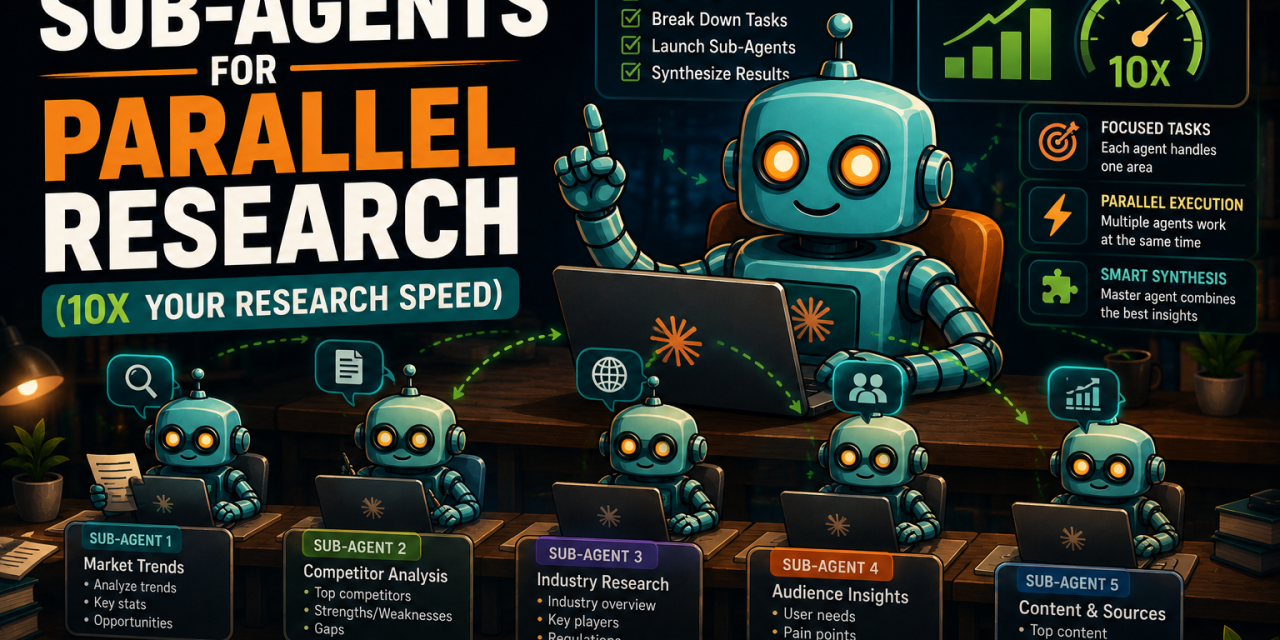
Today, you’ll build an AI Research Squadron that runs multiple research tasks at the same time, in separate contexts, and returns clean results to your main session.
-
✅ A single-agent delegation prompt that keeps research out of your main context
-
✅ A parallel dispatch pattern that runs 3-5 research tasks simultaneously
-
✅ A research brief template that gets better results from every subagent
-
✅ A result synthesis prompt that turns raw research into actionable insights
-
✅ A reusable CLAUDE.md workflow that makes parallel research your default mode
Let’s build it 👇

🧠 How the AI Research Squadron Works
Claude Code can spawn subagents. Each one is a separate Claude session with its own context window. It does the work independently, then sends back just the result.
Here’s why this changes everything:
-
🧹 Clean main session: All the research noise stays in the subagent’s context, not yours
-
⚡ Parallel speed: 5 research tasks run at the same time instead of one after another
-
📦 Structured output: Each subagent returns exactly what you asked for, in the format you specified
-
🧠 More room for decisions: Your main context stays reserved for thinking, planning, and building
What used to take 30 minutes of sequential research now takes 3-5 minutes of parallel work. And your main session stays focused.
🔎 Prompt #1 → The Solo Scout (Your First Subagent Delegation)
Before running a full squadron, start with one. This teaches you the basic delegation pattern that everything else builds on.
The goal:
-
Offload a single research task to a subagent
-
Keep the research out of your main context window
-
Get back a clean, structured summary you can actually use
✅ Use this whenever you need to research something before making a decision or writing content.
Prompt:
Use a subagent to research [TOPIC OR COMPANY OR QUESTION].

The subagent should:
1. Search the web for the most recent and relevant information (last 30 days preferred)
2. Focus specifically on: [WHAT YOU CARE ABOUT, e.g., "their pricing model, target audience, and key features"]
3. Ignore: [WHAT YOU DON’T NEED, e.g., "company history, founding story, investor details"]

Return a structured summary in this format:
- **Key findings** (3-5 bullet points, most important first)
- **Relevant details** (anything that directly affects my decision or task)
- **Source quality** (high/medium/low confidence based on what was found)

Keep the summary under 200 words. No filler, no context-setting. Just the findings.
💡 Tip: The magic is in the constraints. Tell the subagent what to ignore, not just what to find. This prevents it from returning a 500-word essay when you needed 5 bullet points. Shorter briefs = faster results = less clutter when you use the output.
⚡ Prompt #2 → The Parallel Dispatcher (Run 5 Tasks at Once)
This is where the real speed comes in. Instead of researching one thing at a time, you launch multiple subagents simultaneously. They all work in parallel and return results independently.
The goal:
-
Launch 3-5 subagents in a single message
-
Give each one a specific, independent research task
-
Get all results back without any of the research cluttering your main session
✅ Use this for competitor analysis, market research, content research, or any task where you need information on multiple topics.
Prompt:
Run these [NUMBER] research tasks in parallel using separate subagents. Each subagent works independently.

**Subagent 1 — [LABEL, e.g., "Competitor A"]:**
Research [SPECIFIC TOPIC]. Focus on [WHAT MATTERS]. Return: [FORMAT, e.g., "5 bullet points covering pricing, features, and target market"].

**Subagent 2 — [LABEL, e.g., "Competitor B"]:**
Research [SPECIFIC TOPIC]. Focus on [WHAT MATTERS]. Return: [FORMAT].

**Subagent 3 — [LABEL, e.g., "Competitor C"]:**
Research [SPECIFIC TOPIC]. Focus on [WHAT MATTERS]. Return: [FORMAT].

**Subagent 4 — [LABEL, e.g., "Market trends"]:**
Research [SPECIFIC TOPIC]. Focus on [WHAT MATTERS]. Return: [FORMAT].

**Subagent 5 — [LABEL, e.g., "Customer sentiment"]:**
Research [SPECIFIC TOPIC]. Focus on [WHAT MATTERS]. Return: [FORMAT].

Rules for all subagents:
- Keep each response under 200 words
- Use bullet points, not paragraphs
- Lead with the most important finding
- Flag anything surprising or unexpected with a ⚠️

After all subagents complete, present their results grouped by label. Do NOT synthesize or combine them yet. Just show me the raw results side by side.
🧠 Tip: The key phrase is “in parallel using separate subagents.” This tells Claude Code to launch them simultaneously, not sequentially. If you don’t say “parallel,” Claude might run them one by one, which defeats the purpose. Be explicit.
🎯 Prompt #3 → The Research Brief (Get Better Results From Every Subagent)
Bad subagent prompts get generic results. Good ones get insights you can act on immediately. The difference is the brief you give each subagent.
The goal:
-
Create a reusable research brief template
-
Give subagents enough context to make smart decisions about what matters
-
Get results that are specific to your business, not generic summaries
✅ Use this to upgrade the quality of every subagent task you delegate, especially for business-critical research.
Prompt:
“}]] Read More in The AI Break