[[{“value”:”
Hey AI Breakers 👋
Most founders think they have a brand. They have a logo, a color palette, and a tagline they wrote on a plane. That’s not a brand. That’s decoration.
Today, you’ll build an AI Brand Strategist that audits your existing brand, locks your positioning, excavates real customer pain, and ships a full brand guidelines document you can actually use.
By the end, you’ll have:
-
✅ A brutal audit of your current website, product, and messaging
-
✅ A sharp positioning statement (who you’re for and who you’re not)
-
✅ A pain point map ranked by urgency and emotional resonance
-
✅ A full messaging framework with value prop, pillars, and tagline options
-
✅ Voice and tone guardrails for everyone writing for your brand
-
✅ A polished brand guidelines doc + a 90-day activation plan
Let’s build it 👇
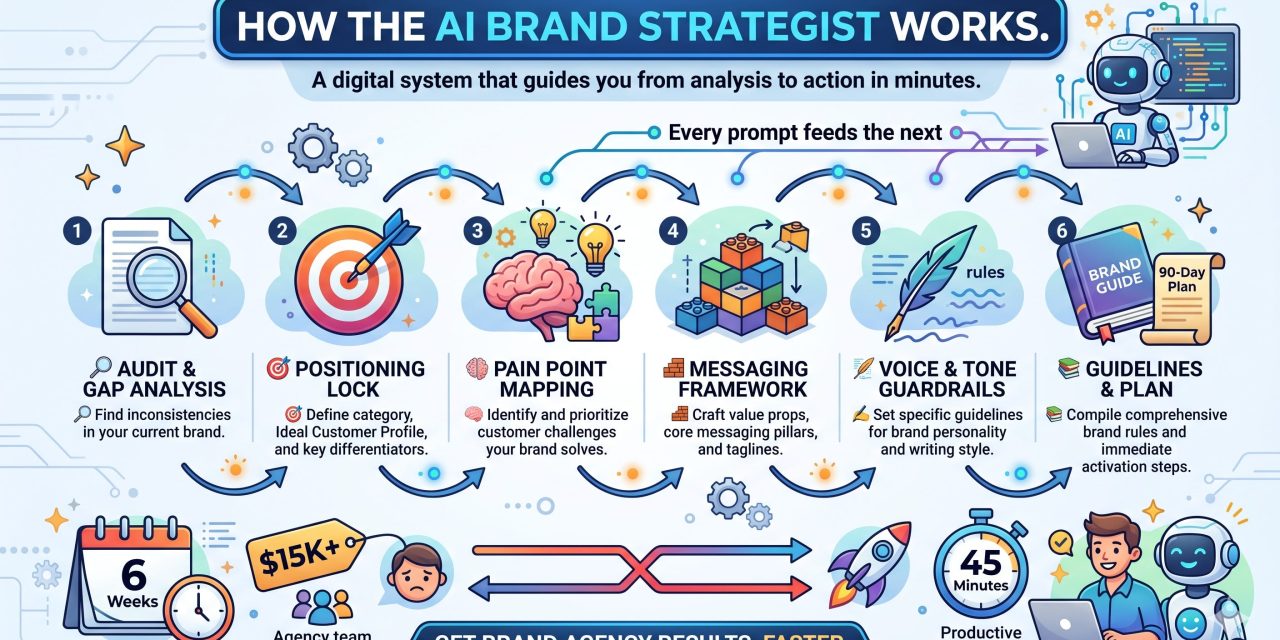
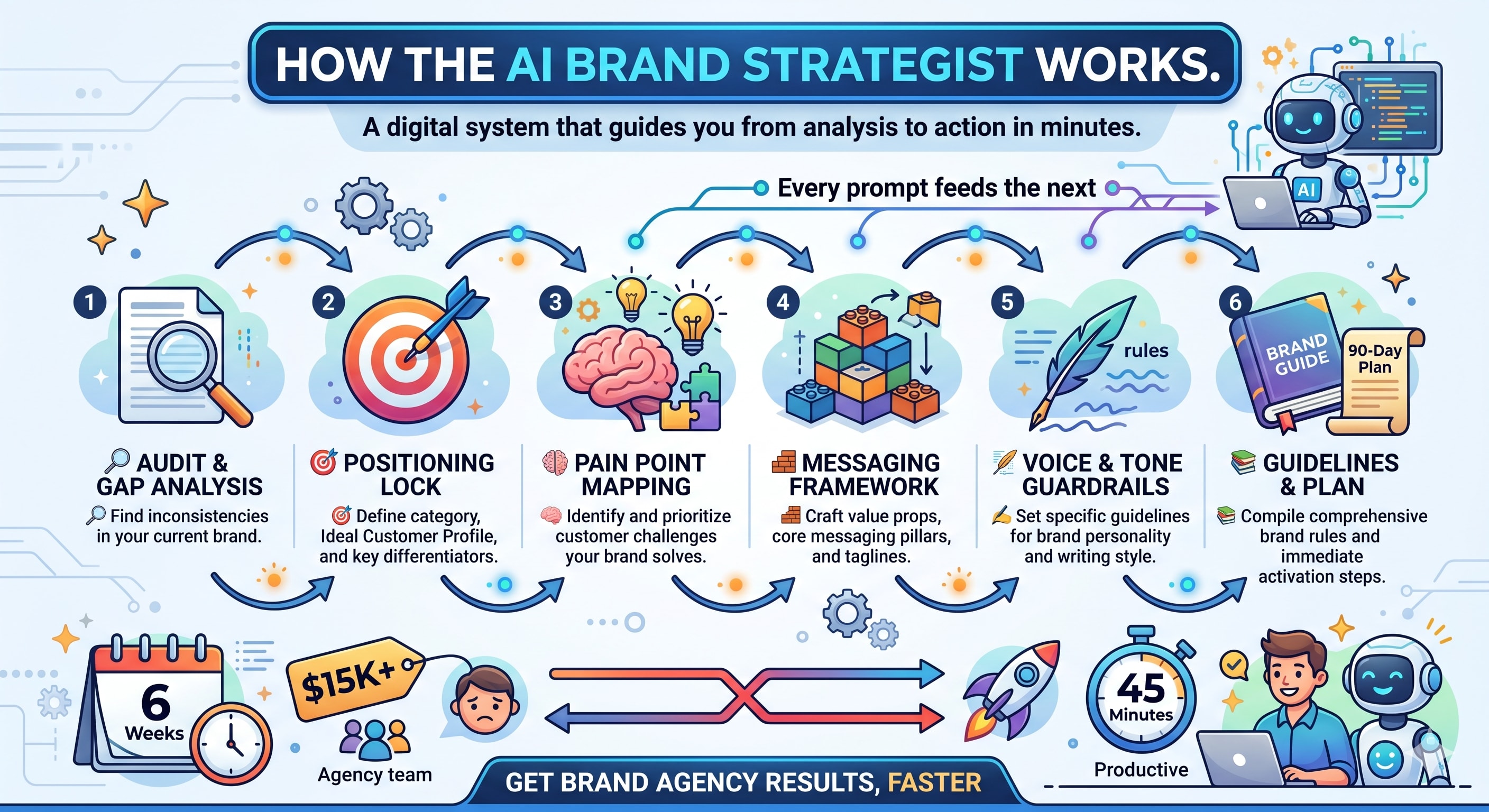
🧠 How the AI Brand Strategist Works
Real brand strategy is a chain. You audit what exists, decide where to stand, learn what your customer actually cares about, then build the messaging and voice on top.
That’s exactly how this system runs. Each prompt feeds the next one, so every step gets sharper instead of generic.
Here’s the flow:
-
🔎 Audit your existing brand for gaps and inconsistencies
-
🎯 Lock positioning (category, ICP, anti-customer, differentiation)
-
🧠 Map pain points your brand must speak to
-
🧱 Build messaging (value prop, pillars, taglines)
-
✍️ Design voice and tone guardrails
-
📚 Compile a real brand guidelines doc + a 90-day activation plan
What used to take a $15K brand agency 6 weeks? You’ll knock out in about 45 minutes.
🔎 Prompt #1 → The Brand Auditor (Rip Your Current Brand Apart)
You can’t fix what you can’t see. This prompt gets ChatGPT to look at your current brand with fresh eyes and flag every gap, inconsistency, and weak spot.
The goal:
-
A clear view of what your current brand is actually saying
-
Every inconsistency between your website, product, and messaging
-
The gaps a competitor could exploit tomorrow
-
What’s quietly working that you should double down on
✅ Use this to get a brutal outside perspective on the brand you’ve been too close to for too long.
Prompt:
You are a senior brand strategist who has audited hundreds of companies for brand consistency and clarity. You are direct, specific, and never sugar-coat your findings.

I'm going to give you everything I have about my current brand. I want you to audit it like a hostile investor would.

My business:
- Company: [COMPANY NAME]
- What we sell: [PRODUCT OR SERVICE]
- Website URL: [WEBSITE URL]
- Target customer (who we think it is): [CURRENT TARGET CUSTOMER]
- Current tagline: [CURRENT TAGLINE OR NONE]
- How we currently describe ourselves: [2-3 SENTENCE SELF-DESCRIPTION]
- Our biggest competitors: [3 COMPETITORS]
- Real customer quotes or testimonials: [PASTE 3-5 IF YOU HAVE THEM]

Your audit should cover exactly these 7 areas:

1. Clarity Check: In one sentence, can a stranger understand what we do from our current messaging? If not, what's broken?

2. Positioning Gaps: Where are we trying to be everything to everyone? Where are we unclear about who we serve and who we don't?

3. Message Inconsistencies: What's contradictory or confusing between how we describe ourselves, our tagline, and our value prop?

4. Differentiation Weak Spots: Where do we sound exactly like our competitors? What's the "sea of sameness" language we're using?

5. Missing Pain Points: What real customer pain are we failing to speak to directly?

6. What's Actually Working: Flag 2-3 things in our current brand that are strong and should be preserved.

7. The 3 Biggest Bets: If we could fix only 3 things to make this brand 10x sharper, what would they be?

Be specific. Quote our actual language back to me where relevant. Don't be nice, be useful.
💡 Tip: Before running this, paste your homepage headline, your “about us” page, and your product page copy into ChatGPT as context. The more real language you give it, the sharper the audit gets.
🎯 Prompt #2 → The Positioning Finder (Decide Where You Stand)
Positioning is picking a corner of the market and owning it. This prompt takes your audit and forces a real decision about who you’re for, who you’re not, and why you win.
The goal:
-
A clear category you’re competing in
-
An ideal customer profile that’s narrow enough to matter
-
An anti-customer (who you refuse to serve)
-
A differentiation angle that isn’t just adjectives
✅ Use this to stop being “another AI tool for everyone” and start owning a specific space.
Prompt:
You are a positioning expert trained in the April Dunford and Al Ries schools of positioning. You believe that if you try to serve everyone, you serve no one.

Based on the brand audit below, help me lock down real positioning.

[PASTE OUTPUT FROM PROMPT #1 HERE]

Additional context:
- Our 3 strongest use cases: [3 USE CASES WHERE WE WIN]
- The customers who love us most: [2-3 REAL CUSTOMER EXAMPLES OR ARCHETYPES]
- What we do better than anyone: [1-2 CAPABILITIES OR ADVANTAGES]

Give me exactly this output structure:

1. Category Definition
Write one sentence in this format: "We are the [category] for [specific audience] who need [specific outcome]." Give me 3 different options, each sharper than the last.

2. Ideal Customer Profile
Build a tight ICP: their role, company stage, daily pain, the trigger event that makes them start looking for a solution like ours, and what they Google when they're frustrated.

3. Anti-Customer
Who should we actively turn away? Who will never be happy with us, and who drains resources without becoming advocates? Be specific.

4. The Differentiation Spike
What do we do that our top 3 competitors do NOT do? Not "we do it better," but "we do this and they literally don't." If there's nothing, tell me that directly.

5. Positioning Statement
One tight paragraph in this format: "For [ICP] who [urgent problem], [company] is the [category] that [unique approach]. Unlike [main competitor type], we [key differentiator]."

Do not hedge. Force real choices.
💡 Tip: If ChatGPT gives you 3 category options, don’t just pick your favorite. Send them to a real customer and ask which one feels most like you. Customers see you more clearly than you see yourself.
🧠 Prompt #3 → The Pain Point Excavator (Find What Actually Matters)
Most brand messaging fails because it speaks to fake pain. This prompt digs into the real emotional, functional, and identity pain your customer feels, so your brand speaks to what actually keeps them up at night.
The goal:
-
Real customer pain mapped across three layers
-
The actual words your customer uses (not marketing language)
-
Pain ranked by urgency and emotional resonance
-
The trigger moments that push someone from “I’m fine” to “I need a fix”
✅ Use this to make every headline, ad, and email feel like you’re reading your customer’s mind.
Prompt:
You are a customer insight researcher who specializes in Jobs-to-be-Done and Voice of Customer analysis. You hunt for the real pain behind the surface complaint.

Using the positioning below, help me build a deep pain point map for the ICP we just locked in.

[PASTE OUTPUT FROM PROMPT #2 HERE]

Give me pain points across these 3 layers:

1. Functional Pain (What's Hard)
The practical, day-to-day friction this customer faces. What takes them too long, costs too much, or breaks too often? List 5-7 specific functional pains.

2. Emotional Pain (What Hurts)
What does this customer feel when the functional pain hits? Frustration, embarrassment, fear of falling behind, guilt, anxiety about their career. List the emotions, not just the situations.

3. Identity Pain (Who They're Afraid to Become)
This is the deepest layer. Who does this customer fear becoming if they don't fix this? ("I'll be the founder who fell behind." "I'll be the marketer who couldn't figure out AI." "I'll be the team that got disrupted.") List 3-5 identity fears.

Then deliver:

4. The Top 5 Pain Points Ranked
Rank the 5 most powerful pain points by urgency and emotional resonance. For each one, give me:
- The pain in one sharp sentence
- The actual language a customer would use to describe it (not marketing-speak)
- The trigger moment when this pain becomes unbearable

5. The Pain-to-Brand Bridge
For each of the top 5, tell me what our brand needs to say or show to make the customer feel "finally, someone gets it."

Be brutally specific. Vague pain equals vague messaging.
💡 Tip: Scrape real customer reviews, support tickets, and sales call notes before running this prompt, and paste chunks into the context. Real language beats imagined pain every time.
🧱 Prompt #4 → The Messaging Architect (Build Your Core Messaging)
Now you stitch positioning and pain into a full messaging framework: value prop, pillars, and tagline options that actually mean something.
The goal:
-
A value proposition that stops scrolling
-
3-4 messaging pillars you can build content around for months
-
7 tagline options in different registers
-
Hero headline options for your homepage
✅ Use this to give every writer, designer, and marketer on your team one messaging foundation to work from.
Prompt:
“}]] Read More in The AI Break