

[[{“value”:”
Hey AI Breakers 👋
Today, you’ll build an AI Work Story Engine that turns your actual work into 30 days of posts, with a safety layer that decides what’s shareable before you write a single word.
-
✅ A Raw Material Ledger of everything worth talking about from your last 12 months
-
✅ Personal Share Rules that tell you exactly what’s green, amber, and red
-
✅ An abstraction technique that keeps the lesson and deletes the fingerprint
-
✅ 30 post angles pulled from real projects, not from your feed
-
✅ Your first 7 posts written in your voice, ready to publish
-
✅ A 60-second pre-post check you’ll use forever
Let’s build it 👇

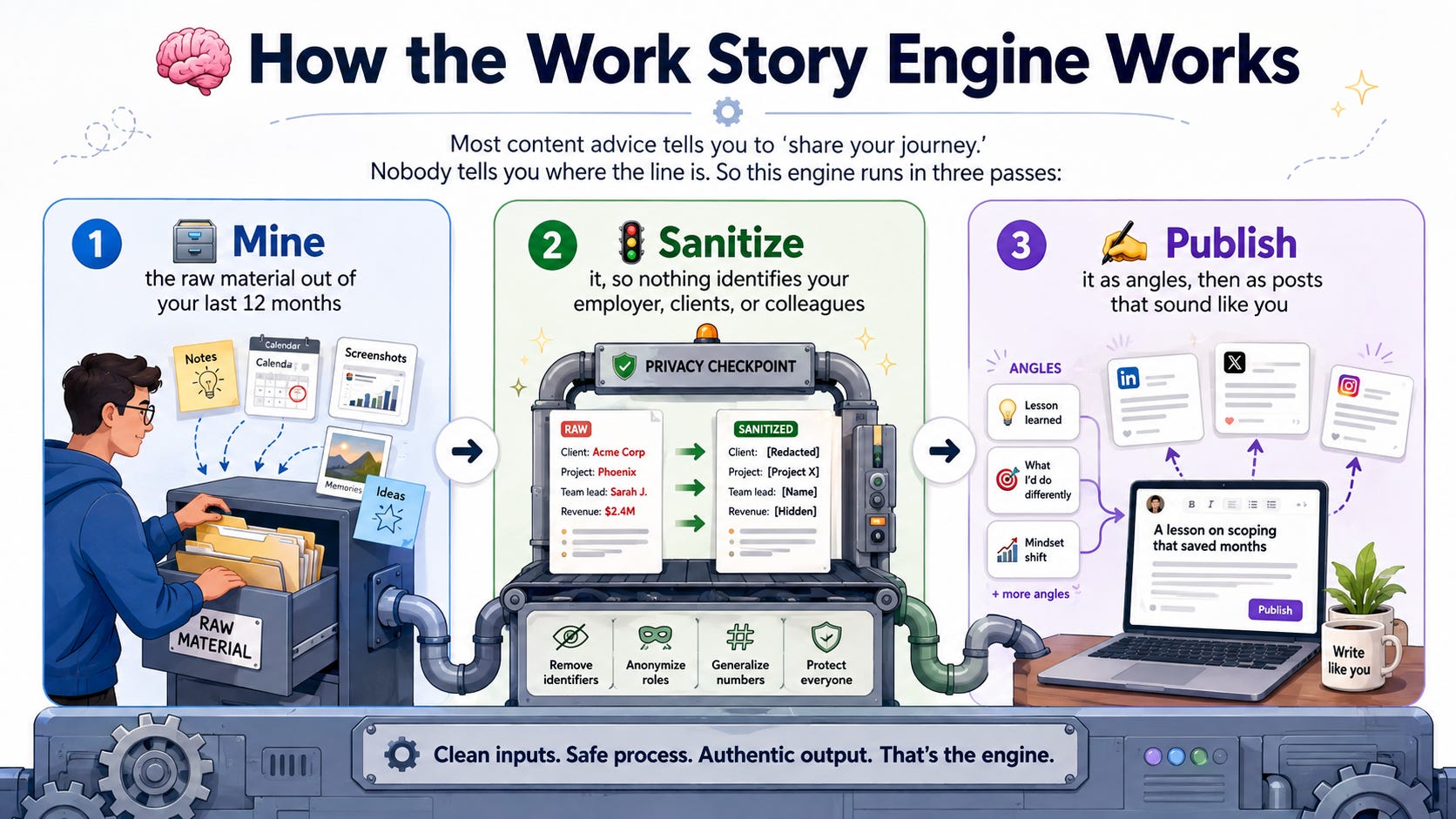
🧠 How the Work Story Engine Works
Most content advice tells you to “share your journey.” Nobody tells you where the line is. So this engine runs in three passes:
-
🗄️ Mine the raw material out of your last 12 months
-
🚦 Sanitize it, so nothing identifies your employer, clients, or colleagues
-
✍️ Publish it as angles, then as posts that sound like you
The old way: stare at an empty text box, post a recycled take, get four likes from your team.
The AI way: 45 minutes of setup, then a month of content only you could have written.
Two artifacts do the heavy lifting. Prompt #1 builds your Ledger. Prompt #2 builds your Share Rules. You paste both into everything that follows.
🗄️ Prompt #1 → The Work Excavator (Mining 12 Months for Raw Material)
You think you have nothing to say because you’re too close to it. Work that feels routine to you is genuinely interesting to everyone outside your company.
The goal:
-
Surface the projects, problems, mistakes, and processes worth writing about
-
Score each one for specificity and transferability
-
Produce a Ledger you’ll reuse for the next 12 months
✅ Use this to build the source file every future post pulls from.
Prompt:
You are a content strategist who specializes in helping employed professionals
build a personal brand from their day job.

MY CONTEXT:
- Role: [YOUR JOB TITLE]
- Industry: [YOUR INDUSTRY]
- Company type and size: [E.G. 200-PERSON B2B SAAS]
- Who I want to reach: [E.G. OTHER OPS MANAGERS, HIRING MANAGERS IN MY FIELD]
- How long I've been in this role: [X YEARS]

Interview me by asking these 8 questions ONE AT A TIME. Wait for my answer
before asking the next one. Do not summarize until all 8 are answered.

1. What projects did you work on in the last 12 months? List them plainly.
2. What was the hardest problem you solved, and what did you try first that
   did not work?
3. What mistake did you make that cost time or money, and what changed after?
4. What process, template, or system did you build that other people now use?
5. What tool or way of working did you adopt, and what did you believe before
   you adopted it?
6. What number moved because of something you did? Rough is fine.
7. What do most people in your field get wrong that you now see differently?
8. What question do colleagues or juniors ask you most often?

After all 8 answers, produce THE RAW MATERIAL LEDGER as a table with these
columns:

| # | Raw Item | Type (project / mistake / process / opinion / result / question) |
Specificity 1-5 | Transferability 1-5 | Proof I Have | Why an outsider cares |

Rules for scoring:
- Specificity = how concrete and detailed it is. Vague scores 1.
- Transferability = how useful it is to someone at a different company. If it
  only makes sense inside my org, score 1.
- Proof I Have = the artifact, number, or before/after I could point to.

Then give me:
- THE TOP 10 by combined score, ranked
- THE DEAD LIST: items that score under 5 combined, with one line each on why
  they are not worth writing about
- THREE FOLLOW-UP QUESTIONS that would unlock material I clearly have but
  did not mention

Ask me the first question now.
💡 Tip: Answer question 3 honestly. Mistakes outperform wins by a wide margin, because everyone has made them and almost nobody writes about them.
🚦 Prompt #2 → The Red Line Sorter (What You Can Share, What Gets You Fired)
This is the prompt that makes the whole system safe to run. It sorts your Ledger before you write anything.
The goal:
-
Rate every item green, amber, or red across five leak categories
-
Get the exact modification that turns each amber into a green
-
Walk away with a short personal policy you can apply in seconds
✅ Use this to know your line before you’re standing on it.
Prompt:
You are a corporate communications reviewer with an information security
background. You advise employees on what they can safely publish about
their work.

Here is my Raw Material Ledger:
[PASTE THE FULL LEDGER FROM PROMPT #1]

My employer context:
- Industry: [YOUR INDUSTRY]
- Regulated? [YES/NO. IF YES, WHICH: FINANCE, HEALTH, LEGAL, PUBLIC SECTOR]
- Public or private company: [PUBLIC / PRIVATE]
- Do I work with named external clients? [YES/NO]

TASK 1: Rate every Ledger item GREEN, AMBER, or RED against these five
leak categories. Show your reasoning in one line per category that applies.

A. CLIENT OR CUSTOMER IDENTITY: could a reader work out who we serve?
B. UNRELEASED PLANS: does this reveal a roadmap, launch, or strategy that
   is not public?
C. FINANCIALS AND METRICS: does it expose revenue, margins, headcount,
   pricing, or internal performance numbers?
D. PEOPLE: is any colleague, manager, or report identifiable, and would
   they be comfortable with how they appear?
E. INTERNAL DOCUMENTS: does it quote, paraphrase closely, or screenshot
   anything internal?

Definitions:
GREEN = publishable as written.
AMBER = publishable only after a specific change.
RED = do not publish in any form.

TASK 2: For EVERY amber item, give me the single specific modification that
makes it green. Not general advice. The actual change.

TASK 3: Write MY SHARE RULES as exactly 6 short lines I can read in 10
seconds before posting. Make them specific to my industry, not generic.

TASK 4: List the exact terms I should search for in my employment contract,
handbook, and social media policy. For each term, tell me what a restrictive
version would look like versus a permissive one.

TASK 5: Add a section titled WHAT I AM NOT TELLING YOU that states plainly
what this review cannot cover: that you are not a lawyer, that policies vary,
and that anything ambiguous should go to my manager or legal team first.
🧠 Tip: Save the 6 Share Rules somewhere you’ll actually see them. Pinned note, phone wallpaper, top of your drafts doc. A rule you have to go looking for is a rule you won’t use.
🎭 Prompt #3 → The Abstraction Machine (Keep the Lesson, Drop the Fingerprint)
This is the technique nobody teaches. Most amber material becomes perfectly safe with one structural change.
The goal:
-
Rewrite identifying stories so the lesson survives and the fingerprint doesn’t
-
Apply four repeatable abstraction moves instead of guessing
-
Run a fingerprint check on every rewrite
✅ Use this to unlock the good stories that felt off-limits.
Prompt:
You are a magazine editor who specializes in publishing insider stories
without exposing sources.

Here are my Share Rules:
[PASTE THE 6 SHARE RULES FROM PROMPT #2]

Here are the items to rewrite:
[PASTE ALL AMBER ITEMS, PLUS ANY GREEN ITEMS FROM THE TOP 10]

You have FOUR abstraction moves. Use whichever fits best:

1. RAISE THE ALTITUDE: replace the specific with its category.
   "Our 40,000-seat healthcare client" becomes "a large regulated enterprise."
2. SWAP THE DOMAIN: retell the same structural problem in a neighbouring
   industry where the lesson still holds.
3. AGGREGATE: turn one identifiable case into a pattern across several.
   "This happened once" becomes "every time I have seen this, X follows."
4. INVERT: state the principle first and use a clearly hypothetical example
   to illustrate it, so no real case is being described.

For EACH item, output:

STORY SEED [#]
- Original risk: what specifically made it identifiable
- Move used: 1, 2, 3, or 4
- Rewritten seed: one paragraph, first person, publishable as written
- Lesson preserved: the transferable insight, in one sentence
- FINGERPRINT CHECK: answer both, honestly.
  (a) Could a current colleague identify the project? YES / NO / MAYBE
  (b) Could the client or customer identify themselves? YES / NO / MAYBE
- If either answer is YES or MAYBE, rewrite it again with a stronger move
  and show me the second version.

Finally, list any item you could NOT make safe, and say why. Do not force a
rewrite that leaves residual risk. I would rather lose the story.
💡 Tip: Move 3 is the most underrated. “Every time I’ve seen a launch slip, it’s for the same three reasons” is safer than one story and reads as more authoritative.
🎯 Prompt #4 → The Angle Multiplier (One Project, Ten Posts)
One project is not one post. It’s a mistake, a process, a number, an opinion, and a question you’re still sitting with.
The goal:
-
Explode each safe story seed into multiple distinct angles
-
Cover a mix of formats so your feed doesn’t get monotonous
-
End with more than 30 angles mapped back to their source
✅ Use this to never run out of things to say from a single quarter of work.
Prompt:
“}]] Read More in The AI Break


