[[{“value”:”
Hey AI Breakers 👋
You pay a copywriter $3K a month and still rewrite the first draft yourself. Because nobody holds your voice, your offer, and your proof in their head at the same time.
Today you’ll build The Copy Desk: four Claude Skills that install once on Claude and write on-brand from a cold start, forever.
Let’s build it 👇
⚙️ The 30-Second Install (Do This First)
Every skill in this tutorial is a small text file called SKILL.md inside its own folder.
Here’s the shape of one:
---
name: draft-desk
description: Writes ads, emails, and landing page copy in our brand voice. Use whenever the user asks for marketing copy, a promo email, an ad, a headline, or website wording.
---

[the instructions go here]
That description line is the trigger. It’s how Claude decides to load the skill without being told.
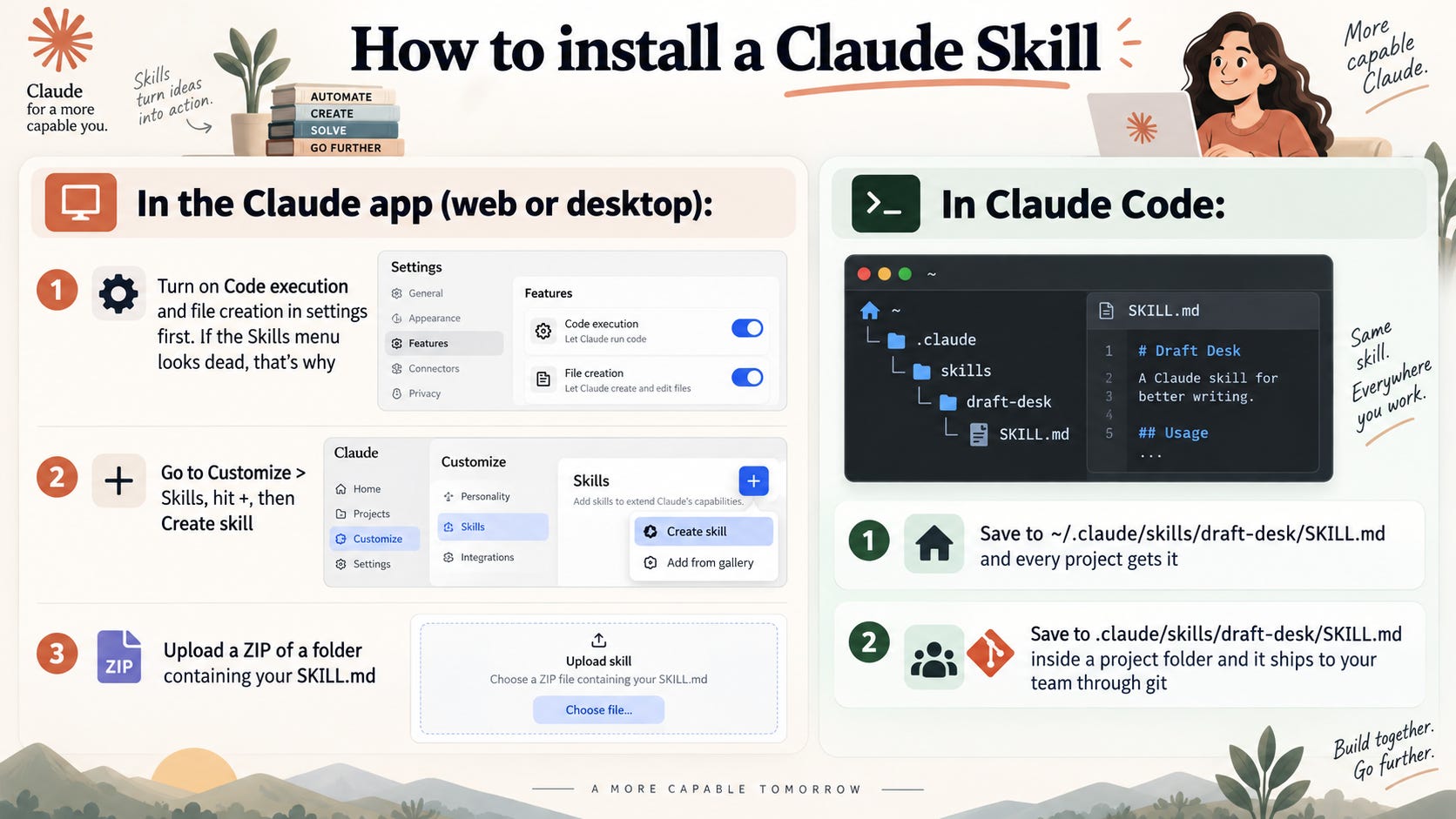
In the Claude app (web or desktop):
-
⚙️ Turn on Code execution and file creation in settings first. If the Skills menu looks dead, that’s why
-
➕ Go to Customize > Skills, hit +, then Create skill
-
📦 Upload a ZIP of a folder containing your SKILL.md
In Claude Code:
-
🏠 Save to ~/.claude/skills/draft-desk/SKILL.md and every project gets it
-
📁 Save to .claude/skills/draft-desk/SKILL.md inside a project folder and it ships to your team through git
💡 Tip: the fastest route is to paste the skill text into Claude and ask it to save this as a skill file for you.
🧾 Prompt #1 → The Copy Core Extractor (the context every draft reads)
Your copywriter’s real value was knowing your business. Build that knowledge once, here.
The goal:
-
Your offer in facts and numbers, not adjectives
-
Who buys, and what they’ve already tried that failed
-
The claims you’d never make and the words you’d never use
✅ Use this to generate the COPY CORE block you’ll paste into all four skills.
Prompt:
You are a direct response strategist who writes context briefs that other AI systems will use to produce copy.

Interview me to build a "COPY CORE" for my business.

Ask these 9 questions ONE AT A TIME. Wait for my answer before asking the next one. Do not summarize until the end.

1. What do you sell, and what does it cost?
2. Who buys it? Give me role, company size or life situation, and what they are responsible for.
3. What did they try before you, and why did it fail them?
4. What is the single measurable result a customer gets? Use a number if you have one.
5. What do customers say out loud right before they buy?
6. What objection kills the most deals?
7. What claim would you never make, even if it sold?
8. What words, phrases, or formats are banned in your brand?
9. Paste 3 to 5 sentences you have written that sound exactly like you.

After my final answer, output a single block titled "COPY CORE" containing:
- Offer: one line plus price
- Buyer: role, situation, responsibility
- Failed alternative: one line
- Core result: the number or outcome
- Buying language: 5 exact phrases customers use
- Top objection: one line plus the honest answer to it
- Never claim: bullet list
- Banned words: comma separated
- Voice rules: 6 rules written as instructions, each starting with a verb

Keep the whole block under 400 words. Write it so a stranger could use it to sound like me.
💡 Tip: answer question 9 with real writing, not a polished bio. A Slack message or a reply you sent a customer works better than anything from your website.
🔍 Prompt #2 → The Proof Vault (the part that actually sells)
Copy that converts is mostly evidence. This prompt mines yours so no skill has to invent any.
The goal:
-
Real customer language pulled from real sources
-
Specific numbers, timeframes, and before and after states
-
A flag on any claim you cannot back up
✅ Use this to build the evidence bank your drafts will quote instead of guessing.
Prompt:
You are a customer research analyst who extracts usable proof from raw feedback.

Here is my COPY CORE:
[paste the COPY CORE block from Prompt #1]

Here is my raw material:
[paste 10 to 30 of any of these: reviews, testimonials, support tickets, sales call notes, survey answers, cancellation reasons]

Do this:
1. Pull every SPECIFIC outcome mentioned. Include the number and the timeframe. Ignore anything vague like "great service".
2. Pull the 10 most repeated phrases customers use to describe the problem. Use their exact words.
3. List the 5 objections that appear most, ranked by frequency.
4. For each objection, write the strongest honest answer using only evidence above.
5. Flag anything I currently claim that is NOT supported by this material.

Output a block titled "PROOF VAULT" with five sections:
- Hard results: bullet list, each with a number
- Customer phrases: 10 quotes in their words
- Objections: ranked, each with its honest answer
- Unsupported claims: what I should stop saying until I can prove it
- Best single testimonial: the one quote that does the most selling

Do not invent, smooth over, or upgrade anything. If the material is thin, say so plainly.
🧠 Tip: no reviews yet? Use your last 20 sales emails and any call notes. The objections section alone is worth the exercise.
📋 Skill #1 → The Brief Desk (a vague ask becomes a real brief)
Bad copy usually starts as a bad brief. This skill refuses to write anything until the job is defined.
The goal:
-
One audience, one promise, one action per piece
-
The proof that carries it, chosen before drafting
-
A named success metric so you can judge it later
✅ Use this to stop getting drafts that are technically fine and completely off target.
Prompt: save everything below as brief-desk/SKILL.md
“}]] Read More in The AI Break