[[{“value”:”
Hey AI Breakers 👋
One channel brings you almost every customer. That is not a growth strategy; that is a single point of failure.
Today you’ll build an AI Channel Scout that finds your next acquisition channel, scores it honestly, and tests it cheaply before you bet real money on it.
-
✅ A brutally honest audit of where your customers actually come from
-
✅ Your real CAC ceiling, so you stop guessing what you can afford to pay
-
✅ A map of where your best buyers already spend attention
-
✅ 12 channels scored against your business, narrowed to 3 finalists
-
✅ A cheap test design for each one with kill and scale criteria set upfront
-
✅ A 30-day rollout calendar and a 15-minute weekly readout ritual
Let’s build it 👇

🧠 How the AI Channel Scout Works
A good growth marketer does not start by picking a channel. They start by working out what they can afford, then follow the attention.
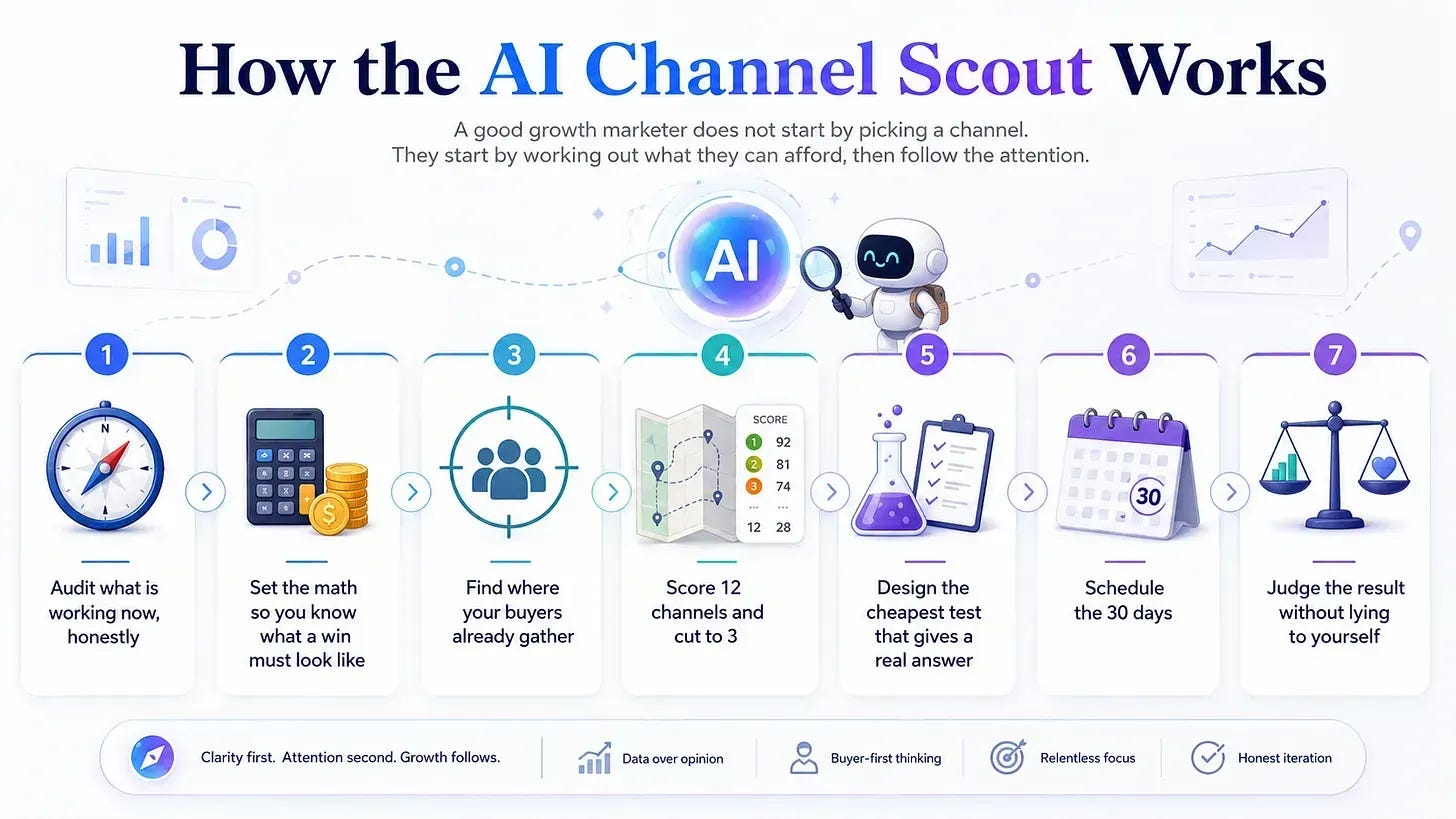
The Scout runs that same sequence in seven prompts:
-
🧭 Audit what is working now, honestly
-
💰 Set the math so you know what a win must look like
-
🎯 Find where your buyers already gather
-
🗺️ Score 12 channels and cut to 3
-
🧪 Design the cheapest test that gives a real answer
-
📅 Schedule the 30 days
-
⚖️ Judge the result without lying to yourself
The old way: a $3K/month growth marketer takes 6 weeks to deliver a channel strategy deck.
This way: 60 minutes to a decision, 30 days to an answer.
One rule that makes the whole thing work. Prompt #1 produces a Growth Profile that you paste into every prompt after it. Build it once, and every later answer is about your actual business instead of a generic startup.
🧭 Prompt #1 → The Growth Audit (your honest starting position)
Every bad channel decision starts with a founder who cannot say precisely where last quarter’s customers came from.
The goal:
-
A factual picture of your current acquisition, not the story you tell investors
-
Your concentration risk stated as a number
-
A reusable Growth Profile block for every prompt that follows
✅ Use this to establish the baseline you will measure every new channel against.
Prompt:
You are a growth strategist who has run acquisition for 40+ companies and is known for being blunt about weak data.

I want you to build my GROWTH PROFILE. Interview me first, then produce it.

MY BUSINESS:
- What we sell: [YOUR PRODUCT OR SERVICE]
- Price point and model: [E.G. $99/MONTH SUBSCRIPTION, $5K ONE-OFF PROJECT]
- Who buys it: [YOUR BUYER, BE SPECIFIC ABOUT ROLE AND COMPANY TYPE]
- Roughly how many new customers per month: [NUMBER]
- Where I believe they come from: [YOUR BEST GUESS, LIST CHANNELS AND ROUGH PERCENTAGES]
- What I have already tried that failed: [LIST, OR "NOTHING YET"]
- Monthly budget I could genuinely commit to a new channel: [AMOUNT]
- Hours per week I or my team can spend on it: [NUMBER]

YOUR TASKS:
1. Ask me up to 6 clarifying questions, one at a time, focused on whatever is
   vaguest or least evidenced above. Do not ask questions I already answered.
2. Flag every place where I gave you a belief instead of a measurement. Say
   plainly: "You are guessing here, and this guess could cost you."
3. Calculate my concentration risk: what percentage of new customers comes from
   my single largest source. Tell me what breaks if that source halves.
4. Name the 3 structural constraints that should rule channels in or out for me
   (budget, time, sales cycle length, price point, content ability, geography).

5. Then output a block titled GROWTH PROFILE containing:
   - Business in one sentence
   - Buyer in one sentence
   - Price, model, and rough gross margin
   - Current channel mix with percentages
   - Concentration risk score (LOW / MEDIUM / HIGH) with the number behind it
   - Budget and time available
   - The 3 structural constraints
   - What has already failed, and the most likely reason it failed

Keep the GROWTH PROFILE under 250 words. I will paste it into every later prompt,
so it must be dense and self-contained.
💡 Tip: If it tells you your concentration risk is HIGH and you feel defensive, that is the signal you needed this tutorial. Save the Growth Profile somewhere you can copy it fast. You will paste it six more times.
💰 Prompt #2 → The Math Guardrail (what a win has to look like)
Most channel tests fail because nobody decided what success meant before spending.
The goal:
-
Your maximum acceptable cost per customer
-
How long you can wait to get that money back
-
A single number that makes every later decision obvious
✅ Use this to kill channels on arithmetic before they waste a quarter.
Prompt:
You are a growth-focused CFO. You are allergic to vanity metrics and you show
your working.

GROWTH PROFILE:
[paste the GROWTH PROFILE from Prompt #1]

ADDITIONAL NUMBERS:
- Average revenue per customer per month: [AMOUNT]
- Average months a customer stays: [NUMBER, OR "I DON'T KNOW"]
- Rough gross margin percentage: [NUMBER, OR "I DON'T KNOW"]
- How long I can float spend before it must pay back: [E.G. 3 MONTHS, 12 MONTHS]

YOUR TASKS:
1. Calculate my lifetime value on gross margin, not revenue. Show the arithmetic
   line by line. If I said "I don't know" for anything, use a clearly labelled
   industry assumption and mark it ASSUMED.
2. Set my CAC CEILING: the absolute most I can pay to acquire one customer
   without the business getting worse. Give me three versions:
   - Aggressive (grow fast, accept thin payback)
   - Sane (the number you actually recommend)
   - Conservative (cash-tight, must pay back quickly)
3. State my payback window in months for each version.
4. Convert the Sane ceiling into practical thresholds I can check weekly:
   - Max cost per lead, assuming a realistic lead-to-customer rate for my model
   - Max cost per booked call, if my model has calls
   - Minimum conversion rate a channel must hit to work at that cost
5. Give me one sentence I can pin above my desk, in this shape:
   "A channel works for us if it delivers a customer under $X within Y months."

Do not soften the numbers to make me feel good. If my model cannot support paid
acquisition at all, say that directly and explain why.
🧠 Tip: If the answer is “your model cannot support paid acquisition,” that is not a failure. It is the most valuable thing you will learn today, and it points you straight at organic and partnership channels instead.
🎯 Prompt #3 → The Watering Hole Finder (where your buyers already are)
You do not need a new channel. You need the specific place your best customers already pay attention.
The goal:
-
Named communities, newsletters, podcasts, and events, not channel categories
-
The moment your buyer is most receptive
-
Evidence of who is already reaching them
✅ Use this to turn “we should try LinkedIn” into “we should sponsor these four newsletters.”
Prompt:
“}]] Read More in The AI Break