[[{“value”:”
Hey AI Breakers 👋
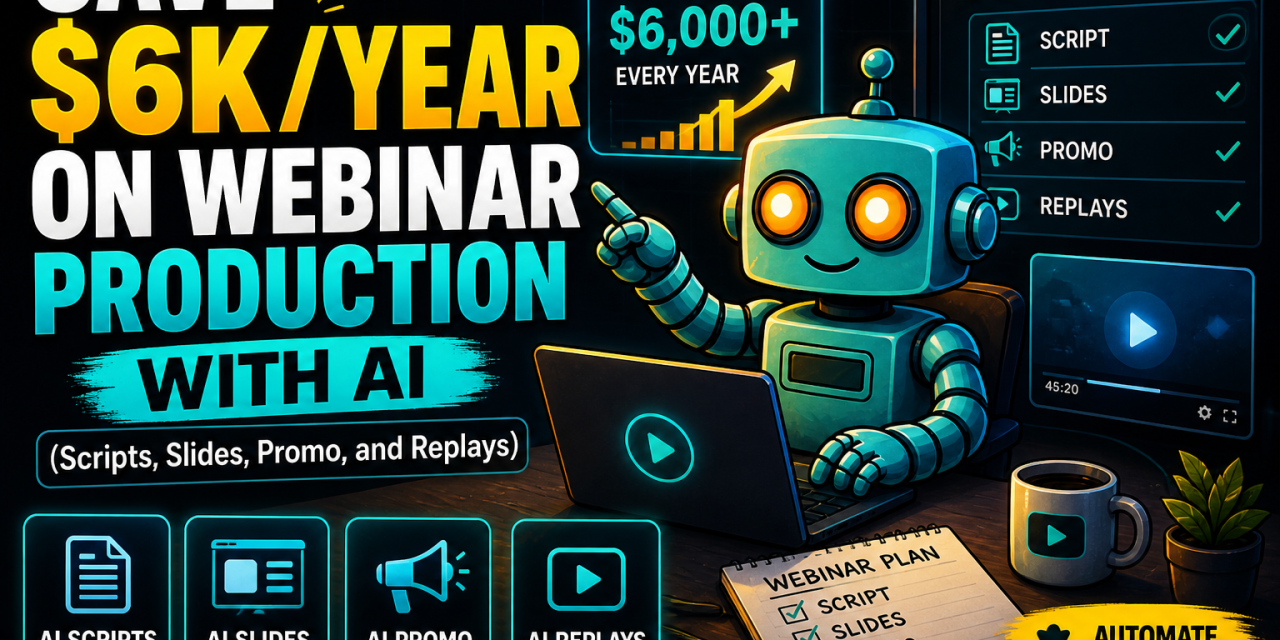
Webinars convert like crazy. The problem is everything around them: writing the script, building the deck, drafting promo emails, designing the replay page.
That’s where $6K/year (or 40+ hours per webinar) silently disappears.
Today, you’ll build an AI Webinar Engine that produces a complete webinar kit (topic, deck, script, promo, replay) in one focused session.
-
✅ A validated webinar topic with proven audience demand
-
✅ An 18-22 slide deck outline with talking points and visual cues
-
✅ A full 45-minute speaker script with hooks, stories, and CTAs
-
✅ A registration page + 4-email promo sequence + social posts
-
✅ A replay landing page + post-event follow-up + 30 days of repurposed content
Let’s build it 👇
🧠 How the AI Webinar Engine Works
Most webinars fail before they start. Either the topic is too broad, the deck is a wall of bullet points, the script is read from notes, or the promo lands in the wrong inboxes. This system fixes each step.
The flow is simple:
-
🎯 Stage 1: Pick a topic your audience actually wants to attend
-
🧱 Stage 2: Build the deck frame (slide-by-slide)
-
🎤 Stage 3: Write the speaker script (with stories and transitions)
-
📣 Stage 4: Generate the promo machine (page + emails + social)
-
🔁 Stage 5: Multiply the replay into 30 days of content
Old way: 2 weeks, $1,500 to a producer + designer + copywriter, one webinar. New way: 4-6 hours, $0 in production cost, one webinar plus 30 days of repurposed marketing assets.
🎯 Prompt #1 → The Topic Sniper (Pick a Webinar Worth Showing Up For)
If the topic is wrong, nothing downstream matters. Most webinars die on slide 1 because they answer a question nobody asked.
The goal:
-
Generate 3 candidate webinar topics tied to real audience pain
-
Score each on demand, urgency, fit with your offer, and replay shelf life
-
Pick the winner with a clear thesis and registration promise
✅ Use this to start every webinar from a topic that already has built-in demand.
Prompt:
You are a webinar strategist who has run hundreds of high-converting events.

Here is my context:
- Business: [DESCRIBE YOUR BUSINESS IN 1-2 SENTENCES]
- Target audience: [WHO YOU SERVE, e.g., "B2B founders running 5-25 person teams"]
- Audience pain points: [LIST 3-5 SPECIFIC PROBLEMS THEY FACE]
- Your offer / what you sell after the webinar: [PRODUCT, SERVICE, OR NEXT STEP]
- Recent topics you've covered: [LIST 3-5 RECENT CONTENT TOPICS]

Generate 3 candidate webinar topics. For each, give me:
1. Working title (clear benefit, 8-12 words, no clickbait)
2. One-sentence registration promise (what attendees walk away with)
3. Demand score (1-10): How starved is the audience for this?
4. Urgency score (1-10): Why now and not next year?
5. Offer fit score (1-10): How naturally does it lead to your paid offer?
6. Replay shelf life (1-10): How long will the recording stay relevant?
7. The one risk (the most likely reason it underperforms)

Then pick the winner and write a 3-sentence thesis statement explaining why this topic, this audience, this moment.

End with the headline registration page promise in the format: "Join us live to learn how to [SPECIFIC OUTCOME] in [SPECIFIC TIMEFRAME] without [COMMON FRUSTRATION]."
💡 Tip: If all 3 topics score under 7 on demand, your inputs are too generic. Re-run the prompt with sharper pain points (use exact words your audience uses in DMs or sales calls). The winner should jump out, not feel like a coin flip.
🧱 Prompt #2 → The Deck Architect (Build the Slide Frame in 20 Minutes)
Most decks are 40 slides of bullet points. This prompt builds a 18-22 slide frame that respects attention spans and lands the offer naturally.
The goal:
-
Map the full webinar arc: hook, agenda, content, CTA, Q&A
-
Get a slide-by-slide outline with talking points and visual cues
-
Build natural transition moments where the offer slots in (not bolted on)
✅ Use this to skip the “blank deck panic” and start with a structure that already works.
Prompt:
You are a senior webinar designer. I need a slide-by-slide deck outline.

Webinar topic: [PASTE WINNER FROM PROMPT #1]
Registration promise: [PASTE THE HEADLINE PROMISE FROM PROMPT #1]
Audience: [SAME AUDIENCE AS PROMPT #1]
Total runtime target: 45 minutes (35 min content + 10 min Q&A)
Offer to introduce naturally: [WHAT YOU'RE SELLING AFTER, e.g., "$1,500 strategy intensive"]

Build me a full slide-by-slide outline (18-22 slides) following this proven arc:

1. HOOK (slides 1-2): Cold-open story or contrarian claim that makes them lean in
2. CREDIBILITY (slide 3): Why you (1 slide, no resume dump)
3. AGENDA (slide 4): The 3 things they will learn (specific, benefit-driven)
4. CORE CONTENT (slides 5-15): The actual teaching, organized in 3 modules
5. CASE STUDY OR DEMO (slides 16-17): Concrete proof or live example
6. NATURAL TRANSITION TO OFFER (slide 18): Bridge from content to "what's next"
7. THE OFFER (slides 19-20): What it is, who it's for, what they get, how to act
8. Q&A PROMPT (slide 21): Specific question that primes good Q&A
9. CLOSE (slide 22): Final CTA + thank you + how to follow up

For each slide, give me:
- Slide number + title (max 8 words, benefit-driven)
- 2-4 bullet talking points (NOT slide text, what the speaker says)
- Visual cue (one sentence: "Image of X" or "Chart showing Y" or "Single bold word")
- Speaker timing (in seconds)

Output as a numbered list. Total runtime should add up to ~35 minutes for content slides.
🧠 Tip: If your CTA slide feels jarring, the transition slide (#18) is doing too little. Rewrite it to acknowledge what they just learned and frame the offer as the obvious next step, not a sales pitch.
🎤 Prompt #3 → The Speaker Script (Words That Hold the Room)
This is where most webinars lose people: a presenter reading bullet points instead of telling stories. This prompt writes a script you can speak naturally.
The goal:
-
Turn each slide’s talking points into spoken script (your voice, not corporate)
-
Plant 2-3 stories or examples that anchor the abstract ideas
-
Embed transition lines that flow slide-to-slide without “next slide please”
✅ Use this to walk on with a script you barely need to glance at.
Prompt:
You are a webinar copywriter who specializes in conversational speaking scripts.

Slide outline: [PASTE FULL OUTPUT FROM PROMPT #2]
Speaker style: [DESCRIBE YOUR VOICE, e.g., "casual, story-driven, occasional humor, never corporate"]
Personal anecdotes you can pull from: [LIST 2-3 STORIES OR CLIENT WINS YOU CAN REFERENCE]

Write the full speaker script for the 35 minutes of content slides (skip the offer + Q&A slides for now). For each slide:

1. OPENING LINE (the first sentence on this slide, attention-grabbing)
2. CORE DELIVERY (3-6 sentences of spoken-style script, written for the ear not the eye)
3. EXAMPLE OR STORY (where it fits, 2-4 sentences anchoring the abstract idea to a real situation)
4. TRANSITION LINE (one sentence that bridges to the next slide naturally)

Style rules:
- Write in spoken language. Contractions, fragments, rhetorical questions are OK.
- Avoid jargon. If you use a technical term, define it in the same sentence.
- One idea per sentence. Short.
- Include 2 deliberate pauses (marked [PAUSE]) where the audience needs to absorb something.
- Plant 2 callbacks: one early reference you bring back later for closure.

Then write a separate OFFER SCRIPT for slides 18-20 (the transition + offer reveal). Keep it 2-3 minutes total. Frame as: "Here's what to do if you want help applying this", NOT "Now I'll pitch you for 5 minutes."

Output as: SLIDE N + script blocks, clearly separated.
💡 Tip: After you generate the script, read the offer section out loud once. If it feels like a different person wrote it (vs the rest of the script), rewrite that section in your voice. The whiplash from teaching voice to selling voice is what kills conversions.
📣 Prompt #4 → The Promo Engine (Fill the Room Without Burning a Budget)
A great webinar with 12 attendees is a great webinar nobody saw. This prompt builds your registration page, promo emails, and social posts in one shot.
The goal:
-
A registration page that makes the “yes” obvious
-
A 4-email promo sequence that pulls warm audience without spamming
-
5 social posts (LinkedIn, X, Substack note) and 1 personal-DM template
✅ Use this to hit your registration target without paying a copywriter or running ads.
Prompt:
“}]] Read More in The AI Break