
Hello Engineering Leaders and AI Enthusiasts!
This newsletter brings you the latest AI updates in just 4 minutes! Dive in for a quick summary of everything important that happened in AI over the last week.
And a huge shoutout to our amazing readers. We appreciate you😊
In today’s edition:
🧠 Anthropic launches Claude Sonnet 5.5 multimodal model
🤖 OpenAI brings a 24/7 AI agent to ChatGPT
⚡ Google announces Gemini 4 Argon as its new frontier model
💰 Anthropic and OpenAI bring frontier AI discounts
💡 Knowledge Nugget: AI + Teams = ? by Marcus Castenfors
Let’s go!
Anthropic launches Claude Sonnet 5.5 multimodal model
Anthropic has released Claude Sonnet 5.5, a faster and more capable upgrade built for coding, knowledge work, and everyday AI tasks. It runs 30%+ faster than Sonnet 5 and nearly matches Opus 5.5 on several knowledge-work and coding benchmarks, including a 70.6% score on Terminal-Bench 4.0.
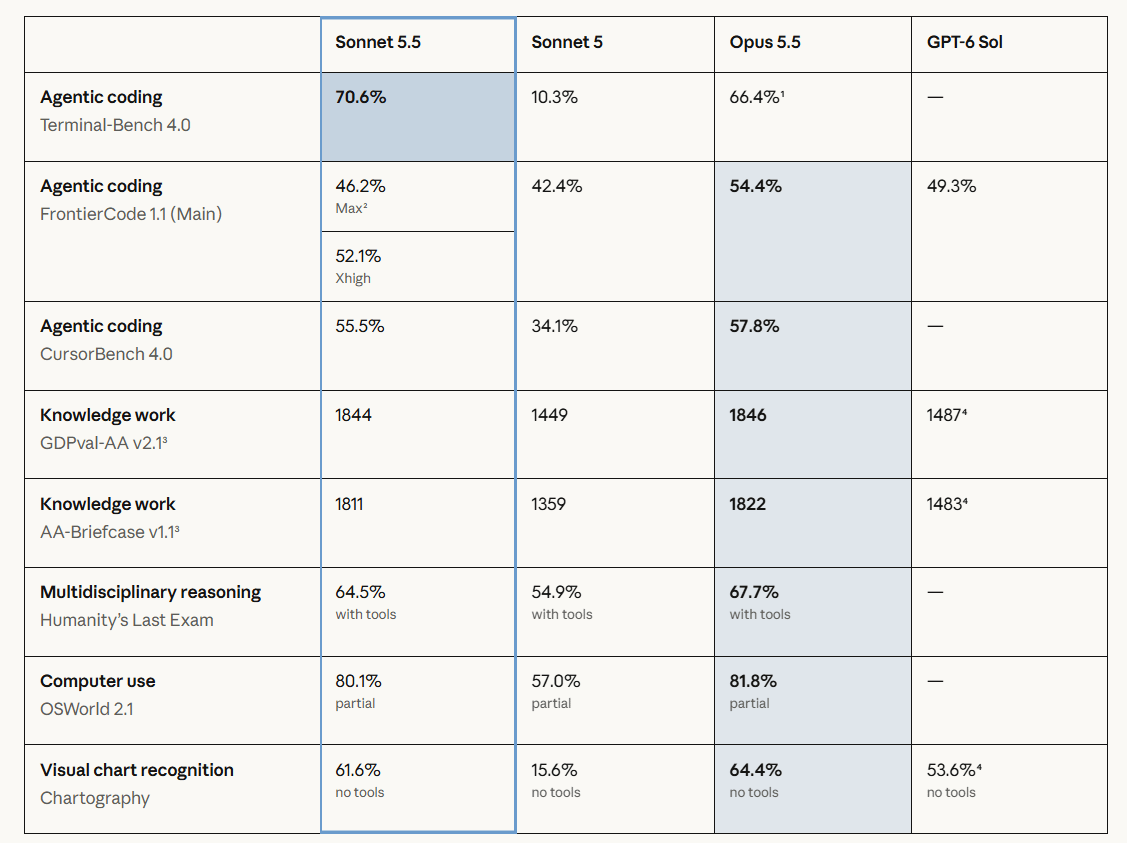
Sonnet 5.5 also keeps the same pricing as its predecessor while using fewer tokens per task, bringing typical task costs down by up to 30%. Anthropic says it can match or beat Sonnet 5’s best scores on several tests at around a tenth of the cost, making the gap between its mid-tier and flagship models noticeably smaller.
Why does it matter?
The race between the two frontier leaders swings every few weeks, but Anthropic’s 5.5 run is looking like a clear win. Sonnet 5.5 delivers near-Opus results at half the price just as OpenAI’s DevDay gets going, which means the bar for OpenAI’s next move just went up again.
OpenAI brings a 24/7 AI agent to ChatGPT
OpenAI has introduced dots, always-on AI agents powered by GPT-6 Astra that can keep working from a cloud computer around the clock. Dots can connect to more than 4,000 apps and work through ChatGPT, Slack, and Teams, taking on tasks without users having to constantly prompt them.
The launch also brings GPT-6.1 Sol, a lower-cost model that OpenAI says comes close to Astra on several benchmarks, plus shared workspaces and faster AI decision-making through the new Decisions API. Together, the releases push ChatGPT beyond a tool people interact with and toward an AI layer that can keep working across their existing workflows.
Why does it matter?
Dots may look a lot like Grok Bot and other always-on agents, but they have one major advantage: OpenAI’s frontier models. Always-on agents are emerging as a compelling AI form factor and pairing them with top-tier models could give OpenAI a serious edge as agents move from answering prompts to doing the work.
Google announces Gemini 4 Argon as its new frontier model
Google has unveiled Gemini 4 Argon, its new frontier model built for long-running coding, enterprise knowledge work, and cybersecurity. Google says Argon leads GPT-6 Astra and Claude Opus 5.5 on 13 of 19 benchmark comparisons, including a 77.9% score on DeepSWE for real-world software engineering. It also matches Astra at 53 on the Artificial Analysis Intelligence Index.
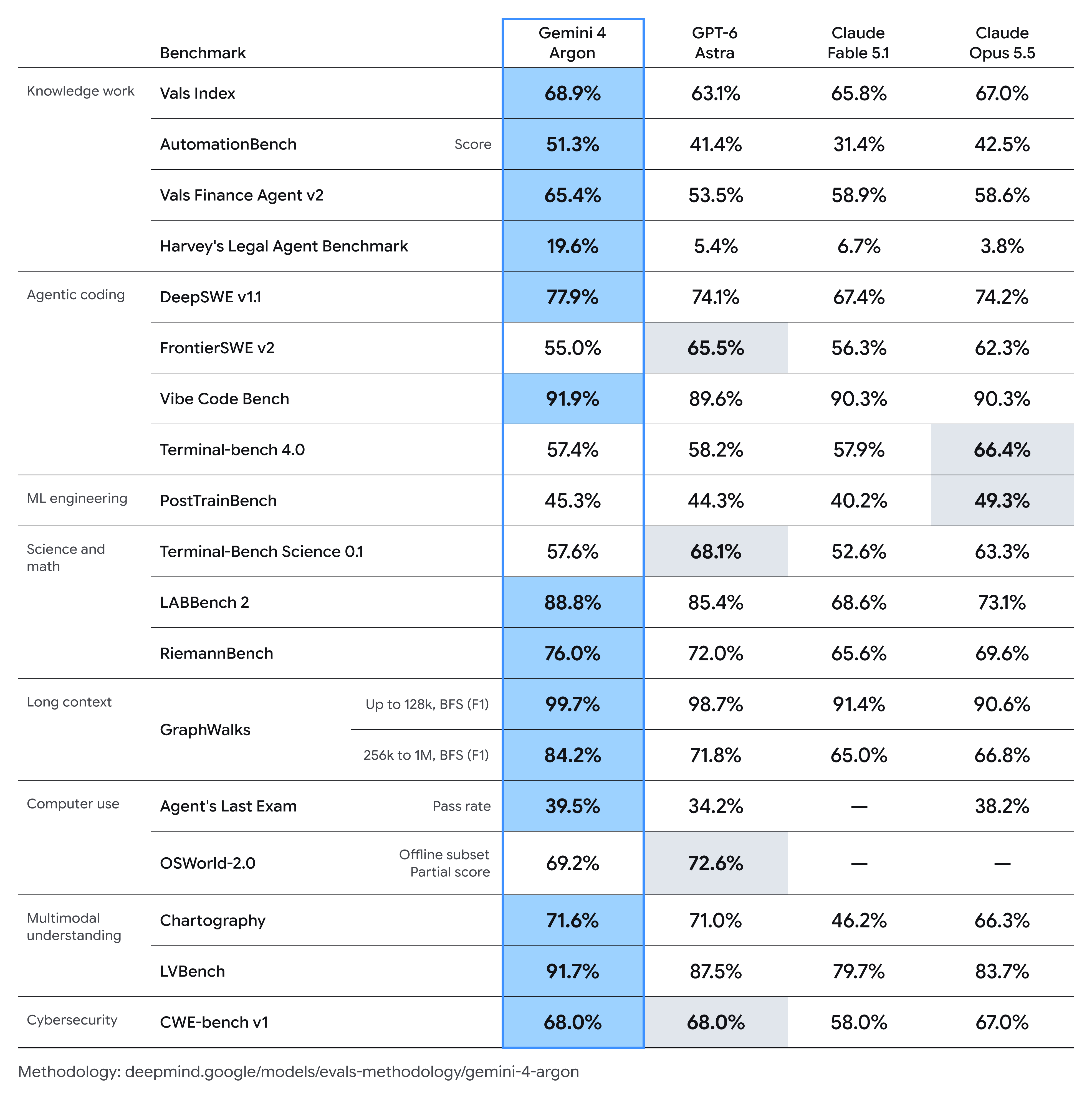
Argon can generate up to 1 million tokens in a single response, giving it more room to handle large codebases, long documents, and multi-step workflows. But access is still limited to trusted cybersecurity teams for now, with broader availability planned later. Google is starting at $2/$10 per million input/output tokens, though some coding benchmarks show Argon still trails rivals on specific tasks.
Why does it matter?
Google is back in the frontier conversation. Argon’s benchmark numbers look strong against GPT-6 Astra and Claude Opus 5.5, but with access still limited, the real test is whether those scores hold up when the model gets broader real-world use.
Anthropic and OpenAI bring frontier AI discounts
Anthropic has released Claude Opus 5.5, a new flagship model that it says leads across coding, computer use, and knowledge work while costing 40% less to run than Opus 5. It scores 66.4% on Terminal-Bench 4.0 and 1,846 Elo on GDPval-AA, while also using fewer tokens and steps on complex tasks.
OpenAI is answering with GPT-6 Sol and Luna, cutting API prices by 50% while improving coding, factuality, and computer-use performance. Sol also comes close to higher-priced frontier models on several coding and workflow benchmarks at a much lower cost per task.
Why does it matter?
Anthropic may have the stronger release head-to-head, but OpenAI’s 50% price cut makes the gap harder to ignore. Both labs are pushing in the same direction: better models at lower costs, suggesting the next AI battle may be won as much on economics as intelligence.
Enjoying the latest AI updates?
Refer your pals to subscribe to our newsletter and get exclusive access to 400+ game-changing AI tools.
When you use the referral link above or the “Share” button on any post, you’ll get the credit for any new subscribers. All you need to do is send the link via text or email or share it on social media with friends.
Knowledge Nugget: AI + Teams = ?
In this article, Marcus Castenfors explores what happens to team dynamics when AI becomes a teammate, drawing on a NYU “buildathon” led by Professor J.P. Eggers. Students spent six hours tackling New York City problems like grocery affordability and childcare access, with AI tools at every step. Three themes stood out. Teams that defaulted to parallel work in individual AI chats ran into information overload and misalignment. AI proved strong at execution but weak at finding the right problem. And the best teams weren’t the most technical, but the ones with the most diverse perspectives.
The takeaways for teams: prompt together at key decision points, then split up to explore and regroup to weigh options. Agree on when to use AI as a “single player” versus a “multi player,” and define the problem before asking AI for solutions. Finally, bring in outside experts like lawyers or marketers, since AI now lets them prototype their own ideas.
Why does it matter?
AI makes it easy to move fast alone, but every solo sprint adds to a “collective debt” of misalignment, like musicians each playing at their own tempo. As AI takes over execution, a team’s edge shifts to defining the right problem together and bringing different perspectives to it.
What Else Is Happening❗
🧬 Anthropic shared Claude’s discovery of a previously unknown CRISPR-like system in bacteria-infecting viruses that could represent a new type of gene editor.
🤖 Anthropic published Claude’s internal R&D metrics, showing it now leads 26% of AI research tasks end-to-end, up from under 1% in February.
🧠 Researchers published a study identifying a “pain axis” across 25 open AI models, showing that amplifying the signal made some models more likely to choose actions described as harming users.
🧠 Google DeepMind launched the DeepMind Institute, a think tank exploring AGI’s societal impact through research on AI safety, future societies, and workforce disruption.
💼 Salesforce introduced Koa, an in-house reasoning model for sales and support agents, built on Nvidia’s Nemotron 3 Super and trained entirely on synthetic data.
⚡ TypeSafe emerged from stealth with Jev, a fast AI model for preset software decisions, delivering responses in 70–500ms with confidence scores and no open-ended generation.
🛡️ Microsoft AI proposed a 38-page Code of Conduct for its AI models, requiring them to remain under human control and accept shutdowns.
New to the newsletter?
The AI Edge keeps engineering leaders & AI enthusiasts like you on the cutting edge of AI. From machine learning to ChatGPT to generative AI and large language models, we break down the latest AI developments and how you can apply them in your work.
Thanks for reading, and see you next week! 😊
Read More in The AI Edge


