
🎧 Audio version (or download audio for later):
Good Morning,
Dermot McGrath is an Irish entrepreneur and advisor based in Shanghai with over a decade in China. He founded ZenGen Labs, a research and strategy advisory firm focused on AI, robotics, energy and advanced manufacturing.
The firm helps Chinese companies expand abroad and Western companies build on Chinese innovation and supply chains. He previously co-founded and scaled a global VC fund to nine-figure USD assets under management, and has held roles at Chinese blue-chip conglomerates and investment firms. His research has been cited in Bloomberg, Forbes and Wired, among others.
ZenGen Labs Newsletter
Dermot and his team report on the ground in Shanghai and beyond, on how technology actually gets identified, built, and scaled. To get access to more research like this, subscribe for free. And follow him on LinkedIn.

Recent Articles by the author
-
From Turbines to Tokens
-
Space as a Service: China’s Alternative to the SpaceX Model
-
Building Trust at Grid Scale
-
The Printer Maker That Built a World Model
For more deep dives like this, consider supporting AI Supremacy and our numerous guest contributors. We’ve lowered our subscription price for a limited time.
Consider sharing this article if you know someone interested in the future of Physical AI, robotics, embodied AI and China’s role in its future.
The State of Chinese Physical AI
Five years ago a humanoid robot was a clumsy research tool that cost about the same as a new house. Today, for the price of a used car, you can order a humanoid that does kung fu and parkour, from a company in Hangzhou. That company is called Unitree (宇树) and it went public on the Shanghai stock exchange in August 2026 at a valuation of $50 billion.
Morgan Stanley estimates that by 2050 there could be more than 1 billion humanoids on the planet deployed in a range of scenarios including: * running the night shift in factories * stocking the shelves of your local supermarket * running warehouse fulfillment * cooking, cleaning and looking after the elderly at home.
To get anywhere near that future, someone has to build these bots. If current trends continue, most of them will be built in China.
Humanoids are one part of a much larger field now known as physical AI. These machines can perceive what is happening around them, reason about what to do, then act, all in the physical world. It spans self-driving vehicles, industrial robots, drones, quadrupeds, dexterous robotic hands, as well as the AI models that control them and the data systems used to train them. The Chinese term for this industry is 具身智能 (”embodied intelligence”, also called “embodied AI”).
China already leads in many of these fields. It is the world’s largest market for industrial robots, and DJI leads the global commercial-drone market, according to market research firm IMARC. China now operates the world’s largest combined robotaxi fleet, spread across companies including Baidu (百度), Pony.ai and WeRide. Crucially, its factories produce many of the motors, sensors, batteries, and precision components these machines rely on.
Humanoids get most attention, and most of the capital, because they make the loftiest promises. A robotaxi is built to drive, an industrial arm to perform tasks at a workstation. A humanoid, however, promises a general-purpose machine that can move from the factory floor to the warehouse, the shop and the home, carrying bricks, threading needles and everything in between.
But it takes more than just brawn. Despite the promise of a machine that can do almost any job, most humanoids still rely on human remote control or preset programs, according to Chinese technology publication TMTPost.
The companies that make them are raising obscene amounts of money anyway.
Half a century ago China was among the poorest countries on earth. Today its companies ship more humanoid robots than the rest of the world combined, supply many of the components other robot makers need, and are spending billions to teach these machines to think.
In this piece, we will examine how we got here, the current state of play from the body to the brain, where the money is going and what the future may hold.
First, how did China get so good at building these machines?
The Workshop of the World
When Deng Xiaoping, then China’s leader, began opening China in 1978, the path out of poverty was well trodden: industrialize. Leverage abundant labor and low-cost land to build factories and make the things the world needed. It had nearly a billion people and a long coastline where factories could ship to the world. Over the following decades it attracted foreign companies and accumulated infrastructure, manufacturing capacity and supply chains at extraordinary scale.
It also cultivated talent. Project 211, launched in the 1990s, concentrated resources on roughly 100 universities and key disciplines; Project 985 went further, pouring money into a smaller group including Tsinghua and Peking University with the explicit aim of building world-class research universities. Alongside them, a vast vocational system trained the technicians and skilled workers needed on the factory floor.
Rising incomes and high domestic savings helped finance infrastructure and industry through a largely state-controlled banking system. Foreign investment brought additional capital, technology and know-how.
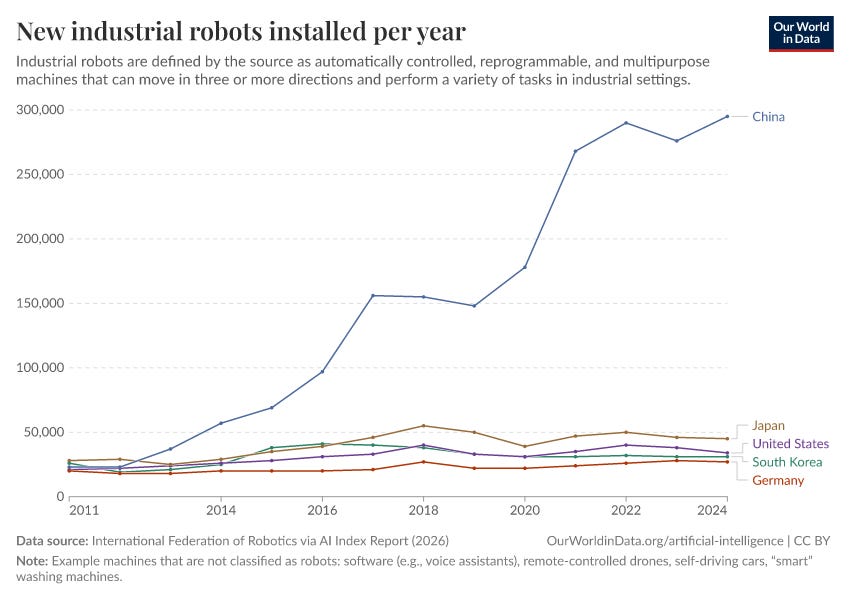
The country’s ambition grew in tandem. By then, China didn’t want to just make the best things, it wanted to make the best things that make the best things. Rapid industrialization had made it the world’s largest market for industrial robots, the machines needed to automate jobs such as welding, lifting and assembly on factory floors. Yet in 2014 roughly 72% of new installations still came from foreign suppliers, most of them German or Japanese. In May 2015 the State Council, China’s cabinet, published Made in China 2025, a national plan to upgrade domestic manufacturing, which ranked high-end machine tools and robotics among its priority sectors.
But how would it achieve this?
One route was to buy the capability. In 2016, appliance maker Midea launched a €4.6 billion takeover of German robot maker KUKA, causing an uproar in Germany over the loss of such a strategic technology. But the real progress was being made domestically. Local manufacturers were also building robots of their own by moving up the value chain. Nanjing-based Estun (埃斯顿) had expanded from industrial controls and servo systems into robots in 2012, reaching batch production two years later.
Made in China 2025 was delivering results. By 2025, Chinese brands accounted for more than half the domestic industrial-robot market, and Estun had become the country’s best-selling brand, ahead of its foreign rivals.
In 2024 alone, China installed 295,000 new industrial robots, more than the entire rest of the world combined.
This created an expansive network of manufacturers and suppliers, from raw materials to components and finished machinery.
The Supply Chain
As China industrialized, every new factory needed machinery, and that machinery needed parts. Car production lines, packaging equipment and machine tools all depended on firms that could work metal, make motors and build the electronics that controlled them.
At its base was precision metalworking. Machinery needed shafts to transmit rotation, bearings to support moving parts while reducing friction, and housings to hold the mechanism together. Ningbo Yichuang (宁波一创) spent years machining metal parts for the automotive industry. Parts like these need tight tolerances so the finished mechanism runs smoothly.
Electric motors drew on another layer of suppliers. Inside a permanent-magnet motor, current in copper windings creates a magnetic field that interacts with the magnets to produce rotation. Making those magnets was a specialist business of its own. Dongguan Juxin (东莞聚鑫), founded in 2009, manufactured such magnetic materials, including magnets and magnetic rings.
Motors needed electronics to tell them how far and how fast to turn. Leadshine (雷赛智能), founded in Shenzhen in 1997, developed motion-control cards and servo drives. The cards send movement commands; the drives adjust the electrical power supplied to the motors to carry them out. Coordinating a whole machine required another kind of controller. Hechuan Technology (禾川科技), or HCFA, began with programmable logic controllers, industrial computers that read sensors and run equipment through a programmed sequence of actions. Its early applications included textile looms, air-conditioning systems and tower cranes. It later added motors and servo drives of its own.
Some suppliers began developing more sophisticated products from the manufacturing expertise they already had. Precision reducers are gear mechanisms that turn a motor’s fast rotation into slower movement with more turning force (kind of like the gearbox in a car), allowing it to move a heavier load. Leaderdrive (绿的谐波) grew out of Hengjia Metal (恒加金属), whose machining business supplied parts to the industrial groups ABB and General Electric. Its founder, Zuo Yuyu, decided in 2003 to develop products of his own and chose harmonic reducers after a research trip to Japan. He drew on the company’s machining and quality-control experience to enter a market dominated by foreign suppliers. Reducer sales began in 2013.
That industrial base gave entrepreneurs a chance to pursue an ancient ambition.
The Dream
The dream behind the humanoid is older than the robot itself. To build a machine that can free humanity from the yoke of physical labor. More than two thousand years ago, Aristotle imagined tools that could work by themselves, though he framed it as an impossibility, using it to explain why masters still needed slaves. Da Vinci later tried to reproduce the mechanics of the human body in his mechanical knight, the Automa cavaliere. In 1920, Czech writer Karel Čapek finally gave these artificial workers a name. He imagined “robots” that would free people from toil (albeit before turning on their creators).
Engineers eventually began building versions of that dream. Japan’s Waseda University unveiled WABOT-1 in 1973, widely considered the first full-scale humanoid; Honda introduced ASIMO in 2000. In the US, Marc Raibert studied how machines could balance and move, progressing from one-legged hoppers to bipeds and quadrupeds. He founded Boston Dynamics in 1992. In 2005 it built BigDog, a four-legged robot designed as a mule for rough terrain.
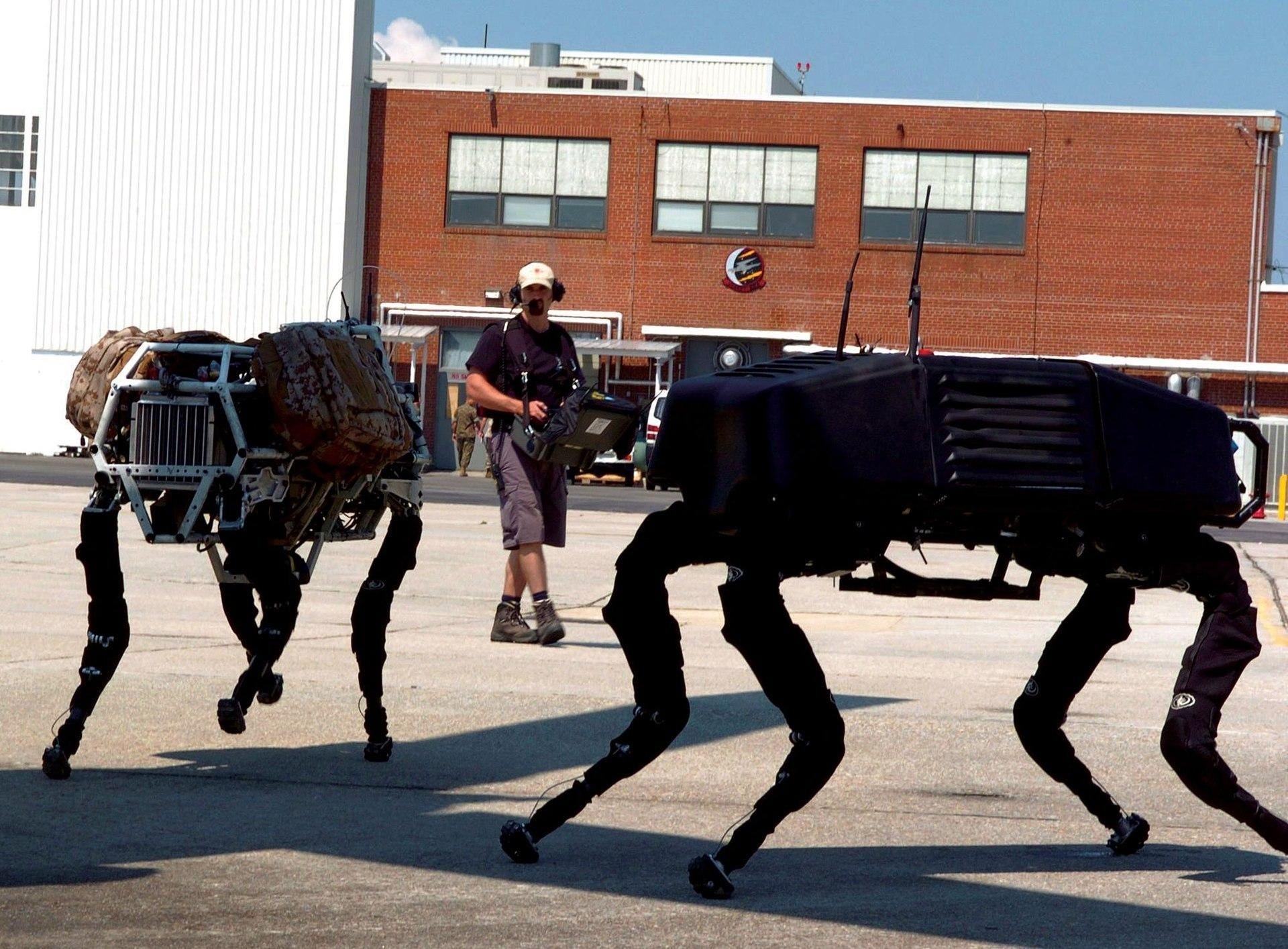
By the 2000s, these machines were capturing the public imagination. Videos of Raibert’s early robots, and later those of Boston Dynamics, were spreading on the internet. While the robots themselves didn’t make it into the hands of many consumers, they would inspire engineers around the world.
Particularly in China.
How China Built the Body
The first wave (2012-2016)
By the late 2000s, China had factories that could machine gears, wind motors and make custom parts quickly and cheaply. For the first wave of humanoid founders, that was an environment ripe for experimentation, though each had to find a way to make a business out of it where Boston Dynamics and Honda failed.
Unitree: A different breed
Wang Xingxing was born in 1990 and grew up in Yuyao, in Zhejiang province near Shanghai. At the age of ten, he saw footage of Marc Raibert’s robots and was amazed. From then on, he knew what he wanted to do with his life. Better with his hands than his books, he tried building a miniature turbojet engine in junior high while, by his own account, achieving a passing grade in English only about three times in all of high school. He still made it to university.
As a first-year student at Zhejiang Sci-Tech University in 2009, he built a two-legged robot himself for about ¥200 (~$30). As a graduate student at Shanghai University in 2013, he started work on a four-legged robot. Boston Dynamics’ BigDog used hydraulics. Wang chose electric motors, aiming to make a capable quadruped simpler and cheaper to build. He bought the motors, designed the motor drivers himself, and delayed graduation by six months to finish “XDog”.
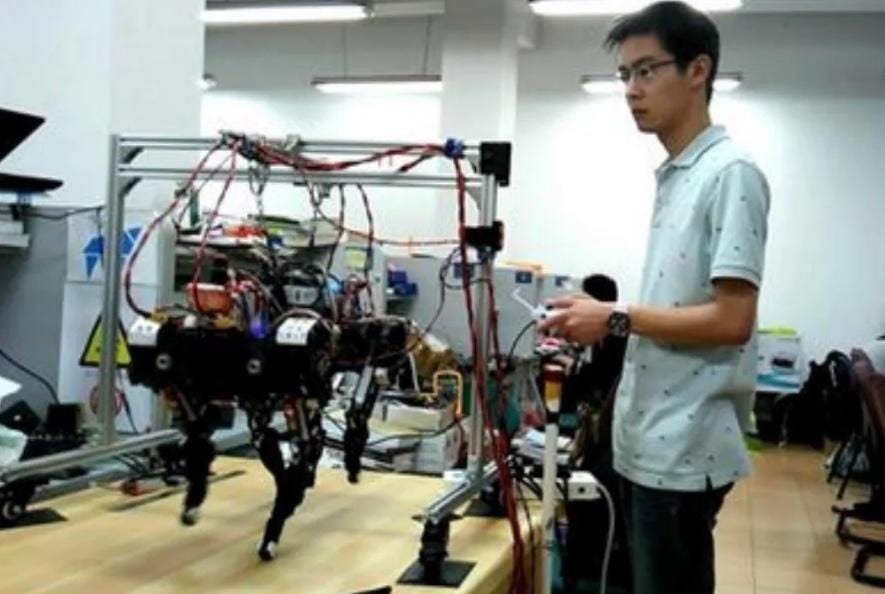
When Google put Boston Dynamics up for sale in 2016, Wang joked on Zhihu (知乎, like a Chinese Quora): “Luckily Google had no plan to develop a low-cost electric quadruped, or my research project would have been completely pointless.”
After graduating, he took a job at drone maker DJI. During his probation, fate came calling. A test video of XDog was picked up by overseas media, and people began contacting him to buy one or to invest. So he quit. He founded Unitree in Hangzhou in August 2016 on ¥2 million (~$300,000) of funding. Investors kept asking whether he would build a humanoid, but he kept putting it off. He believed nobody’s control technology was good enough yet to make one useful. Unitree began selling its first robot dog, Laikago, for about $20,000 in 2017.
His early customers were research labs that wanted cheaper robots they could modify for their own work. He deliberately stayed out of the consumer market while he worked to make the dogs more capable and affordable. In 2018 the money nearly ran out, a planned follow-on investment fell through, and he stopped paying himself.
But he stuck to the plan. When Boston Dynamics began selling Spot in 2020, it cost $74,500, more than three times Laikago’s launch price. By July 2023, Unitree’s Go2 Air had become, by Unitree’s account, the first robot dog priced under ¥10,000 (~$1,500).
Standing tall
That year, Wang reversed course on humanoids. Breakthroughs in AI had set off a boom in humanoid development. Drawing on their work with robot dogs, three full-time staff developed Unitree’s first humanoid, the H1, in about six months. It launched in August 2023.
Unitree designed and assembled components using parts from other manufacturers. Its IPO filing names Dongguan Juxin as a supplier of magnets. It also outsourced some motor winding. Automotive-parts machinist Ningbo Yichuang supplied shafts to transmit rotation, connecting rods to transfer movement, and carriers to hold gears in position.
Most suppliers were small and medium sized factories in Jiangsu, Zhejiang and Shanghai, according to the Chinese financial magazine Caijing (财经). Local officials helped connect Unitree with nearby bearing, motor and electromechanical-parts makers in 2024.
In January 2025, 16 Unitree humanoids danced their way onto the world stage at the Spring Festival Gala, the Lunar New Year show on state TV watched by more than a billion people. The G1 launched in China at ¥99,000 (~$15,000), followed by the $5,900 R1 in July 2025. It shipped more than 5,000 humanoids that year.
Its robot dogs are used for performances, promotions, industrial inspection and emergency response; its humanoid business is still weighted toward research. In the first nine months of 2025, research and education provided nearly three quarters of humanoid revenue, commercial uses such as promotions and performances most of the rest, and industrial uses around 9%.
UBTech: The affordable joint
Zhou Jian originally made his fortune supplying China’s factories. Born in Shanghai in 1976, he studied at Nanjing Forestry University, joined German woodworking-machinery maker Weinig, then became its Chinese distributor, selling to the rapidly industrializing nation. Before thirty he had houses, cars and tens of millions of yuan. At a trade show in Japan in 2008, he came across small humanoids that, while fascinating, cost thousands of dollars. He wanted to bring humanoid robots into ordinary homes and wondered whether Chinese technology and suppliers could make one affordable for families.
That same year, he began developing humanoid robots in Shanghai with a few friends, first buying foreign robots and disassembling them. Their main challenge was the servo (a motor, gears, sensors and control electronics combined into a joint that can move a limb to the right position). By Zhou’s account, imported servos could cost more than $100 each at the time, and a small humanoid needed more than a dozen. His team traveled south for tooling and parts. In Shenzhen, in late 2009, he found factories that could make the custom gears he needed. He recalled getting parts at least 50% faster and about 30% cheaper than elsewhere, so he decided to move there.
Even with those suppliers, Zhou spent ¥20-30 million (~$3-4.5 million) between 2008 and 2011 without producing a working joint. He sold his cars and even some property to keep going. His team eventually built a working servo, and he registered UBTech in March 2012. By 2016, the company said, servos made in Japan and Switzerland typically cost $50-100 each. UBTech made its own for about ¥20 (~$3).
That allowed UBTech to build Alpha, a small humanoid selling for a few thousand yuan. In 2016, 540 Alphas danced at the Spring Festival Gala, nine years before Unitree’s humanoids would take the stage.
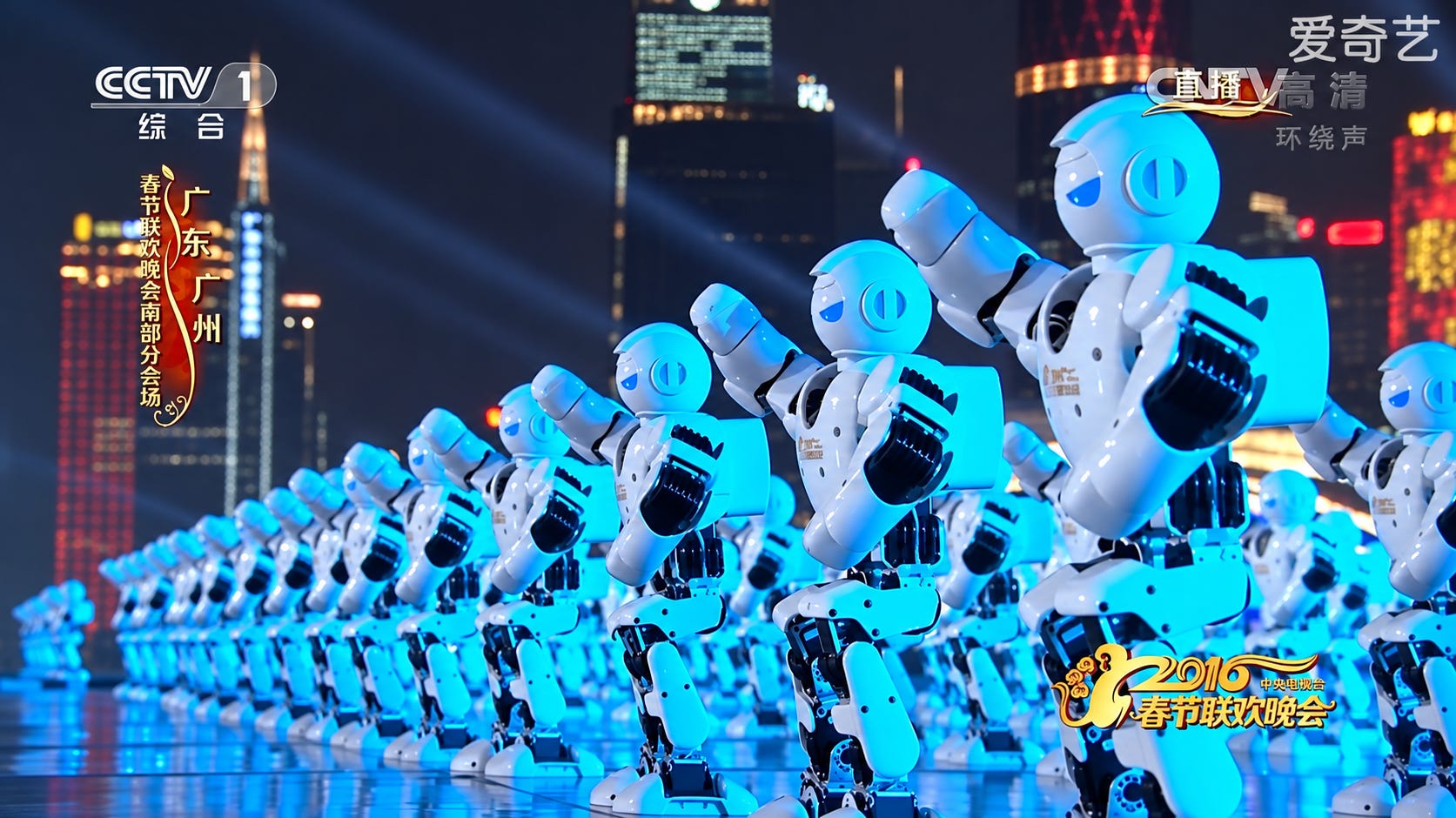
Alpha and its Jimu robot-building kits had brought in nearly ¥60 million (~$9 million) the year before, and in 2018 Tencent led an $820 million funding round. Toys and education gave the company a business while it developed larger machines. UBTech listed in Hong Kong in December 2023; its Walker S industrial humanoids began training in car factories the following year. In 2026, it also launched the U1, for companionship, staying true to its original ambition to put a robot in the home.
Factory sold separately
Making its own joints still meant buying specialized components. By 2017, UBTech was buying harmonic reducers from Leaderdrive. UBTech could combine the reducers with motors, sensors and controls in its own joints.
It is now buying manufacturing capacity too. In April 2026, UBTech completed its acquisition of a 43% controlling stake in Fenglong (锋龙), a maker of garden-machinery, automotive and hydraulic parts. Fenglong’s existing skills included casting and machining aluminum parts and assembling circuit boards. In June, Fenglong disclosed plans to supply up to ¥81 million (~$12 million) of electromechanical components to UBTech in 2026.
UBTech’s industrial range now centers on machines such as Walker S2, which it says can carry 15 kilograms and change its own battery in three minutes.
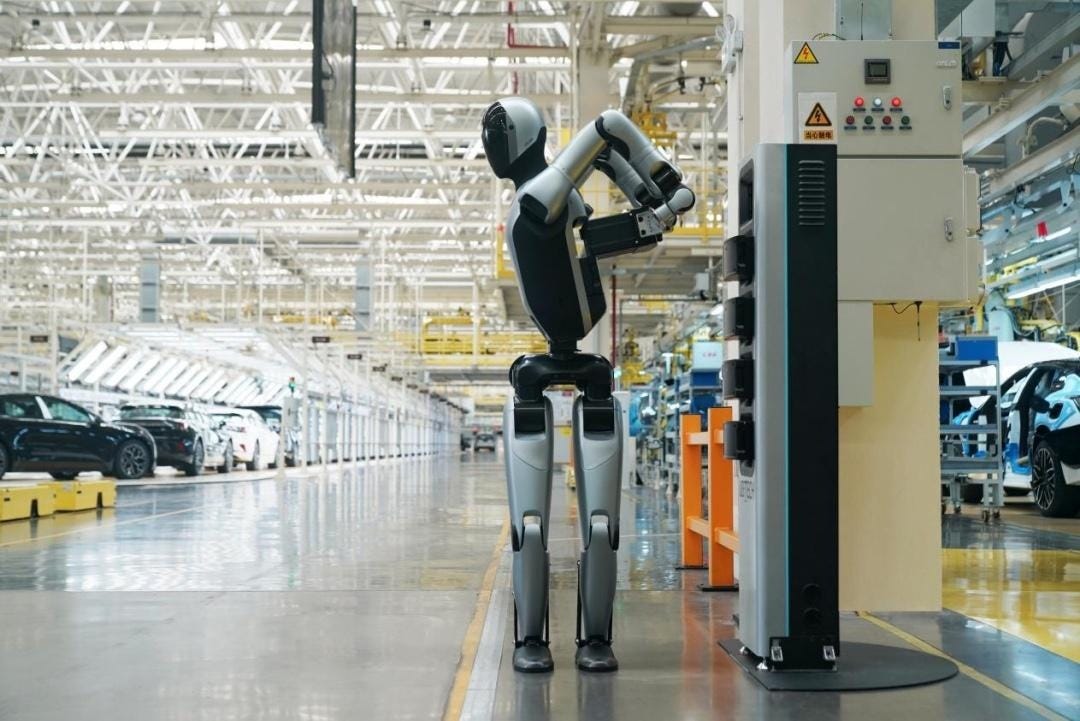
In January 2026, UBTech announced that Airbus had bought Walker S2 robots for its manufacturing plants. In total, UBTech sold 1,079 full-size humanoids in 2025 and 921 in the first half of 2026, across several applications.
As UBTech expanded its manufacturing capacity, it also faced a growing field of competitors. ChatGPT’s arrival in late 2022 had encouraged another generation of founders to explore what advances in AI could make possible for robots.
The second wave (2023-2024)
AgiBot: A robot for every occasion
In 2021, Peng Zhihui was gaining a following posting his hardware projects on Bilibili (哔哩哔哩, China’s YouTube), under the name Zhihui Jun (稚晖君). After falling off his bicycle on the way to work, he spent four months building one that could balance and steer itself. Another project was a miniature robotic arm precise enough to stitch a grape’s skin.
He worked at phone maker OPPO and then Huawei (华为), researching AI chips and algorithms. ChatGPT launched in November 2022. The next month, he left Huawei to start his own business, co-founding AgiBot in Shanghai in February 2023. His co-founder Deng Taihua had run Huawei’s computing business; Peng became chief technology officer, while Deng would become CEO.
By August 2023, the team had built its first humanoid, the A1, initially intended for electronics and car manufacturers. A human-shaped body could use tools and equipment designed for people. The team designed its own hands and joints, using liquid cooling to prevent overheating during sustained work, then worked with specialists to turn those designs into production hardware. Industrial motion-control company Leadshine helped develop motors that fit directly inside the joints, from defining the product through to mass production.
Proximity helped. In March 2026, AgiBot executive Wang Chuang said many mass-production problems could be solved without leaving Shanghai, with some core suppliers no more than an hour’s drive away.
Its earliest commercial deployments were in shopping assistance and guided tours, led by the smaller Lingxi (灵犀) humanoids, which also performed at events. Lingxi remained its largest series by shipments through June 2026. AgiBot developed different machines for different jobs: its full-size Yuanzheng (远征) robots explained exhibits, welcomed hotel guests and guided visitors, while the wheeled Genie G2 was designed for electronics manufacturing and warehouse sorting.
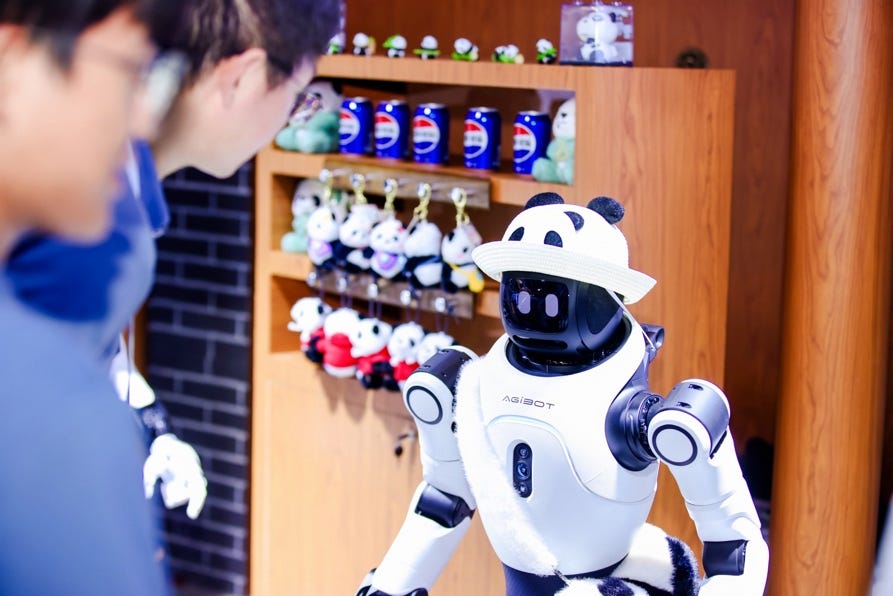
Citing market research firm Omdia, AgiBot reported more than 5,100 humanoid shipments in 2025. In June 2026, it livestreamed its wheeled G2 robots inspecting tablet computers over six days.
Galbot: From research to retail
In September 2021, Wang He joined Peking University as an assistant professor after completing his PhD at Stanford. In March 2023, Google unveiled PaLM-E, an AI model that combined images and language to help guide robots. It convinced Wang that such models could lead to more general-purpose machines. Wang knew the research but lacked experience in manufacturing and fundraising. In May 2023, he co-founded Galbot in Beijing with Yao Tengzhou, whose experience at ABB’s Shanghai robotics research center complemented Wang’s research background.
Galbot built its first robot, the G1, to fetch goods from shop shelves. It has two arms on a wheeled base and a body that moves up and down to reach different heights. Its hands can be swapped between grippers, suction cups and dexterous fingers. The team focused on the less glamorous skills of moving, picking up and placing goods rather than showy demonstrations. Wang said wheels suited customers’ work better and offered longer battery life and less noise than legs.
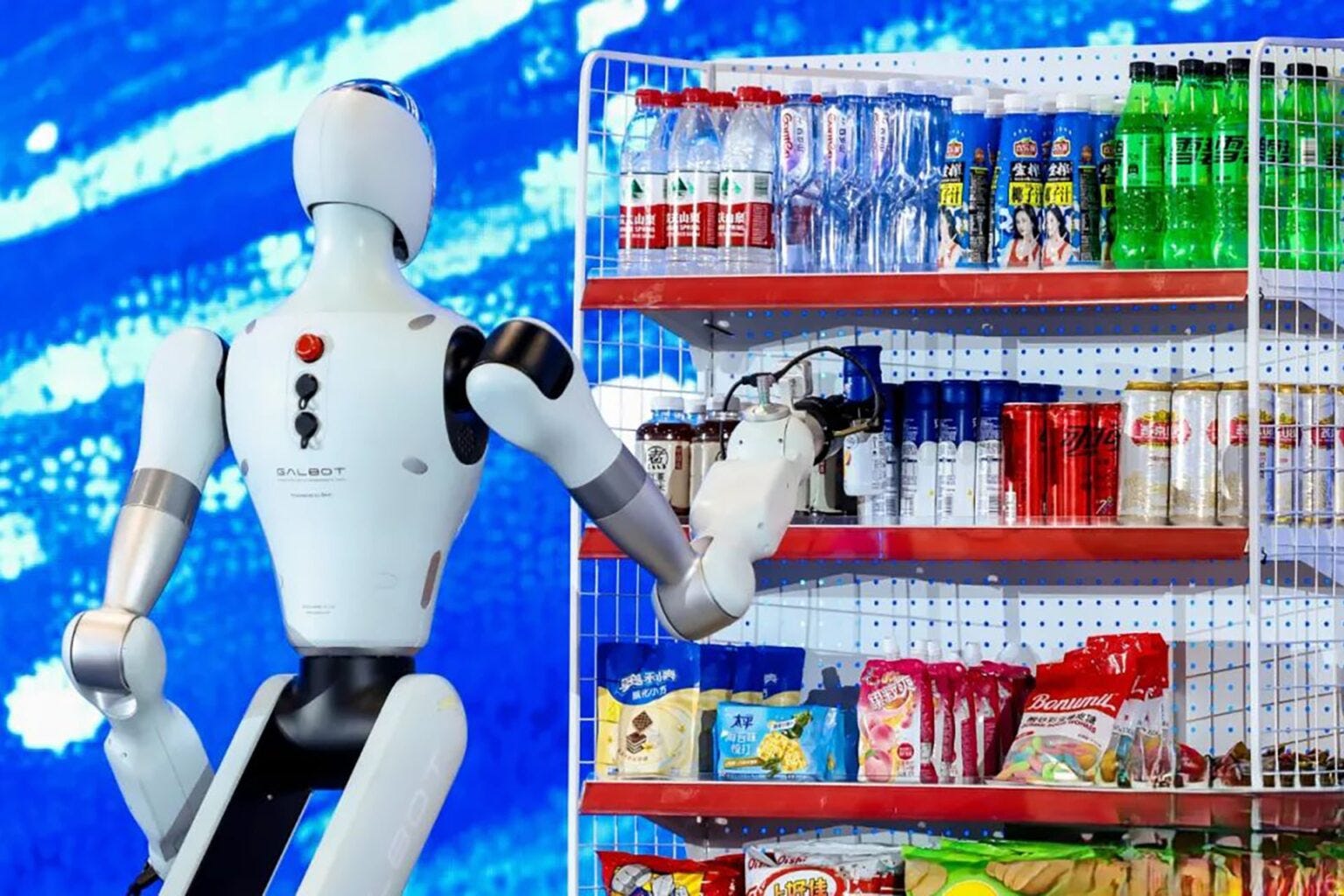
Galbot also bought robot dogs, humanoids and components from Unitree to develop and train its AI and adapt the machines for resale. Its clearest commercial foothold is retail: by September 2026, it reported more than 170 automated convenience-store locations across over 40 cities.
More fighters enter the ring
Other Chinese robot makers are finding customers in entertainment. First is Shenzhen’s EngineAI (众擎). It recently went viral for its URKL humanoid fighting league, which opened in July, using its full-size T800 robots. At the Shanghai event on September 19, thousands of spectators watched the machines trade blows. One even kept fighting with a damaged head (who wouldn’t want to see that?).
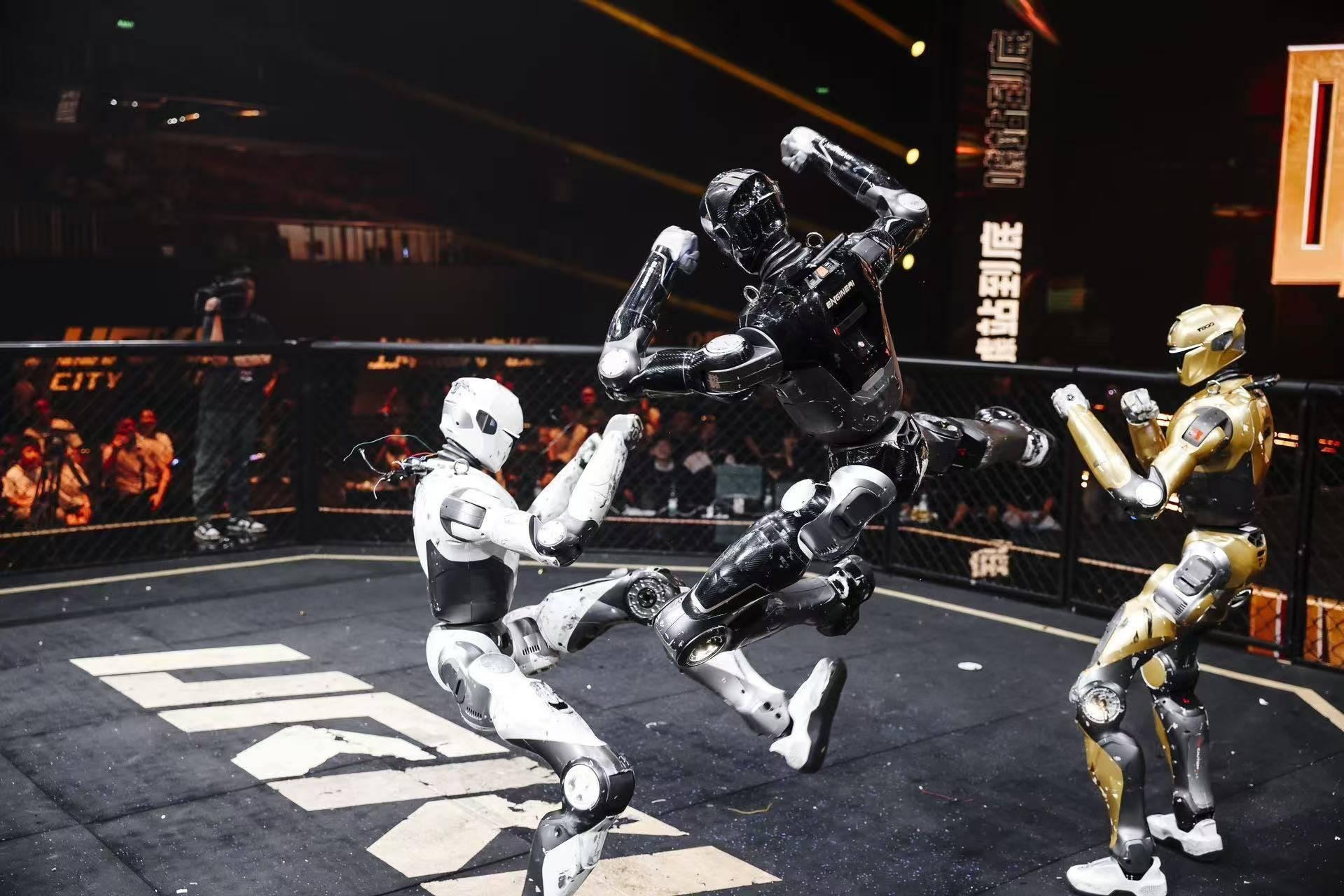
Perhaps entertainment will be an early killer use case. League rules give every team a human operator, so a robot that cannot yet work a factory shift can still put on a show for people.
Carmakers are entering too, bringing depth in manufacturing, quality control and vehicle AI. XPeng announced on September 8 that its new IRON humanoid had walked off a newly commissioned production line. XPeng’s initial applications are visitor tours, sales assistance and patrol duties, with deployment starting at its own stores and company sites before planned external deliveries in 2027.
For the robots being asked to fetch goods, handle factory parts and eventually help around the home, getting into position was only the beginning. To actually do the work, they needed capable hands.
The last centimeter
Think of a human hand. It can do everything from dumbbell curls to sewing to cracking eggs (and, equally importantly, not cracking them). Take something as simple as using a screwdriver. The hand has to turn it without dropping it, keep it lined up with the screw and adjust for slip and gravity, all at once.
A robot has to reproduce that control with motors, mechanical parts and sensors, coordinating its fingers and adjusting its grip before an object slips or gets crushed.
Need a hand?
A specialist market has grown around making these “dexterous robot hands”. Major overseas suppliers include Britain’s Shadow Robot and Singapore’s Sharpa; Chinese suppliers include Linkerbot and Inspire Robots, while AgiBot sells its own OmniHand. Chinese brokerage TF Securities estimated that there were more than two dozen Chinese hand makers in 2025. Research firm Gaogong forecasts 70,000 hand shipments in China in 2026. In Gaogong’s 2025 ranking of Chinese hand shipments, Inspire led, with Linkerbot and BrainCo tied for second.
I spoke to Forbes in August about Linkerbot (灵心巧手), a Beijing startup founded in 2023. Its six hand models ranged from about $980 to $14,700, from basic grasping to precise finger movements. Its April funding round valued it at $3 billion. Its L30 uses cables that act like tendons to move the fingers. Sensors measure position and touch, while the controller adjusts tension. Robot hands need miniature versions of the motors, reducers and precision parts we met earlier in the supply chain. As I explained to Forbes, Linkerbot makes many key components internally, helping it control costs and iterate faster. It also buys from specialist suppliers: in February, it ordered 100,000 sets of tactile sensors from Chinese materials maker Fulai.
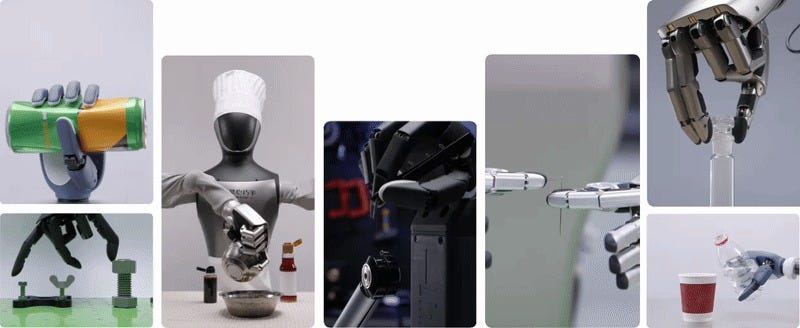
China has become a major source of the hands other robot developers need. Linkerbot’s chief executive told Reuters it held over 80% of the global market for high-degree-of-freedom hands, which can make more independent movements and so move more like human fingers. He also said many customers attached its hands to existing robot arms. This is important because Linkerbot’s fate is not necessarily tied to the broader humanoid rollout. With specialist suppliers like Linkerbot selling ready-made hands, other developers can focus on teaching robots to use them rather than designing a hand from scratch.
So from head to toe, China dominates a lot of the hardware. MERICS, the Berlin think tank, now puts China at about 63% of the key companies in the humanoid supply chain worldwide. But to put all that hardware to work, these machines need a brain that can make sense of their surroundings and decide what to do.
The brain
The Tin Man in The Wizard of Oz went looking for a heart. He could afford to, because walking around Oz and swinging an axe, he had already nailed perception and motor control. The tin men of today aren’t so lucky.
“Put the cup in the sink” is a short instruction with a lot of baggage. A robot must identify the cup, grasp it and carry it without spilling. If the grasp fails, it has to adapt, lest we cry over spilled milk. Writing a rule for every variation is impractical, if not impossible, so developers use machine learning.
Developers are exploring several approaches, which can overlap:
-
Vision-language-action models (VLAs) turn camera images, instructions and the robot’s current state into movement commands. They learn from demonstrations and can draw on pretrained models’ knowledge of objects and language. Fresh observations let them adjust their actions as they work, rather than replay a fixed sequence.
-
World models learn representations of physical environments. Predictive models estimate what happens next, such as how a cup moves when pushed, helping robots compare actions. The broader category includes spatial models: Fei-Fei Li’s World Labs generates 3D environments and combines them with simulation for robot training and testing.
-
World-action models (WAMs) learn to predict movements and their consequences together. Given the instruction to move a cup, a model predicts both the robot’s actions and how the scene changes. Learning from video could help it handle unfamiliar situations with fewer demonstrations of each particular task.
These approaches can also use reinforcement learning: feedback on previous attempts helps train the robot to favor actions with better outcomes.
Companies are pursuing different combinations of these approaches, some developing brains for their own robots and others building models for other manufacturers to use.
The mind makers
-
Spirit AI, founded in 2024, develops models alongside its own robots and uses around 1,000 contractors to record human activity for training. By September, it had tens of Moz1 robots deployed at battery maker CATL and e-commerce group JD.com.
-
AgiBot collects demonstrations on real robots. Its 2025 AgiBot World project released more than a million recorded task attempts across 217 tasks, alongside the GO-1 model trained on them.
-
Galbot uses simulation: its GraspVLA trained on a billion frames of synthetic grasping data before being tested on real robots. It also develops AstraBrain-WAM, a world-action model, alongside models for whole-body control and dexterous hands.
-
Alibaba’s DAMO Academy, the group’s research lab, builds RynnBrain on its Qwen models to help robots locate objects and plan interactions. The team tested robot-action models on other manufacturers’ machines, including Unitree’s G1.
-
Robbyant, the robotics arm of Alipay parent Ant Group, released its LingBot-VLA model and training code, drawing on robot recordings and human video. Its world-action model, LingBot-VA 2.0, combines predictions of future scenes with robot actions.
American developers are pursuing similar approaches:
-
World Labs, co-founded by Stanford AI researcher Fei-Fei Li, builds models of 3D environments. It introduced Atlas in September, initially for selected partners, and is developing simulated worlds for robot training. It announced a $1 billion funding round in February.
-
Physical Intelligence, a San Francisco startup, trains models across different machines using demonstrations, human videos and autonomous practice. Its π0.7 model demonstrated laundry folding and espresso making, including transferring laundry-folding skills to a different robot.
-
NVIDIA supplies both models and infrastructure. Its GR00T models learn robot skills from real and simulated demonstrations, its Cosmos and Isaac tools help developers create and test training environments, and its hardware trains and runs these systems.
It’s noteworthy that several of these companies are releasing models and code that others can download and adapt, much as DeepSeek and Alibaba’s Qwen have done with language models. NVIDIA and Physical Intelligence release some robot models too. For robot manufacturers, this offers a way to develop their machines’ capabilities without training a model from scratch or depending entirely on one model provider. The companies releasing the models may benefit if other developers improve them, build compatible products or buy their hardware and computing services. Will be interesting to see how the commercial side plays out.
Regardless, adapting these models to new robots and tasks often requires more training data, and China’s manufacturing base can help developers collect it. Affordable robots make recording demonstrations cheaper, while factories offer real tasks on which to test the robots and record how they perform. Many companies and local governments are even investing in dedicated training grounds, where robots practice tasks while their movements and sensor readings are recorded.
Robot school
At Jufu Technology (具福科技)’s data-collection factory in Fuzhou, in Fujian province, an April report described nearly 30 robots practicing tasks such as stacking paper cups, wiping tables and sorting fruit and vegetables. Operators use VR headsets and handheld controllers to guide the robots while cameras and sensors record their movements, joint angles and gripping force. They vary the cups, tables and tablecloths so the training covers more than one fixed setup. AgiBot runs a similar facility in Shanghai’s Pudong district, with settings modeled on homes, shops and workplaces. Such factories have popped up all over China.
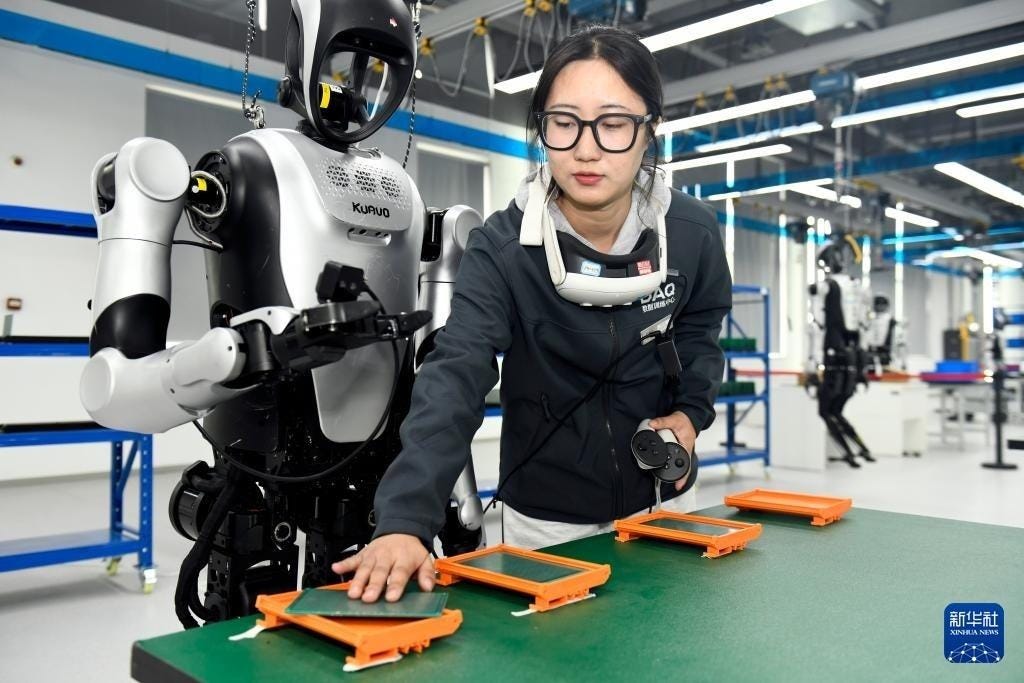
The industry calls these sites 训练场 (”training grounds”). By the end of June, more than 70 were operating across China and 46 more were under construction or planned, according to a report co-published by the China Academy of Information and Communications Technology. Some are company-run; AgiBot has built or signed nine. Others receive government support through land, funding or favorable policies. Equipping these centers also brings orders for robot makers. In November 2025, UBTech won a ¥264 million (~$39 million) contract, mostly for Walker S2 robots, to equip a data-collection center in Fangchenggang, Guangxi, and an AI education project.
A site covering a few thousand square meters costs tens of millions of yuan to more than ¥100 million (~$15 million) to build, with robots the largest single cost. The report estimates that a ¥50 million (~$7.5 million) site producing 100,000 hours of data a year would need more than three years to recover its construction cost from data sales alone, even if it sold all the data it produced.
China’s manufacturing advantages make collecting data and testing robots cheaper. But turning that advantage into better models still depends on the variety and quality of the data, and whether the skills learned transfer to unfamiliar tasks and machines.
Selling skills
The robots themselves are becoming more affordable. Unitree’s G1 launched at ¥99,000 (~$15,000) in China in May 2024; its advertised starting price there is now ¥85,000 (~$13,000). As hardware gets cheaper and competition intensifies, manufacturers are exploring software and skills as sources of recurring revenue and potentially higher margins.
The idea is to keep earning from a robot after the initial sale by charging customers for new abilities. At its May earnings call, XPeng’s management described working with partners on models for different jobs, which customers could download and activate, and plans for software subscriptions. The company still expects to earn a healthy margin on hardware.
Hand makers are developing skills for their hardware too. Linkerbot’s founder Zhou Yong sees hand skills as a way to distinguish its products. Alongside the hands themselves, it is developing models to control them and a library of more than 500 hand skills.
Imagine one day downloading a skill that lets your kitchen robot cook like a Michelin-starred French chef, or subscribing to it for one evening a week. The machine could be a humanoid or a pair of robotic arms with capable hands. You would keep the hardware and pay for new things it could do, much as you install apps on a phone today.
China’s manufacturing base gives its companies an advantage in building affordable robots. But if software and skills become lucrative businesses, much of the profit could go to the developers who teach those machines what to do. Those developers may be the robot makers themselves, or other companies selling skills for their hardware.
Developing those bodies, hands and brains requires substantial investment before companies can earn the recurring revenue they envisage.
The finances
Investors have supplied much of that money. How close are the companies to paying their own way?
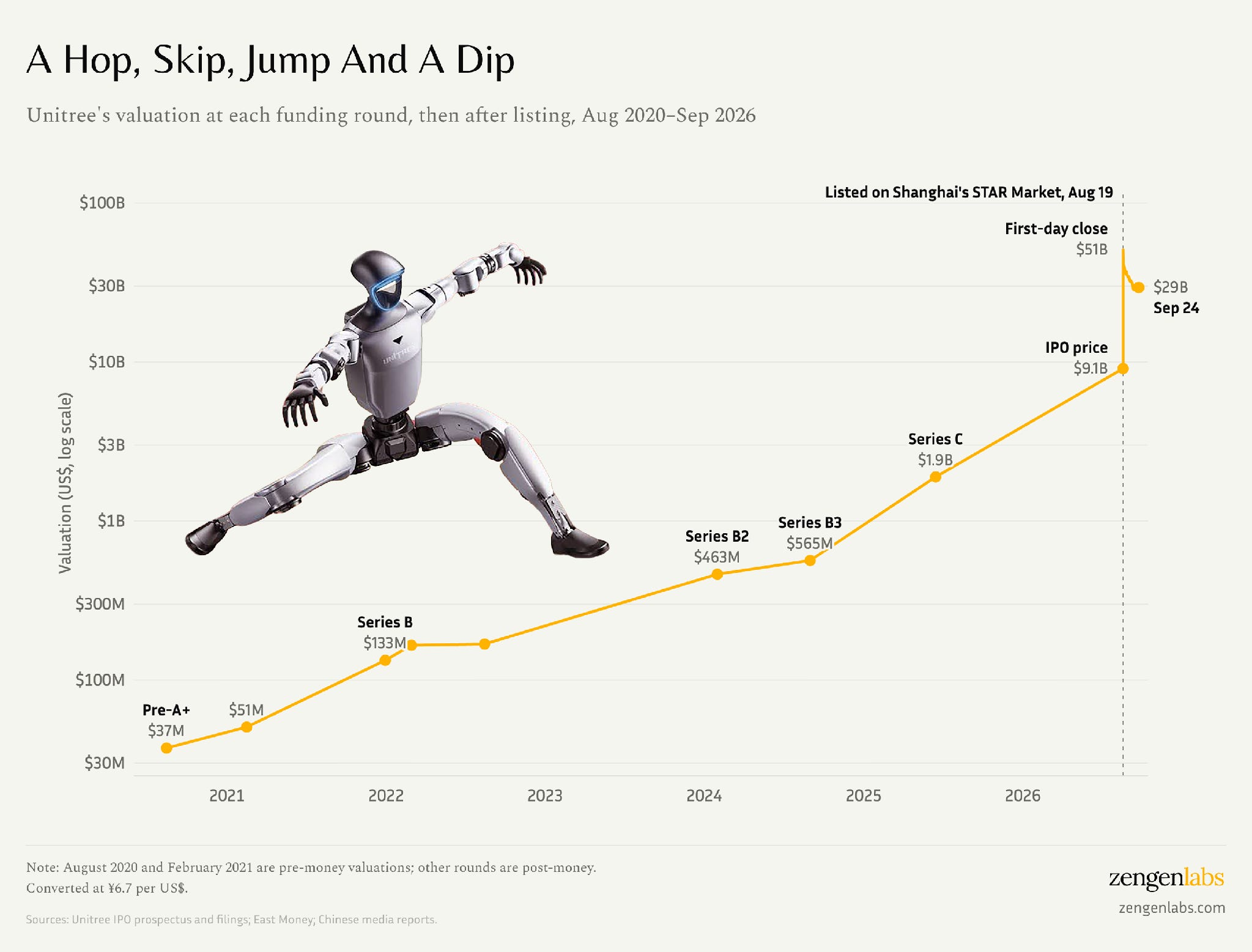
Unitree makes money. Revenue reached ¥1.7 billion (~$250 million) in 2025, more than four times the year before. In the first half of 2026, revenue rose 49% to ¥1.15 billion (~$170 million) and net profit was ¥274 million (~$41 million), although profit excluding one-off items fell 19% as research and marketing spending grew. Its August Shanghai listing raised about $905 million. By September 24’s close, its shares had fallen 42% from the first-day close, leaving a valuation of about $29 billion.
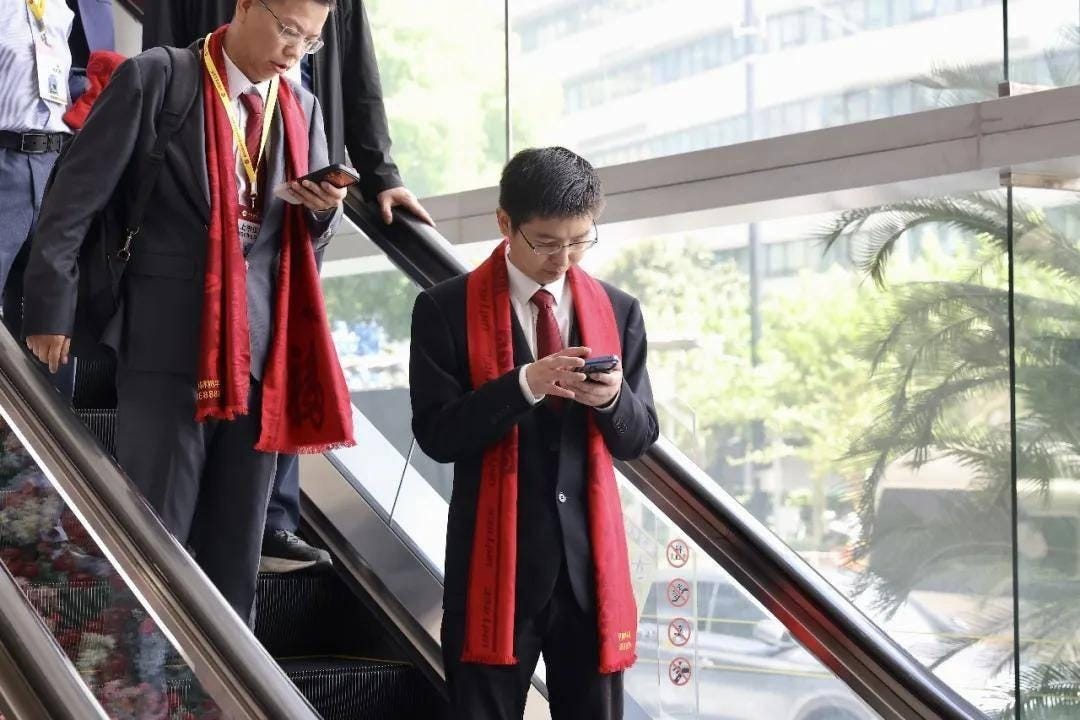
Unitree founder Wang Xingxing on the company’s listing day in Shanghai, August 19. Source: Sohu
For comparison, Figure AI, the American humanoid startup, shipped fewer than 500 units in 2025 and last raised money at a $39 billion valuation.
UBTech is increasingly relying on humanoids as education sales weaken. Revenue from full-size humanoids and related services rose from ¥38 million (~$5.7 million) in the first half of 2025 to ¥590 million (~$88 million) in the first half of 2026, almost half its total revenue. That business includes commercial services, education and research as well as industrial applications.
UBTech says the higher-margin humanoid business helped lift its overall gross margin from 35% to 44.7%, meaning it retained more of each yuan of sales after direct costs. But research, selling and other expenses still left it with a half-year loss of ¥339 million (~$51 million), 23% less than a year earlier. Its shares closed September 23 at HK$79.05, about half their 52-week high.
AgiBot is prioritizing expansion over immediate profit. Its revenue passed ¥1.05 billion (~$160 million) in 2025, and September reporting put its first-quarter 2026 revenue at roughly ¥1 billion (~$150 million), close to its revenue for all of 2025. CEO Deng Taihua told the Chinese financial newspaper 21st Century Business Herald that he wanted sales volume large enough to spread research costs across more machines.
The rental platform Botshare (擎天租), which AgiBot incubated, was its largest sales channel, according to the platform’s CEO. When I wrote about Botshare earlier, I saw rentals as a way to get robots into customers’ hands and let them try before buying. For the businesses buying robots to rent out, the question is whether rental income will cover the purchase price and the cost of operating and maintaining them.
In July AgiBot confirmed it had started the Hong Kong listing process. Caijing put its valuation above ¥20 billion (~$3 billion); an investor told the publication the IPO target was HK$40-50 billion (~$5-6 billion).
The road to IPO
Robot developers need money to hire engineers, train models and prepare machines for production, often long before they can make commercial deliveries.
America has the world’s largest VC market, backing young companies in Silicon Valley and beyond all the way to IPO (initial public offering), and the world’s two largest stock exchanges, together worth more than the next ten combined.
China has long been focused on narrowing that lead. Its state and private investors have plenty of appetite for risk, backing robotics startups through multiple rounds before their first products even reach the market.
Funding the first steps
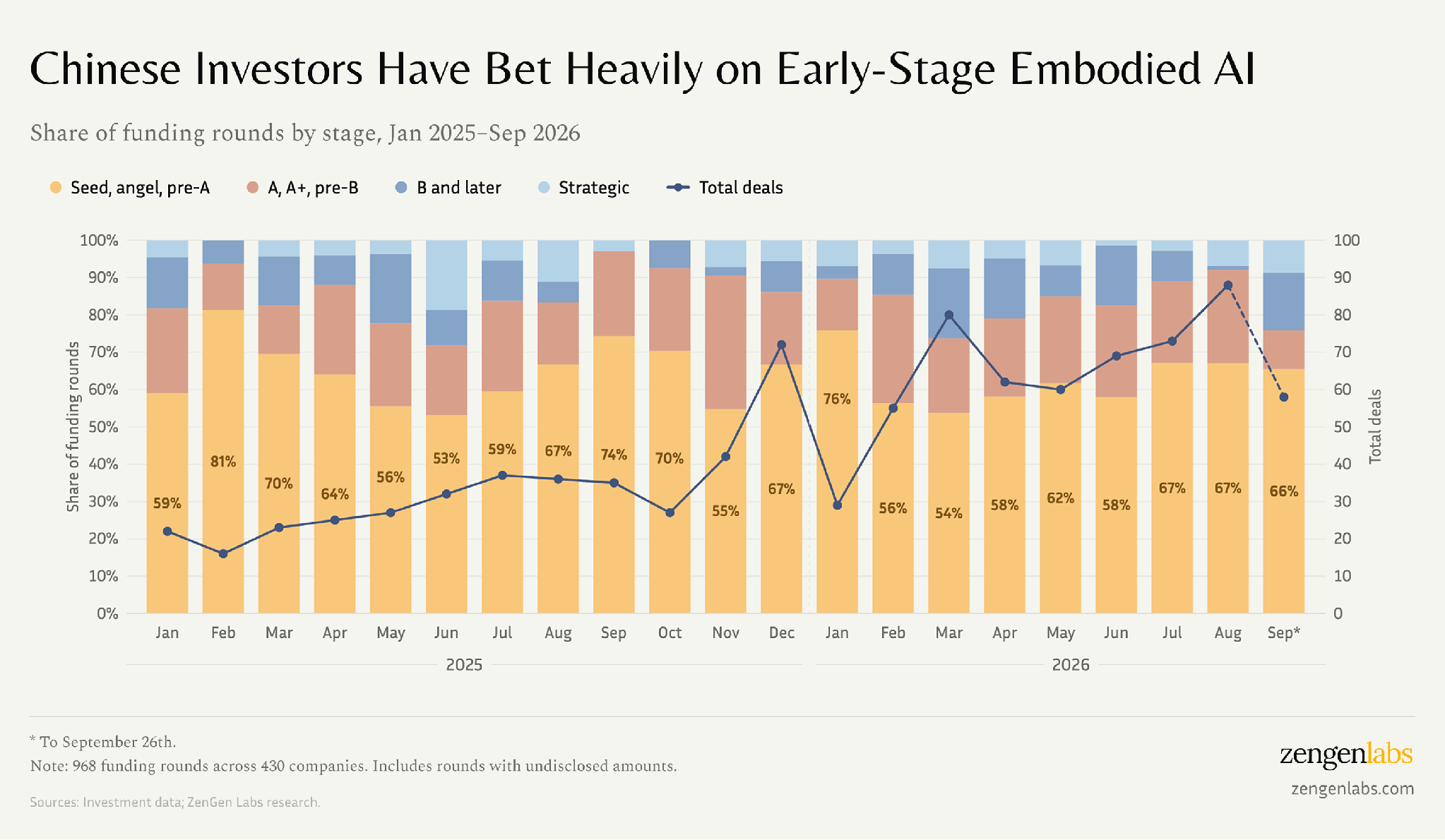
At ZenGen Labs, we track Chinese funding rounds every week. Our embodied-AI dataset covers 1,169 reported financings dating back to 2023. The charts focus on January 2025 through September 26, 2026, covering 968 rounds across 430 companies. In that period, only about one in five rounds disclosed an exact funding amount, while nearly two-thirds were early stage (seed, angel or pre-A rounds).
All data shows strong appetite for embodied AI startups.
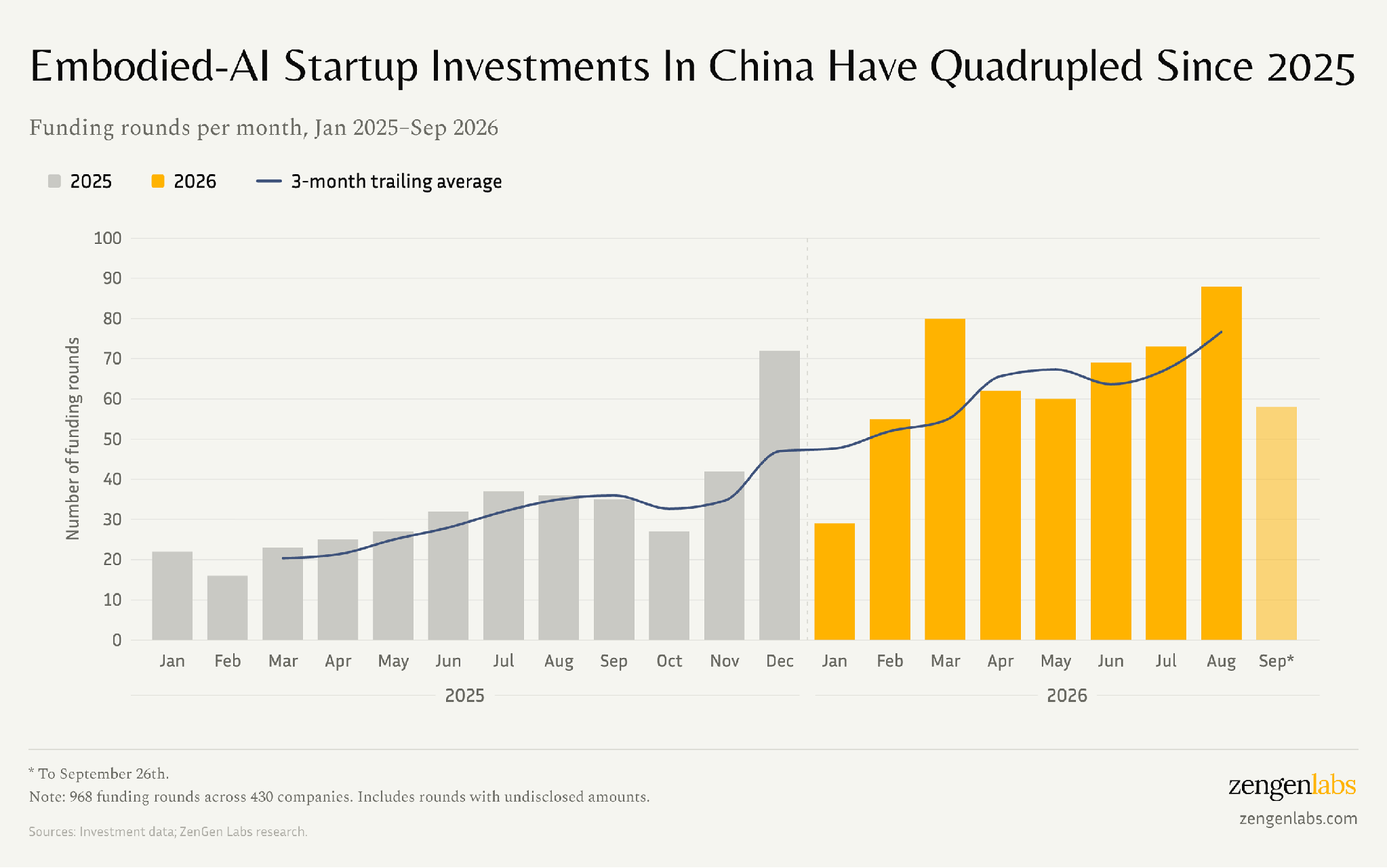
Galbot raised about ¥7 billion (~$1 billion) in three years by March, with a reported valuation of ¥20 billion (~$3 billion) before that round. Spirit AI had raised more than $670 million and reached a similar valuation by September, while its deployments at battery maker CATL and e-commerce group JD.com still numbered in the tens. Co-founder Gao Yang expected the next one to two years to be the initial window for industrial applications.
The velocity of some of these rounds is remarkable. DISCOVER Robotics raised more than $200 million across two angel rounds less than a month apart, announcing the second in August. Incubated by Tsinghua University’s Institute for AI Industry Research, it develops robot models and training systems.
Knowin, a startup developing household robots, completed four rounds in its first year, including a ¥500 million (~$75 million) angel-plus-plus round reported in August. Its first robot is not expected to launch until 2027.
These are large, rapid rounds, but the willingness to invest so early is widespread. Seed, angel and pre-A rounds accounted for the majority of deals in every month shown below.
Established manufacturers entering robotics are also raising substantial sums. On August 25, XPeng announced agreements to raise more than $900 million for its robotics business, with Tencent and Alibaba among the investors.
While the private funding market is red hot, an IPO can open access to an even larger pool of capital.
Initial Public… Optimism?
For founders and their investors, an IPO can be the culmination of years of building and financing a company. It creates a public market for their shares and gives the business access to a much wider pool of investors, including pension funds, insurers, mutual funds and individual investors.
In June, Wu Qing, head of China’s securities regulator, said Shanghai’s tech-focused STAR Market should support more hard-technology companies, including embodied intelligence. The exchange also clarified how AI-model developers could qualify to list before becoming profitable, provided they meet requirements including having a model already in use at scale.
On June 12, Bloomberg reported that EngineAI had confidentially filed for a Hong Kong IPO, citing people familiar with the matter.
The appetite extended beyond makers of complete humanoids. Mech-Mind, which supplies robot vision systems and other components, listed in Hong Kong on September 1. Investors applied for roughly 3,835 times the shares initially offered to Hong Kong retail buyers. Later that month, Reuters reported that at least half a dozen Chinese humanoid-robotics companies were preparing to go public, including AgiBot, DEEP Robotics and X Square Robot.
But regulators were growing concerned about volatile share prices and whether robot makers’ reported sales reflected sustainable demand. By September, the tech publication The Information and then Reuters reported that regulators were using informal “window guidance” to hold back some humanoid listings. Reuters’ sources said Unitree’s volatile debut was the main trigger. Regulators were also questioning whether revenue from state-backed training grounds and joint ventures reflected demand from independent customers. In some ventures, local governments could provide 80% to 90% of the initial investment. The sources differed on how far the intervention went: one said humanoid IPOs were effectively frozen for now, another that there was no formal ban.
Though the wider market mattered too. Some bankers interviewed by Chinese financial news service Cailianshe (财联社) on September 21 pointed to weakness in the stock market and a succession of large IPOs absorbing available capital as reasons for greater caution, rather than attributing the tightening solely to Unitree.
Beijing wants robotics to succeed, but it also wants a healthy stock market where retail investors do not get burned buying into the hype. However, tighter IPO scrutiny makes private investors more cautious: if a listing looks less certain, they may want to see repeat orders and useful deployments before putting in more money.
The charts above show the latest available data. It’s still too soon to assess whether the recently reported IPO restrictions will slow private investment, but I expect them to have a sizable impact. Separately, some private valuations were already falling: a venture investor told Reuters that some projects had suffered cuts of 30% to 50%.
With a less certain route to selling their stakes and returning money to their backers, VCs have reason to demand lower entry prices to compensate for the risk.
In September, Mech-Mind founder Shao Tianlan publicly challenged Galbot’s revenue model. The dispute centered on whether business arranged through data-collection centers, rental companies and related parties demonstrates sustainable demand. Galbot rejected the allegations, pointed to operating deployments across multiple industries and said on September 12 that it had reported the “rumors” to police.
A university buying a robot for research has a use for it today, even if it cannot work a factory shift. But when an investor also buys the company’s robots, it is harder to tell whether the order reflects a need for the machines or an effort to support the investment. Caijing described purchases involving investors and local state-backed ventures in its reporting on AgiBot.
The scrutiny of robot makers’ revenues raises a broader concern about their valuations. Investors are betting on a large market for useful machines, but that market could take much longer to develop than they expect. Customers need robots that can do enough useful work to justify buying them.
An expensive mannequin?
Humanoid developers are selling hardware while still developing the software that will let it do much of what they promise. Buyers are being asked to put money into a technology whose capabilities could improve over years of updates. Autonomous driving offers a familiar comparison.
Imagine buying a car on the promise that one day it will drive itself. Even while that technology remains unfinished, the car still works as a car. You can drive it yourself. Software updates arrive over the air, and perhaps each one brings it closer to autonomy. If that takes years longer than expected, you still have a vehicle that gets you to work every morning. Now imagine buying a humanoid to do your housework or take over a job in your factory. If it cannot do that job yet, there is no equivalent fallback. You have an expensive mannequin in the corner while you wait for the software to improve. The machine may become more capable over time, but the purchase has to make sense during the wait as well. A lower price makes that wait cheaper; it does not make an idle robot useful.
Many robots still need a “human in the loop”: someone to supervise their work and step in when they get stuck. Occasional intervention may be economical if one person can oversee several robots. The more human attention each robot needs, however, the less the buyer saves on staffing, while still paying to buy and maintain the machines.
While customers weigh whether robots can earn their keep, governments are considering their military uses and the risks of relying on foreign manufacturers. Those concerns are already shaping which robots can be sold where.
The national-security question
Both China and the US are exploring military uses of robots. A remotely operated robot could let a soldier inspect a dangerous building without entering it. A fully autonomous robot could do much more. Governments also have to consider what foreign-made robots might record, who could control them and how to secure supplies of parts.
The US Army’s xTechHumanoid competition sought humanoid systems for military use, with up to $1.25 million earmarked for potential follow-on contracts. In China, a Reuters investigation found a May 2025 PLA tender for a humanoid and a June 2026 budget of about $300,000 for a system to collect and label humanoid training data.
An August 2025 paper from China’s National University of Defense Technology modeled soldiers and robots clearing a building, projecting that the equipment could be available within five to ten years. Chinese defense manufacturer Norinco says a human operator can control its Fuxi (伏羲) humanoid remotely.
Reuters could not confirm whether the PLA tenders had been filled and found no evidence of armed humanoids deployed with operational PLA units.
In a July 2025 article, the PLA’s newspaper discussed reducing casualties through military humanoids and proposed requiring human authorization before one fired at a person. The PLA Eastern Theater Command also released an AI-generated video depicting robot dogs in a hypothetical attack on Taiwan. Four-legged machines are already appearing in exercises. In July 2026, State broadcaster CCTV showed robot “wolves” carrying rocket launchers in an amphibious landing drill, with unmanned equipment moving ahead of troops.
The US House Select Committee on the Chinese Communist Party cited a rifle-equipped Unitree robot in Chinese-Cambodian military exercises in 2024 when it urged US agencies to investigate the company the following year. Unitree denied selling to the Chinese military.
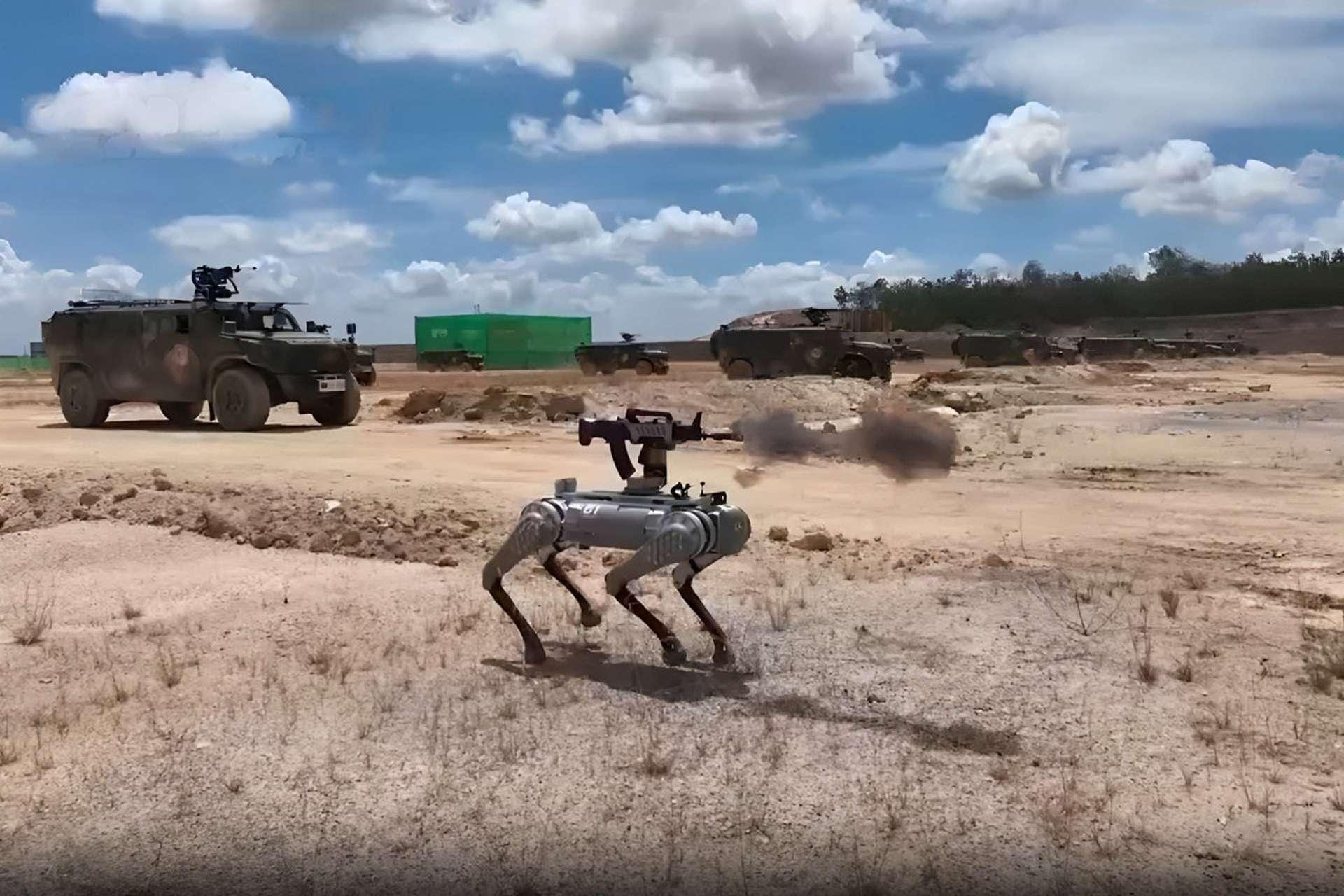
Researchers and a former US defense official told Reuters that Unitree’s robot dogs drew on openly published US Army-funded work, including MIT’s Mini Cheetah. Ironically, in 2023, the Army obtained a waiver to buy two Unitree Go2s because sufficient American alternatives of satisfactory quality were unavailable.
Unitree has also joined American robot makers in a pledge not to weaponize their products.
Security concerns extend to civilian machines. In September 2025, Alias Robotics researchers reported in a preprint that a Unitree G1 sent audio, visual and other sensor data to external servers without explicit user consent. Others disclosed a Bluetooth vulnerability allowing nearby attackers to take control of several models. Unitree said its robots operate offline by default, require authorization to connect and may then send basic product information. It said most security fixes were complete, with updates to follow.
In June, the Pentagon listed Unitree among companies it says support China’s military. On July 28, the FCC blocked new equipment authorizations for foreign-produced advanced robots, including humanoids and quadrupeds, citing surveillance, remote-control and supply-chain risks. These authorizations are generally needed to import, market or sell new models. The restriction covers foreign production beyond China, but previously authorized models and existing users are unaffected, producers can seek conditional approval, and federal purchases and use are exempt. Beijing’s Foreign Ministry accused Washington of stretching national security to suppress Chinese companies, warning of harm to American businesses and consumers and promising to defend Chinese companies’ interests.
Congress has proposed further restrictions. A March bill from senators Tom Cotton and Chuck Schumer would prohibit federal procurement and operation of ground robots from designated foreign entities; June’s GUARD Act would require security reviews of humanoids and quadrupeds linked to countries of concern. Agility Robotics CEO Peggy Johnson endorsed the latter, citing security, safety and economic concerns.
But excluding Chinese robots and reducing dependence on Chinese manufacturing are different tasks. Chinese automotive supplier Tuopu (拓普) confirmed collaborating with Tesla on robot actuators, drawing on its braking-system expertise. Even Figure AI, which says it builds its own actuators, hands and batteries, has used Chinese parts: in 2024, precision-component maker Everwin said it supplied Figure with humanoid-robot components.
Johnson herself said in August that most Agility components were sourced in the US, but it was closely watching supplies of rare-earth magnets for actuator motors. By 2024, China made 94% of the world’s high-strength rare-earth magnets, according to the International Energy Agency. Ghost Robotics, which supplies US special forces, told Reuters it had moved motor sourcing to South Korea but still struggled to replace Chinese magnets and some metal parts. Boston Dynamics has warned Congress that Chinese pricing could push American manufacturers out of the market.
Keeping Chinese robots out could give American makers more customers, but replacing their Chinese suppliers would mean finding the manufacturing skills those firms have spent years developing. UBTech could bring production in-house by buying a company already making automotive and hydraulic parts. The depth of China’s manufacturing ecosystem makes it easier for companies like UBTech to shop around for an acquisition target with the capabilities they need. An American maker would need to find a comparable domestic business or help a supplier develop those capabilities. That could mean paying for new equipment and working through production problems before it could match Chinese quality and prices. A protected market might make that investment worthwhile, but American robots could cost more and take longer to reach customers in the meantime.
China can also restrict supplies. Its April 2025 controls on selected rare earths and related magnets disrupted deliveries to US and European carmakers. Broader October rules would extend licensing to certain foreign-made components containing Chinese rare earths or produced using Chinese technology, potentially affecting robots even when their motors are made elsewhere. Beijing suspended those measures after US–China trade talks, but the suspension runs only until November 10, 2026. If the broader controls take effect, American robot makers could face new hurdles obtaining Chinese materials and components, even as US restrictions protect them from Chinese competitors.
But it’s not all bad news for the US. They may have an advantage in how that supply chain develops. The Chinese ecosystem is quite cutthroat and there is rarely a lot of trust between customers and suppliers. Component makers can find themselves competing with their own suppliers and customers as those businesses expand. This is one of the many reasons there tends to be a lot of duplication in supply in China, as companies choose to do things in-house as opposed to relying on external providers. Buyers benefit from lower prices, but CASBOT co-founder Li En has warned that premature price wars could leave companies unable to fund research.
American robot makers may not need to recreate that crowded market. They could build long-term relationships with one or two specialist suppliers per component, giving those firms enough orders to expand production and recover their investment. That arrangement would work best if suppliers could serve several manufacturers without those customers deciding to make the same parts themselves. While the sheer depth would be hard to replicate, there could be savings in avoiding its breadth.
What comes next
If Morgan Stanley’s billion-humanoid forecast is to become reality, China is well placed to build many of those machines. Decades of industrial development have given its robot makers suppliers, skilled workers and factories that newcomers cannot quickly replicate. Affordable robots also let more developers experiment, potentially helping China turn its manufacturing advantage into better robot intelligence.
Getting there will require customers who buy robots because they do useful work, then come back for more. That can begin with a few jobs performed reliably, with limited human supervision, long before a machine can handle everything we ask of it. Some of that work may go to wheeled robots or capable hands on existing arms. Tighter IPO scrutiny could make financing the wait harder, especially for companies whose products cannot yet earn their keep.
China’s share of production will not necessarily determine its share of the profits. Chinese and American developers are both pursuing the models and skills that make robots useful, while open releases could make some capabilities widely available. Manufacturers may earn from software, and software developers may depend on manufacturers to reach customers. The commercial relationships are still taking shape.
For governments, the stakes extend to who supplies their armed forces and who can control machines operating inside their borders. Both militaries are exploring robots that could send people into danger less often, while armed robot dogs already appear in exercises seemingly putting some people in more danger. The US is restricting foreign robots even as American makers depend on Chinese parts; China can restrict access to some of those materials. The rivalry could sustain investment before commercial demand matures, but it could also make development more expensive and limit where companies can sell.
The factories, funding rounds and military ambitions have brought us a long way from the ancient dream of machines freeing us from physical labor. I hope the focus remains on taking difficult, dangerous or tedious jobs off our hands, giving us more time to learn, create, care for one another or simply enjoy our lives. We may encounter that future first in a warehouse or a shop. One day, perhaps, it will be in the kitchen, getting dinner ready. I’m not sure where, but expect to see more of these humanoids soon. Hopefully not just thrown in a corner.
For more information, visit zengenlabs.com or email dermot@zengenlabs.com. Dermot is Fluent in Mandarin, his research also draws on visits to innovative companies, factories and suppliers across China. His research has been cited in Bloomberg, Forbes and Wired, among others. Learn more about ZenGen Labs.
The post was first published on September 30th, 2026.
Thanks for reading! Today I also started a poll on Substack Notes on the topic that you might be interested in.
Currency note: Dollar amounts are in US dollars unless marked HK$. Renminbi amounts are converted at ¥6.7 to US$1 and rounded. The ~ symbol means approximately.
Addendum
Some reference reading from the editor.
-
China has three new criteria for humanoid robot IPOs. Few, if any, meet them
-
Outperforming GPT-6, the dark horse in China’s physical AI sector has taken the top spot.
-
China Physical AI Index, TechBuzz China.
-
China unveils world’s first humanoid built around a domestic electronic architecture (via Interesting Engineering)
-
Chinese humanoid robots’ biggest obstacle: Humans are still (mostly) better (via )
-
AI Safety in China: A Primer
-
China grabs six of top 10 humanoid robot spots, but US quality is higher: Report
-
Is China Having an AI Safety Debate?
-
Anthropic’s 154-Page Warning Is the Best Argument Yet for Beating China at AI
-
My Chinese Internet Is Talking About AI Doom
Read More in AI Supremacy


