
Hello Engineering Leaders and AI Enthusiasts!
This newsletter brings you the latest AI updates in just 4 minutes! Dive in for a quick summary of everything important that happened in AI over the last week.
And a huge shoutout to our amazing readers. We appreciate you😊
In today’s edition:
🎙️ The sequencing error behind most failed AI programs
🏆 Claude Fable 5.1 takes the AI lead
🧠 OpenAI unveils GPT-6 Astra as its strongest model yet
🚀 OpenAI’s GPT-Image-2.5 makes AI images 50% faster
⚡ Meta and Google bring frontier AI to flash
💡 Knowledge Nugget: How to Build Open Source for AI Agents by Hugo Santana
Let’s go!
The Sequencing Error Behind Most Failed AI Programs
AI programs often fail before the technology even gets involved. In the latest episode of Simform’s Enterprise Cloud and AI Forum, Brandon Micci, Head of AI Strategy & Business Transformation at a leading global financial institution, joins host Rameshwar Balanagu, Co-Founder of Dallas CTO Club, to explain why enterprises are often choosing AI use cases in the wrong order. Drawing from his experience across capital markets, banking, and aviation, Brandon shares a method for identifying which use cases are actually worth building and why the business’s loudest request is rarely the right place to start.

The conversation also explores the governance, ROI, and cost issues that can derail AI programs long after development begins. Brandon shares lessons from an AI governance reset during a major merger, explains why asking employees how much time AI saves them can produce misleading ROI numbers, and discusses why financial services companies need to address AI FinOps and operational constraints before moving toward agentic AI. He also highlights the human cost of moving ahead of AI productivity gains, including layoffs based on savings that had not yet materialized.
Why does it matter?
AI failures often start with the wrong decisions, not the wrong models. Choosing the right use cases, measuring real ROI, and accounting for governance and costs early can make the difference between an AI program that delivers and one that becomes another expensive experiment.
Claude Fable 5.1 takes the AI lead
Anthropic just released Claude Fable 5.1, its new flagship model for coding, research, and knowledge work. It takes the top spot on the AA Intelligence Index with a record 66, while making major gains on long-running coding and scientific research tasks. Anthropic also says typical workloads should cost about 25% less than Fable 5, with savings reaching up to 45% for highly agentic work.
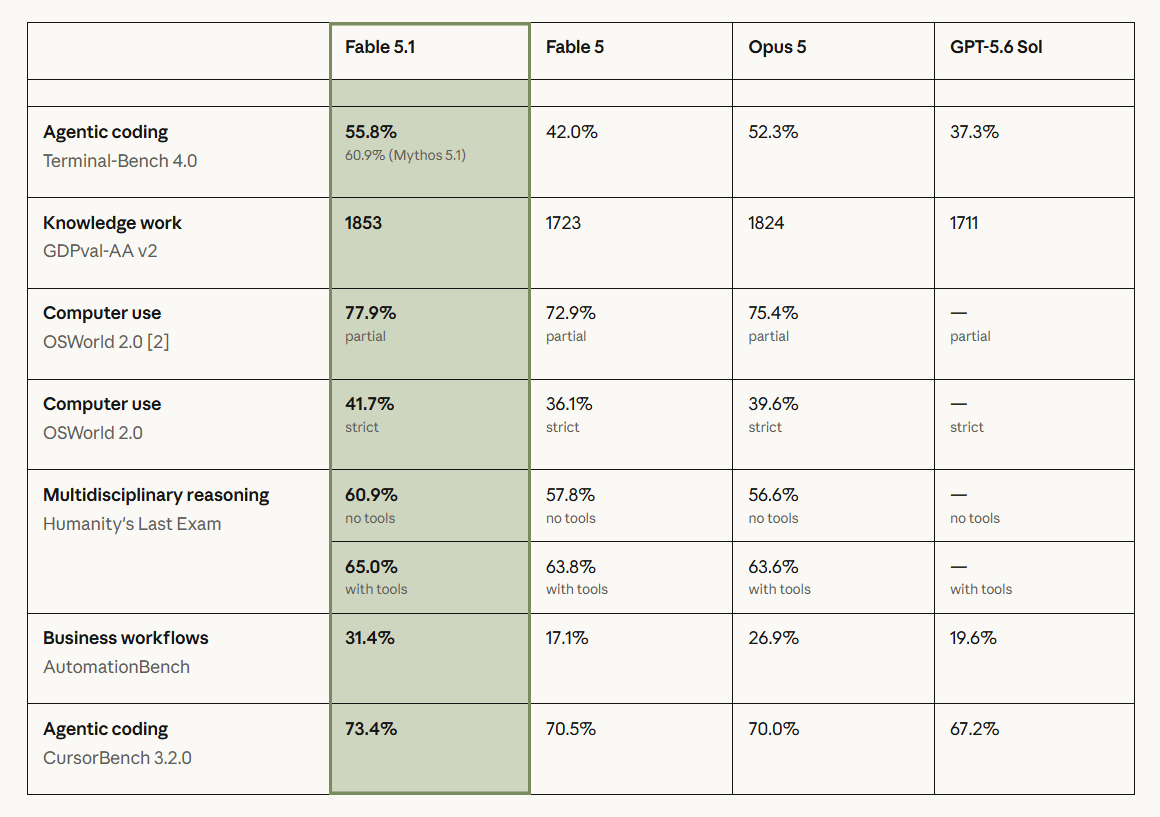
The update also tackles one of Fable 5’s biggest pain points: overly aggressive safety filters. Fable 5.1 cuts cybersecurity interventions by around 60% and benign biology and medical interventions by 85%. Anthropic also released Mythos 5.1, a less restricted version for vetted cybersecurity and life-sciences researchers.
Why does it matter?
Anthropic is coming out of the gate with a strong Fable 5.1 upgrade that tackles some of the biggest complaints around Fable 5, while also taking the top spot on the Intelligence Index. But with OAI’s Astra already making a major push for the frontier, Anthropic may not get to enjoy the lead for long.
OpenAI unveils GPT-6 Astra as its strongest model yet
OpenAI has introduced GPT-6 Astra, its latest flagship model, claiming major gains across science, math, coding, computer use, and cybersecurity. Astra scored 99.9% on ARC-AGI-3, 98% on FrontierMath T4, and a perfect 100% on ExploitBench, while using fewer tokens per task than its predecessor.
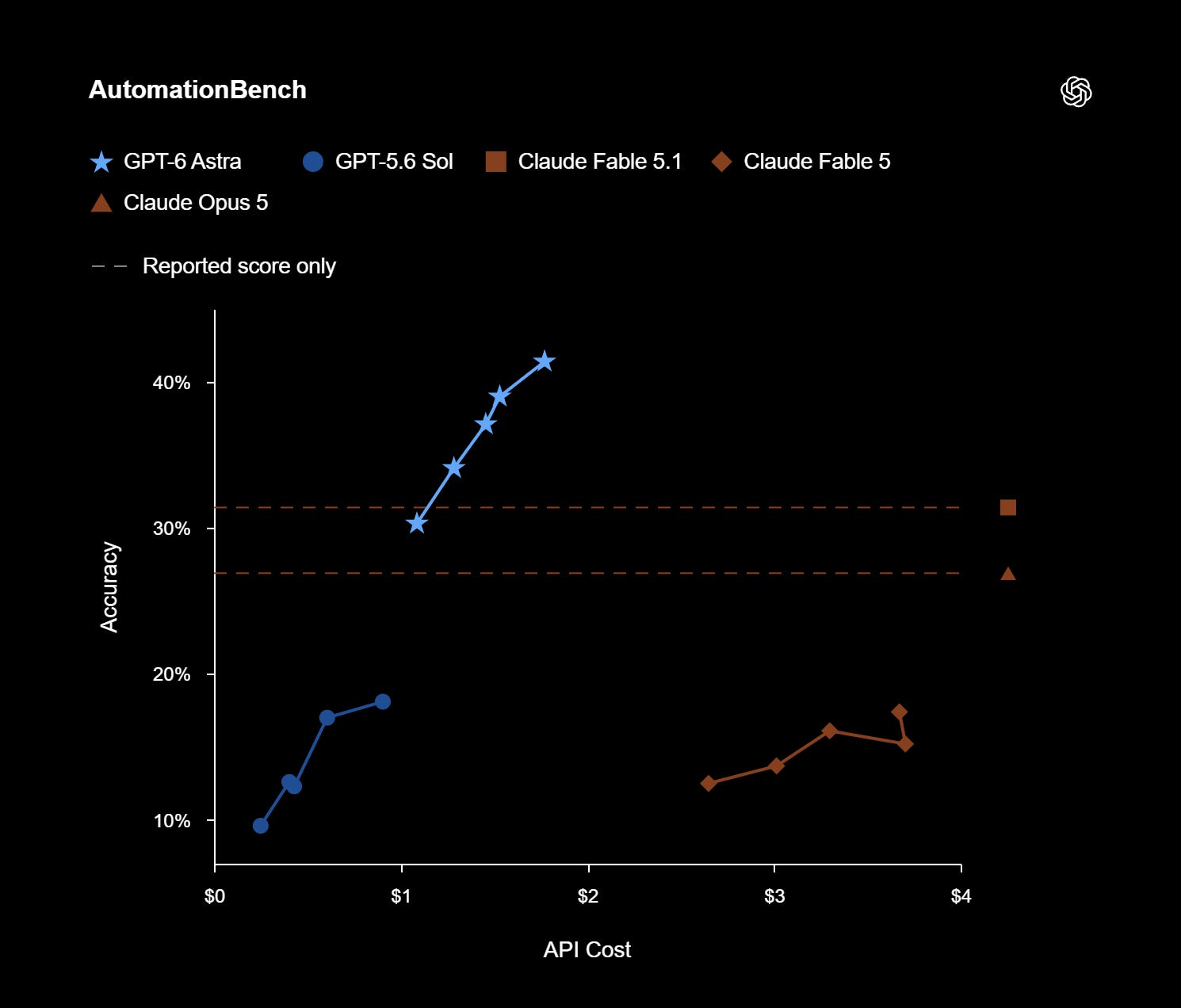
Astra costs about 2.5× more than GPT-5.6 Sol at $10/$50 per million tokens, although OpenAI says its efficiency helps offset the higher price. The model is rolling out first to select organizations, with paid ChatGPT and API access coming next. OpenAI President Greg Brockman also said he personally believes Astra has reached AGI.
Why does it matter?
It’s a huge benchmark jump, but Astra’s 61 on the Intelligence Index shows the frontier isn’t settled yet. With Fable 5.1, Fable 5, Opus 5, and Muse Spark 1.3 still ahead on that measure, Astra’s real test will be how those headline scores translate into everyday work.
OpenAI’s GPT-Image-2.5 makes AI images 50% faster
OpenAI has released ChatGPT Images 2.5, bringing sharper visuals, more precise editing, and up to 50% faster generation than Images 2.0. The model is also better at preserving details across multiple edits, meaning users can change one element without repeatedly rebuilding the entire image.
The update also adds tools like Sketch, which turns doodles into images, templates for common formats, comments for targeted edits, and shareable prompts. For developers, OpenAI is rolling out two API models: Flare for faster, high-volume generation and Sunburst for more precise creative work.
Why does it matter?
OpenAI isn’t just making image generation better, it’s making the whole workflow faster and more usable. With Images 2.0 already near the top of the image leaderboards, 2.5 looks less like a catch-up move and more like OAI widening its lead.
Meta and Google bring frontier AI to flash
Meta and Google both shipped new models aimed at pushing more frontier-level performance into cheaper, faster systems. Meta’s Muse Spark 1.3 is built for longer agentic and coding tasks, with Meta reporting roughly 20% fewer tool calls and 25% fewer tokens than Spark 1.2. It also does a better job of handling complex instructions, asking for clarification, and knowing when it needs help.
Google’s Gemini 3.8 Flash targets long-horizon coding and agentic work while keeping 3.7 Flash’s introductory price of $0.75/$3.75 per million tokens. Google also launched 3.8 Flash Cyber for vulnerability discovery and automated patching, with access limited to trusted defenders.
Why does it matter?
Meta is closing the gap with a strong mix of intelligence, agentic performance, and cost, putting more pressure on the frontier leaders. For Google, Gemini 3.8 is a clear step forward, but with its Pro model still out of the picture until Gemini 4, the pressure is on for a stronger frontier comeback.
Enjoying the latest AI updates?
Refer your pals to subscribe to our newsletter and get exclusive access to 400+ game-changing AI tools.
When you use the referral link above or the “Share” button on any post, you’ll get the credit for any new subscribers. All you need to do is send the link via text or email or share it on social media with friends.
Knowledge Nugget: How to Build Open Source for AI Agents
In this article, Hugo Santana examines five fast-growing open-source products, including PostHog, Supabase, n8n, Postiz, and Resend, to identify what makes them more agent-friendly. The key shift is designing open-source projects not just for developers, but also for AI agents like Claude and ChatGPT that can discover, understand, use, and contribute to software. Clear naming, simple repository structures, agent-specific instructions, and documentation that puts critical information first can make codebases easier for agents to work with.
The article also highlights the importance of giving agents direct ways to use the product through APIs, MCPs, CLIs, and SDKs, while keeping self-hosting and contribution workflows simple. Clear setup instructions, environment variables, testing requirements, coding conventions, and contribution rules reduce the friction for both humans and agents. The broader principle is straightforward: open-source projects need to be easy for machines to find, understand, run, use, and contribute to.
Why does it matter?
As AI agents become a new way to discover and use software, being agent-friendly could become a real distribution advantage. If agents can’t understand or use your product, they may simply move on to one they can.
What Else Is Happening❗
⚡ DeepSeek released V4.1-Flash, an open-weight model that rivals frontier systems on agentic, coding, and cyber benchmarks at just $0.15 per million input tokens.
🍎 Apple released iOS 27 with its rebuilt Siri AI, adding screen awareness, personal context, and cross-app actions in an English-only beta.
🧮 OpenAI claims an unreleased model produced a proof for the Navier-Stokes problem in 88 hours using 10,000 agents, though mathematician Tristan Buckmaster questioned whether his Codex drafts influenced the work.
🌦️ Google DeepMind introduced WeatherNext 3, an AI weather model using live satellite data to deliver hourly updates and up to 50% better day-ahead rain forecasts.
🧠 Anthropic found that Claude agents could autonomously improve AI safety, reducing behaviors like sycophancy and reward hacking by an average of 85% across 10 failure types.
🌐 Runway introduced Solaris, an “Interface World Model” that generates interactive websites and apps as live video, responding to clicks and drags in real time.
New to the newsletter?
The AI Edge keeps engineering leaders & AI enthusiasts like you on the cutting edge of AI. From machine learning to ChatGPT to generative AI and large language models, we break down the latest AI developments and how you can apply them in your work.
Thanks for reading, and see you next week! 😊
Read More in The AI Edge


