

Hello Engineering Leaders and AI Enthusiasts!
This newsletter brings you the latest AI updates in just 4 minutes! Dive in for a quick summary of everything important that happened in AI over the last week.
And a huge shoutout to our amazing readers. We appreciate you😊
In today’s edition:
🏥 The problem hiding behind health AI
🧠 Z.ai’s GLM-5.3 Flash tops OpenRouter
⚡ Alibaba’s Qwen3.8 takes on bigger AI models
🚀 OpenAI’s GPT-5.6 Gets a 14x Speed Boost
💡 Knowledge Nugget: Controlling the Uncertainty Machine: Do You Still Need to Read AI Code? by Adam Tornhill
Let’s go!
The Problem Hiding Behind Health AI
Healthcare AI doesn’t have a model problem. It has a context problem. In the latest episode of Simform’s Enterprise Cloud and AI Forum, Muralidhar Vemulapalli, Chief Enterprise Architect and Acting CTO at a leading healthcare technology company, joins host Rameshwar Balanagu, Co-Founder of Dallas CTO Club, to explain why AI deployments can struggle when the systems, data, and workflows around them aren’t connected. Even a powerful model can fail when it can’t reach the context it needs.
The conversation goes beyond models to the infrastructure underneath enterprise AI, including the difference between human-in-the-loop and human-on-the-loop, the limits of measuring AI purely by outcomes, and the interoperability debt now showing up in agent architectures. His advice is simple. Fix the wiring first. If your systems don’t talk to each other, giving AI more autonomy won’t fix the problem.
Why does it matter?
Enterprise AI doesn’t need more autonomy nearly as much as it needs better foundations. We keep giving agents more power when the real problem is that they still can’t reliably access the data and systems they need. Fix the wiring first, then worry about making AI smarter.
Z.ai’s GLM-5.3 Flash tops OpenRouter
Z.ai has revealed that Ox Alpha, the mysterious AI model that briefly took over OpenRouter, was actually a stealth preview of its new GLM-5.3-Flash model. The model climbed to No. 1 on OpenRouter with more than twice the traffic of DeepSeek, while scoring 57 on Artificial Analysis’ Intelligence Index.
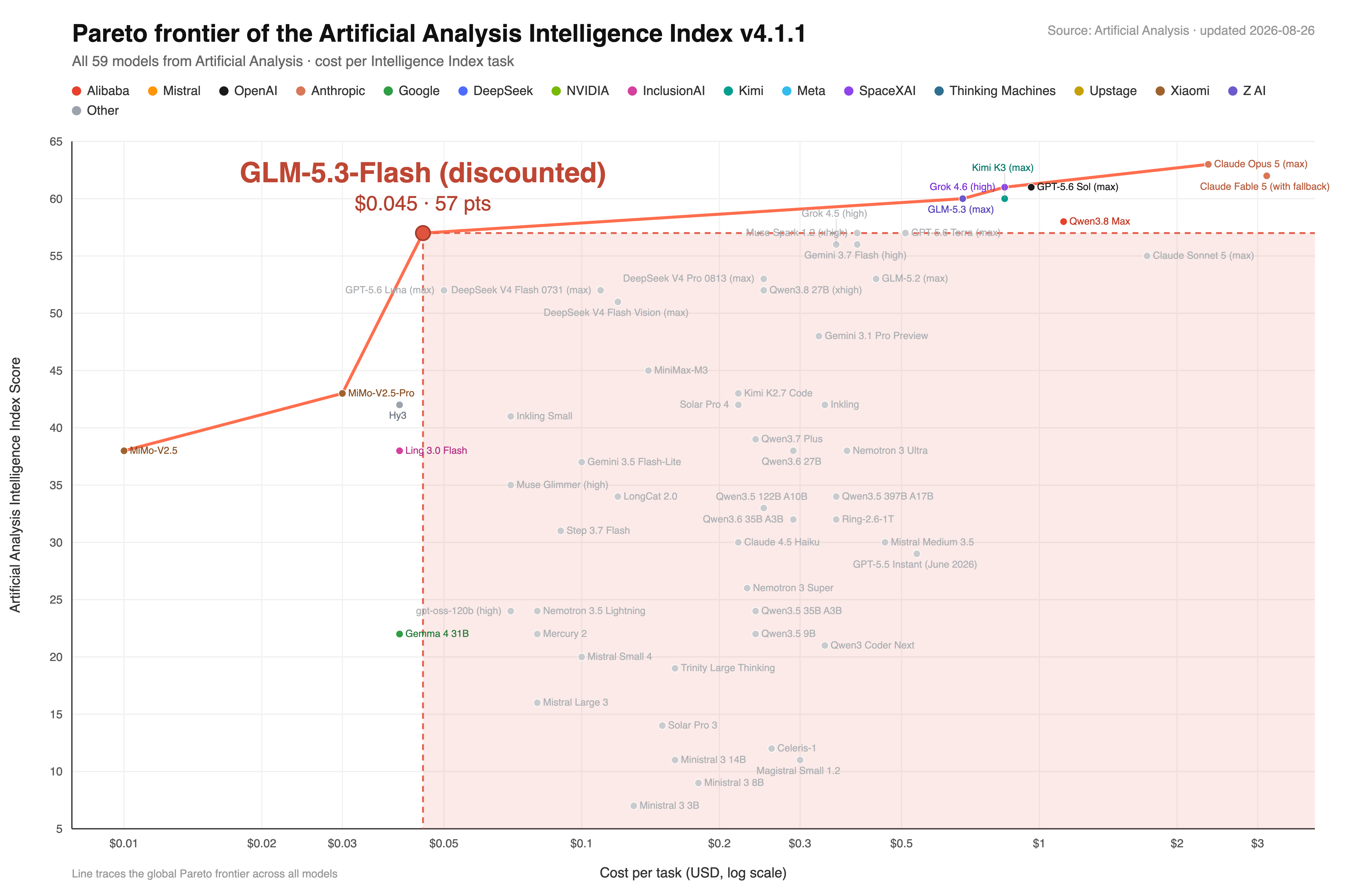
The bigger story is the cost. Z.ai says the model ran entirely on Chinese-made chips and served AI tasks for just $0.045 during its discounted period around 10x cheaper than similarly ranked rivals. Z.ai has now released the model’s weights under an MIT license, bringing near-frontier AI performance to developers at a fraction of the usual cost.
Why does it matter?
The mystery model that took over OpenRouter is finally unmasked, and it was Z.ai all along. But the bigger deal is the intelligence/price combination and the fact that it ran entirely on Chinese-made chips. If those economics hold up, Z.ai may have found a way around one of China’s biggest AI bottlenecks.
Alibaba’s Qwen3.8 takes on bigger AI models
Alibaba has released Qwen3.8-Flash, an open-weight multimodal AI model designed to balance performance, speed, and cost. Despite having 125B parameters, just 6B are activated per token, helping it compete with models like DeepSeek-V4-Flash and Claude Opus 4.6 across coding, agent tasks, tool use, and multimodal benchmarks. It also supports 262K tokens of context, with extensions up to 1 million.
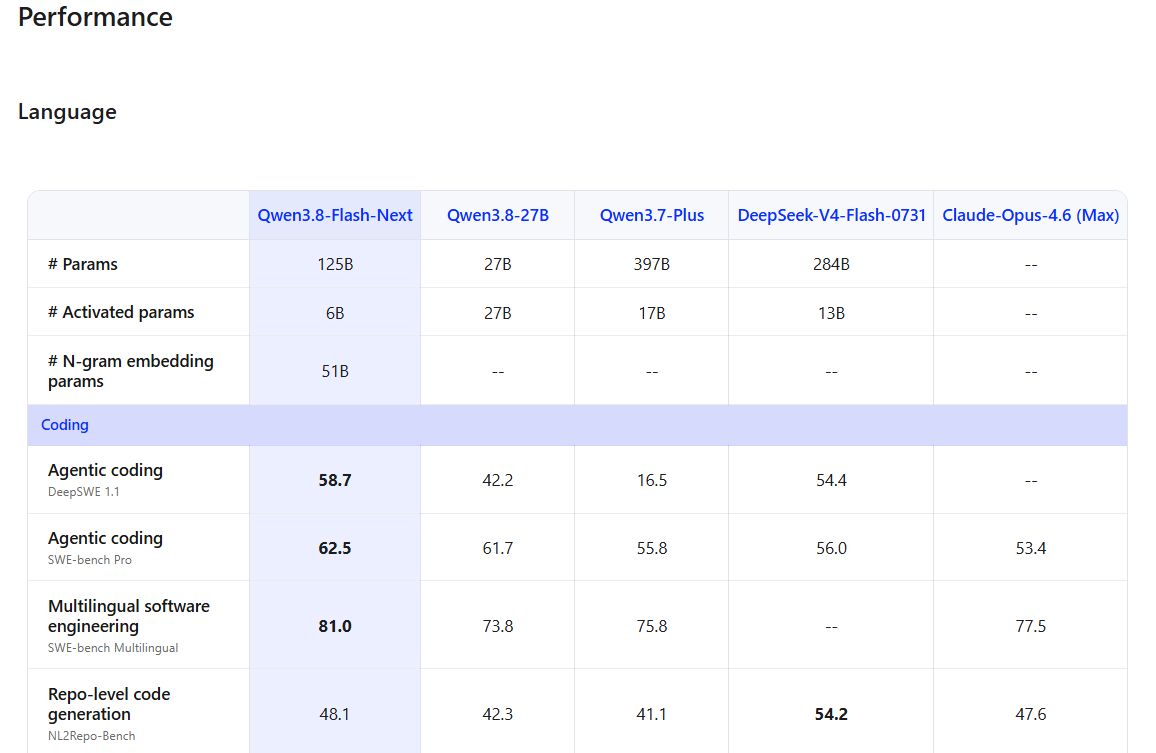
The bigger story is efficiency. Alibaba says Qwen3.8-Flash needs just one-ninth of the training resources of its much larger Qwen3.7-Plus while performing better on coding and office tasks. Its API costs $0.16 per million input tokens and $0.47 per million output tokens, and Alibaba says the architecture is an early preview of what will power its upcoming Qwen4 series.
Why does it matter?
AI competition is starting to look less like a race to build the biggest model and more like a race to get the most intelligence out of every dollar of compute. If Qwen3.8-Flash can deliver frontier-level performance at these economics, model efficiency could become just as important as model size.
OpenAI’s GPT-5.6 gets a 14x speed boost
OpenAI has previewed Ultrafast, a new Cerebras-powered API tier that can run its GPT-5.6 Sol model at speeds of up to 750 tokens per second, or roughly 14x faster than usual. The speed boost is already showing up in demanding workloads. On Humanity’s Last Exam, Sol with Ultrafast completed 2,500 questions in 11 hours versus 78 hours for Fable, with comparable results.
OpenAI staffers say the faster model has cut some security investigations from hours to just 10 minutes, while one described using it as feeling like “genuinely cheating at my job.” Ultrafast is currently invite-only with no public pricing, but OpenAI plans to expand access as more Cerebras capacity comes online.
Why does it matter?
The AI industry has spent years trading off intelligence for speed, but what happens when frontier models can deliver both? The missing piece is still cost, but AI running at these speeds could fundamentally change how agents and real-time workflows are built.
Enjoying the latest AI updates?
Refer your pals to subscribe to our newsletter and get exclusive access to 400+ game-changing AI tools.
When you use the referral link above or the “Share” button on any post, you’ll get the credit for any new subscribers. All you need to do is send the link via text or email or share it on social media with friends.
Knowledge Nugget: Controlling the Uncertainty Machine: Do You Still Need to Read AI Code?
In this article, Adam Tornhill argues that AI coding is changing how developers should think about code review. Instead of trying to understand every line generated by a coding agent, developers should focus their attention where uncertainty is highest. A bug fix may require only checking the evidence and tests, while a new feature with unfamiliar architecture calls for deeper human involvement.
The author uses end-to-end tests as the boundary between human judgment and AI autonomy. They review and refine the tests first, then let the agent write the implementation that makes them pass. Automated checks, architectural rules, linters, security scanners, and accumulated coding “SKILLs” provide additional guardrails for the code that isn’t manually inspected.
Why does it matter?
AI coding is making “review every line” an increasingly outdated engineering habit. The better approach may be to stop treating developers as code inspectors and start treating them as system designers who decide where AI gets autonomy and where it doesn’t.
What Else Is Happening❗
🌐 Runway introduced Solaris, an “Interface World Model” that generates interactive websites and apps as live video, responding to clicks and drags in real time.
🤖 Anthropic introduced the Model Hardware Standard, letting AI agents learn and operate lab machines like microscopes and robotic arms with minimal custom code.
⚡ OpenAI’s custom Jalapeño chip beat Nvidia’s flagship systems in early tests, delivering up to 3.6x faster responses and 1.9x better performance per watt.
💻 Slack launched Slack Code, letting teams build software inside shared channels where AI agents write code while humans guide, review, and approve changes.
🧬 Anthropic showed Claude can autonomously run protein-design campaigns, producing working molecules against 14 of 15 targets at 22–35% success rates.
🛡️ OpenAI rolled out ChatGPT for Teens, adding stricter safeguards, study-focused features, and parental controls for users identified as 13–17.
💻 Cursor launched Origin, an agent-powered code hosting platform that brings repositories, pull requests, code reviews, and AI agents into one workflow.
New to the newsletter?
The AI Edge keeps engineering leaders & AI enthusiasts like you on the cutting edge of AI. From machine learning to ChatGPT to generative AI and large language models, we break down the latest AI developments and how you can apply them in your work.
Thanks for reading, and see you next week! 😊
Read More in The AI Edge


