[[{“value”:”
Hey AI Breakers 👋
You already do something people pay for. You just do it for one employer, forty hours a week, at a price that was set years ago.
Today, you’ll build an AI Second Paycheck Engine that turns one skill you already use at work into a fixed-price side offer with real buyers and a first message ready to send.
-
✅ A Skill Plan of everything you do that someone outside your company pays for
-
✅ A Guardrail Verdict on what you can safely sell without touching your contract
-
✅ One productized offer with fixed scope, fixed price, fixed turnaround
-
✅ The math to $1,000/month checked against the hours you actually have
-
✅ 20 named buyers plus the places they already gather
-
✅ Five outreach messages and a delivery kit so client two costs you half the effort
Let’s build it 👇

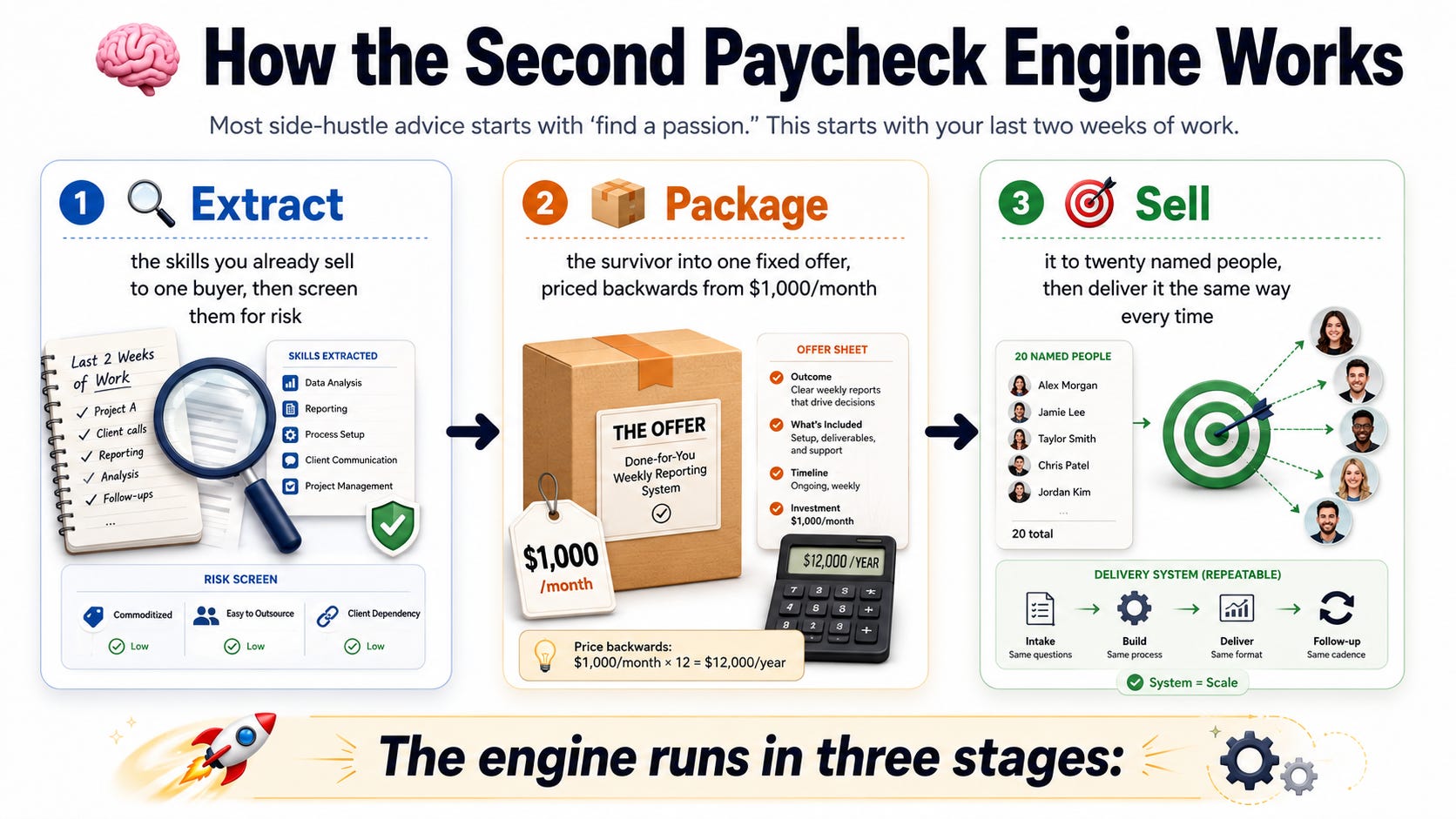
🧠 How the Second Paycheck Engine Works
Most side-hustle advice starts with “find a passion.” This starts with your last two weeks of work.
The engine runs in three stages:
-
🔎 Extract the skills you already sell to one buyer, then screen them for risk
-
📦 Package the survivor into one fixed offer, priced backwards from $1,000/month
-
🎯 Sell it to twenty named people, then deliver it the same way every time
The old way: six months of “figuring out my niche,” a logo, a website, zero customers.
The AI way: one evening to get a priced offer and a send-ready message.
🔎 Prompt #1 → The Skill Excavator (What You Already Sell for Free)
You are a worse judge of your own skills than almost anyone. The stuff you find easy is invisible to you and expensive to everyone else.
The goal:
-
Pull every repeatable task out of your actual working week
-
Separate what’s only valuable inside your company from what sells outside it
-
Rank by real demand, not by what you enjoy
✅ Use this to build the Skill Ledger you’ll paste into every prompt that follows.
Prompt:
You are a career analyst who specialises in finding commercially sellable
skills hidden inside ordinary jobs. You are blunt and you do not flatter.

MY SITUATION:
- Job title: [YOUR JOB TITLE]
- Industry: [YOUR INDUSTRY]
- Years doing this: [NUMBER]
- What I actually did in the last two weeks: [LIST 8-12 REAL TASKS, BORING ONES INCLUDED]
- What colleagues or other departments ask me for help with: [LIST WHAT PEOPLE COME TO YOU FOR]
- Tools I am genuinely good with: [LIST TOOLS AND SOFTWARE]

YOUR TASKS:

1. Break my two weeks into discrete, repeatable tasks. Ignore meetings and
   admin that exist only because of my employer.

2. For each task, mark it as one of:
   - PORTABLE (a business outside my company would pay someone to do this)
   - INTERNAL (only valuable because of my company's systems, data, or politics)
   Kill every INTERNAL task from here on.

3. For each PORTABLE task, tell me who currently pays for this elsewhere:
   what kind of business, and roughly what they pay a freelancer or agency.
   If you are not confident about a rate, mark it UNVERIFIED and say so.

4. Score each PORTABLE task 1-5 on:
   - DEMAND (how many businesses need this regularly)
   - SCARCITY (how hard it is to find someone decent)
   - PROOF (how easily I can show I can do it without breaching confidentiality)
   - SPEED (how fast one unit of it can be delivered by one person in evenings)

5. Build a SKILL LEDGER table: Task | Who pays | Rough rate | Demand |
   Scarcity | Proof | Speed | Total score.

6. Give me the TOP 3 by total score. For each, write one sentence on why it
   beats the others, and one sentence on the biggest reason it might fail.

7. Finally, name the ONE thing in my list that I am probably underrating
   because it feels too easy to me.

Ask me up to 3 clarifying questions before you start if my task list is vague.
💡 Tip: The “what colleagues ask me for” line does more work than anything else in this prompt. If three different people have asked you the same thing this year, that is demand with a pulse.
🛡️ Prompt #2 → The Guardrail Check (What You Can Safely Sell)
This is the step every side-hustle guide skips, and it’s the one that ends careers.
The goal:
-
Screen your top skills for conflict with your employer
-
Turn risky ideas into safe versions instead of abandoning them
-
Know exactly which clauses to go read in your own contract
✅ Use this to get a GREEN, AMBER or RED verdict before you spend a single evening building.
Prompt:
You are a pragmatic risk advisor who helps employed people start side work
without breaching their contract or blowing up their career. You are cautious
but not paranoid, and you are explicit about the limits of what you can know.

MY TOP 3 SKILLS:
[PASTE THE TOP 3 FROM PROMPT #1]

CONTEXT:
- My employer's industry: [INDUSTRY]
- Roughly what my employer sells and to whom: [ONE LINE]
- Country I work in: [COUNTRY]
- Anything I already know is in my contract: [PASTE CLAUSES, OR WRITE "I HAVE NOT READ IT"]
- Do I want my employer to know: [YES / NO / NOT YET]

YOUR TASKS:

1. For each of the 3 skills, assess four risks and rate each LOW, MEDIUM
   or HIGH:
   - CLIENT OVERLAP: could a buyer of mine ever be a customer, supplier or
     competitor of my employer
   - IP AND MATERIALS: would I be reusing templates, code, decks, data or
     processes that belong to my employer
   - TIME AND ATTENTION: would delivery realistically bleed into working hours
     or leave me visibly degraded at work
   - VISIBILITY: how likely is it that this shows up publicly and gets back
     to my manager

2. Give each skill an overall verdict: GREEN (go), AMBER (go with changes),
   RED (do not sell this one).

3. For every AMBER, give me the single specific modification that turns it
   GREEN. Be concrete: change the buyer type, change the deliverable, change
   the industry I serve, or change what I publicly say.

4. List the exact clauses I should search my employment contract for, with
   the words they are usually filed under, and tell me plainly what a bad
   version of each clause looks like.

5. Write me a 5-line "clean operating rule" for keeping the two worlds
   separate: equipment, email, hours, contacts, and materials.

6. State clearly what you cannot assess: you have not read my contract, you
   do not know my jurisdiction's specifics, and this is not legal advice.
   Tell me the one situation where I should actually pay a lawyer or ask HR.

Do not soften a HIGH risk to make me feel better.
💡 Tip: Run this before you tell a single friend about your idea. The cheapest version of this conversation happens with an AI, not with your manager.
📦 Prompt #3 → The Offer Compressor (One Skill, One Package, One Price)
“I do marketing consulting” is not an offer. Nobody knows what to buy or what it costs.
The goal:
-
Compress your GREEN skill into one fixed, nameable thing
-
Fix the scope so evenings and weekends stay yours
-
Make it obvious what is not included
✅ Use this to produce the Offer Card, the single most reused document in this system.
Prompt:
“}]] Read More in The AI Break