👋 Hey there, I’m Mike. Each week I share AI articles at the intersection of tech, business, society and the future. If you want to support the channel or gain full-access to my work, go here. Read Archives | See Substack Notes | Visit our community Chat | Visit Homepage. U.S. A 24 year old Hedge Fund star has emerged and become more famous by the boldness of his mistakes. The AI theme may feature briefly in this story.
Good Morning,
I just wanted to share a little note. Or if you prefer to listen. (20 minutes, 19 seconds).
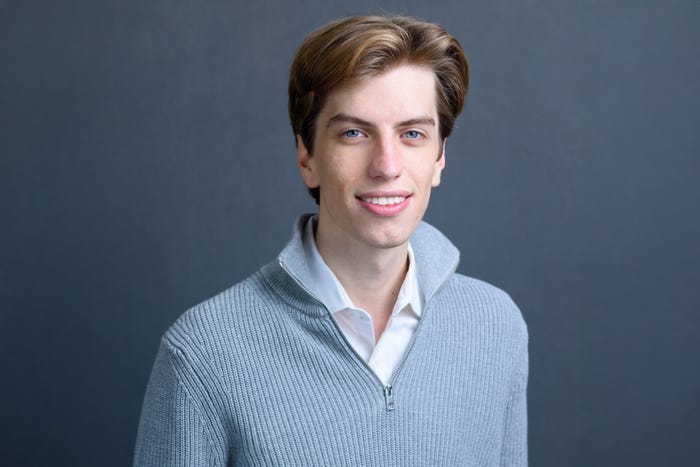
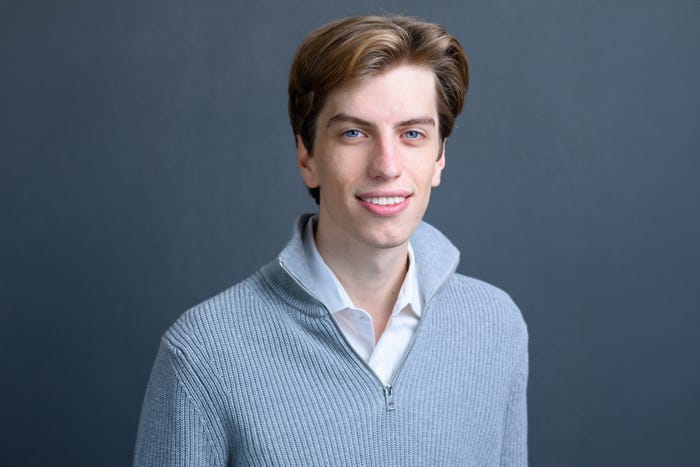
How should we understand the cautionary tale of AI investor and Hedge fund manager Leopold Aschenbrenner in his rapid rise to fame and fortune? For context AI investor Leopold Aschenbrenner worked at the FTX Future Fund (the philanthropic arm of Sam Bankman-Fried’s cryptocurrency exchange FTX) before it collapsed. He later joined OpenAI’s Superalignment team, and after leaving, founded the AI hedge fund Situational Awareness LP. He had a knack for spotting “bottlenecks” in the Semiconductor industry and predicting them well before stocks surged.
Who intersected Sam Bankman-Fried and Sam Altman in quite the same way while heralding the advent of AGI? I remember reading his Situational Awareness manifesto and wondering who was funding him? Remember Sam Bankman-Fried and Alameda Research led a Series B/early-stage investment into Anthropic in 2021 when the AI startup was valued at roughly $2.5 billion. There are a lot of Anthropic connections in this story. That eight percent Alameda stake would be worth $77.2 billion today.
As you’ve likely already heard, Leopold Aschenbrenner’s hedge fund was forced to sell all of its public stock holdings where Ken Griffin’s Citadel hedge fund swooped in and reached a deal to buy the stocks. Of course now he wants to raise even more capital. Situational Awareness, which grew to as big as $45 billion at one point, posted large losses in recent weeks from declines in AI infrastructure investments like SK Hynix but he still has a huge amount of Anthropic shares and made some decent bets, if a bit concentrated.
He was born in Germany to parents who were both doctors. At age 15 he convinced his parents to let him move alone to the United States and enroll at Columbia University. At Columbia he double-majored in economics and mathematics-statistics. He co-founded the university’s effective altruism (EA) chapter, conducted research connected to the Global Priorities Institute at Oxford, and co-authored work with economist Philip Trammell. At 17 he received a grant from Tyler Cowen’s Emergent Ventures; Cowen later described him as an “economics prodigy” after reading one of his papers. He graduated as valedictorian in 2021 at age 19.
In 2023 he joined OpenAI’s Superalignment team (led by Jan Leike and Ilya Sutskever), which focused on technical approaches to controlling AI systems more capable than humans. He co-authored the paper “Weak to Strong Generalization.” In April 2024 OpenAI fired him; the company cited an alleged information leak, while Aschenbrenner has disputed the characterization and pointed to internal security concerns he raised (including about potential foreign espionage risks). The Superalignment team was dissolved shortly afterward.
In a very short time, now 24, he’s become one of the most tracked Financial Creators on X. Aschenbrenner launched the fund after leaving OpenAI in 2024 and quickly became one of the most watched figures in AI investing because of eye-popping returns, according to CNBC.
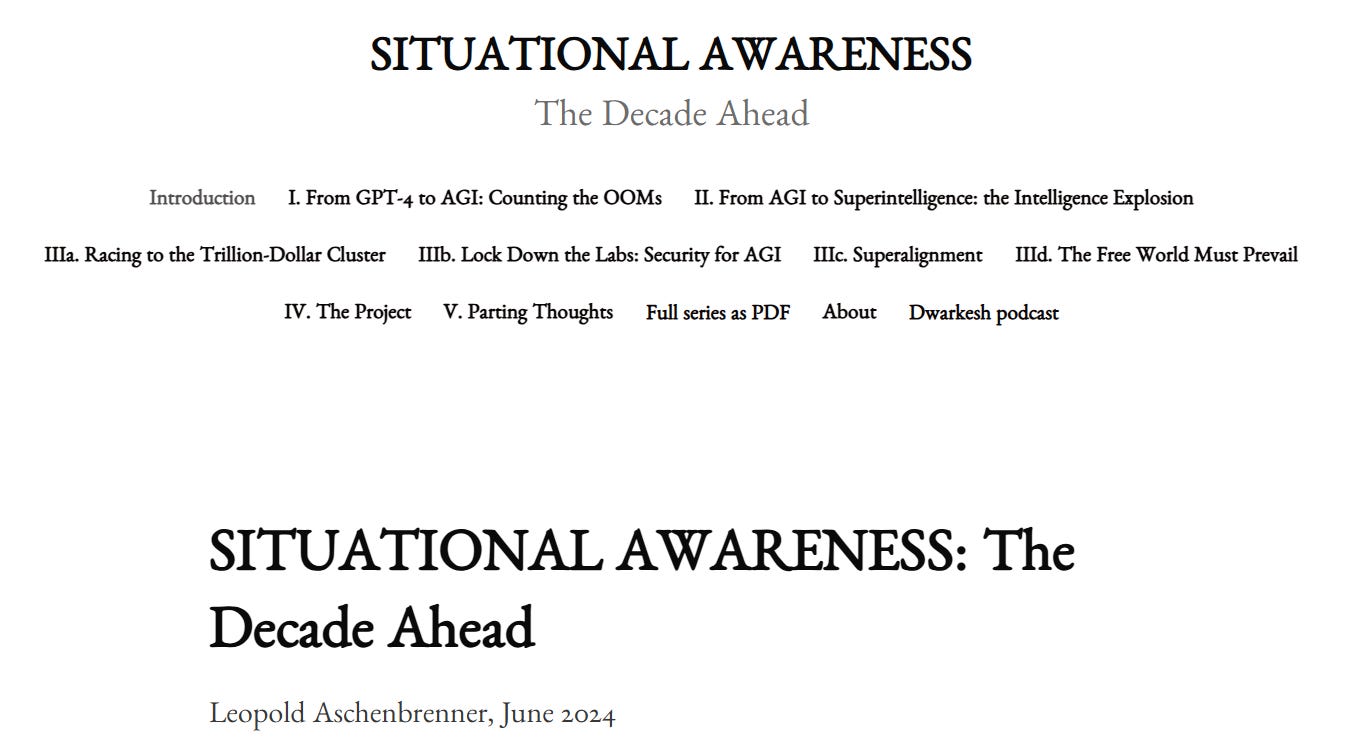
In June 2024, roughly two months after leaving OpenAI, he self-published the ~165-page essay Situational Awareness: The Decade Ahead. It argued that AGI could arrive as early as around 2027, sketched a path toward superintelligence, highlighted compute/energy constraints, geopolitical risks (especially involving China), and national-security implications. The piece circulated widely in AI, tech, policy, and investor circles and various AI boosters.
His Fund has done fantastically well, where returns since inception had exceeded 1000% and the fund had expanded to around $20 billion, according to the FT. Rumor has it he has to sell about half of his Anthropic shares in the recent Bear market correction on Semis of late July, 2026.
The hedge fund Situational Awareness LP (named after the essay), initially with seed capital of roughly $225 million from backers including Nat Friedman, Daniel Gross, and Stripe co-founders Patrick and John Collison. These are very powerful and influential Angel investors in the AI space. Notably Jane Street, the Quantitative trading firm appears to be a major backer. Jane Street has also been incredibly successful in this AI bubble/boom. It’s a very mysterious connection for me.
Leo became a bit of a cult figure around investors cashing in on the Semiconductor boom. But his success is also going to lead to more success, even though his calls have been incredibly high-risk:
The fund hit $45 billion at the start of July. His biggest bets were SK Hynix, Nebius, SanDisk, Micron, and CoreWeave, all down more than 35% this month (at the time of writing). His shorts on software names like Adobe went against him too. Citadel bought the bulk of what was left. He’s 24 or maybe just 25 years old.
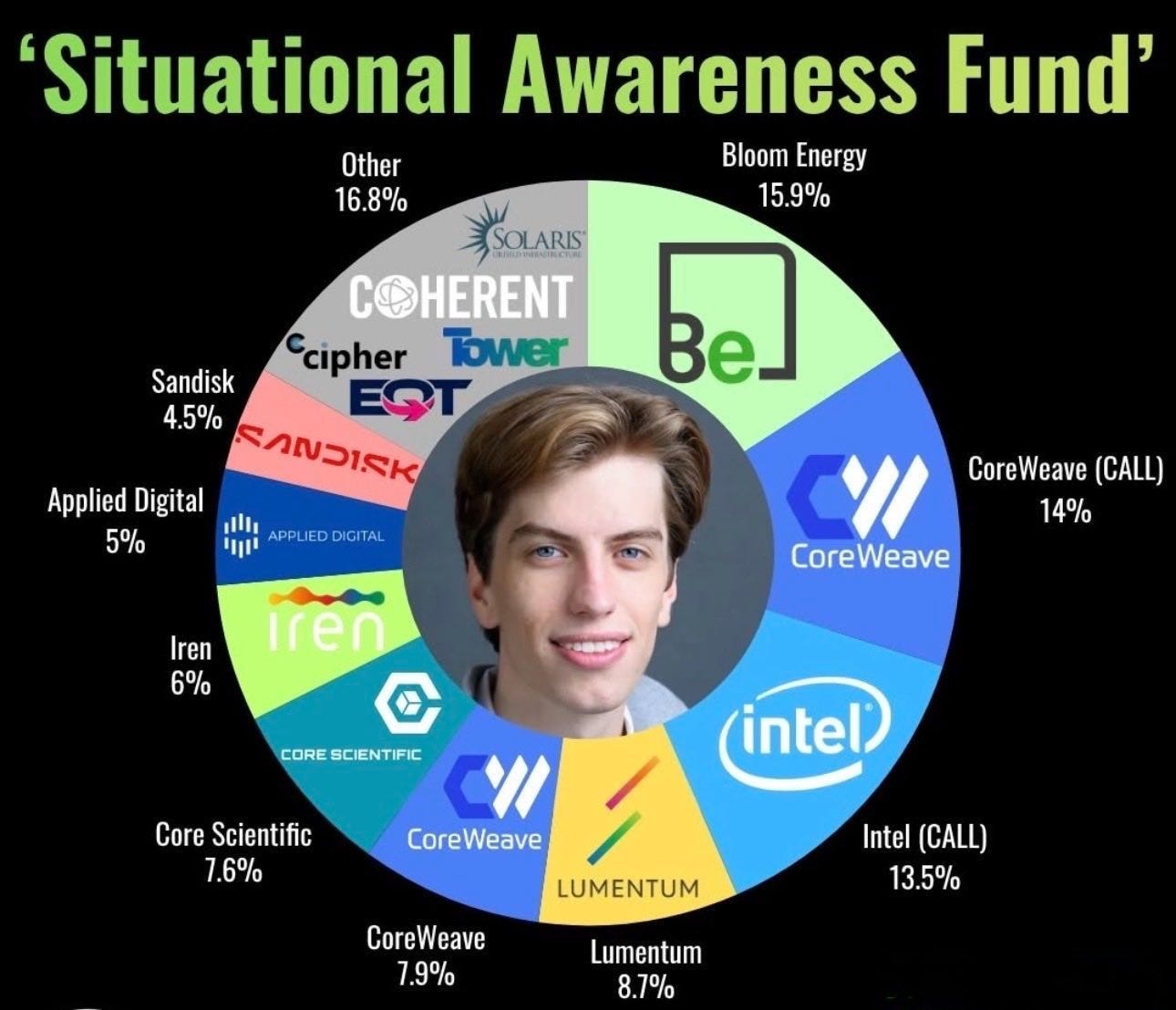
His Hedge Fund operates as a direct financial implementation of his macro-AI worldview, prioritizing extreme concentration and non-obvious infrastructure over standard mega-cap tech stocks. I’m supposing he had access to insider-info on what was most likely to happen with Anthropic’s evolution and the HBM AI chip shortage.
Aschenbrenner wrote the (possibly AI generated) essay series that became the intellectual blueprint for the AI infrastructure trade that made him so famous and he went on to profit from it in a significant (and singular) way that is highly unusual even in the Finance and Hedge Fund world’s faster risers.
He’s made viral news based on the reversal of his fortunes that has been very recent:
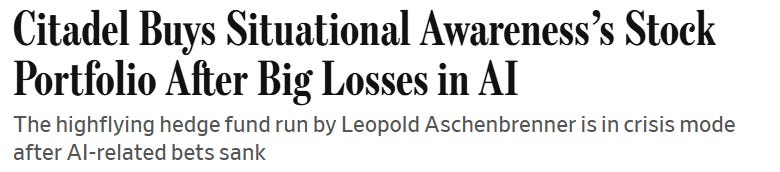



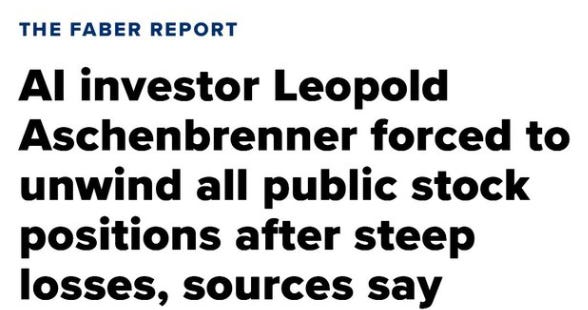

It’s such a surreal story and reminds me of when FTX blew up or, when Sam Altman got fired by the OpenAI board. It’s one of those “collective memory” moments that’s really interesting to me.
The volatility on the way up can be a trap too. He essentially turned $200 million into $45 billion in two years, given back in a month and I’m not even clear what’s left or what’s next.
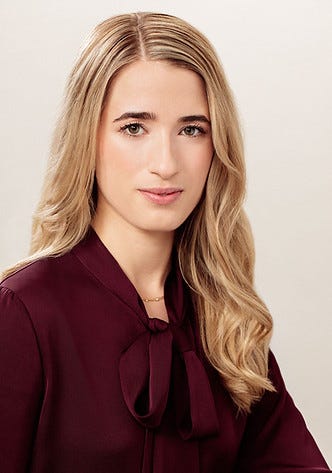
As of 2025 , Aschenbrenner is engaged to Avital Balwit, the chief of staff to the CEO at Anthropic. He lives in San Francisco. So I guess the insider info part of that connection makes a lot of sense. He appears to have $5 Bn. left in his Anthropic position. So this isn’t a disaster, just a bump in the road. He’s engaged and might even be getting married this weekend.
Leopold is clearly talented and this story is so epic in that Leopold Aschenbrenner just got the full “little kid steps up to the big table” experience. It’s Netflix worthy and likely just the opening act of his star studded 20s. He is essentially an HBM shortage and Neo Cloud booster who timed the market well, until he didn’t. If you hadn’t noticed I’m using the term Genius in the title of this piece a little sarcastically (and I’m not even a sarcastic person).
The precocious German student who left a conventional path early, moved into elite U.S. academia and EA networks, worked at FTX’s philanthropic arm and then OpenAI’s alignment team and hacked the AI boom to perfection, almost! His over-leveraged mistake makes him arguably even more famous.
Many of the fund’s initial backers agreed to multi-year capital lockups to support its focused, long-term AI infrastructure strategy. The fund was under pressure to either raise fresh capital from investors or offload its entire book, and eventually chose the latter option. That level of concentration was of course, pretty dangerous, which is oddly reminiscent of FTX.
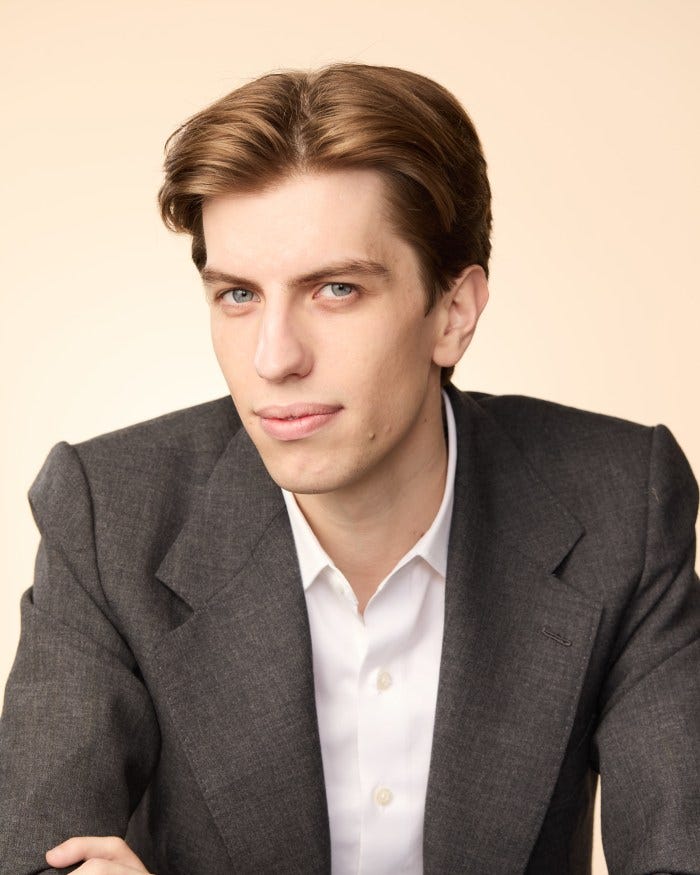
Situational Awareness gained roughly 439% after fees through the end of June 2026 and grew to as much as $45 billion before the AI sell-off.
His cult-like image is like being an AGI prophet, a term which of course philosophically I don’t agree with. Real AGI before this AI cycle meant something entirely different to what it does today warped by the likes of Sam Altman and OpenAI for marketing purposes.
This is bigger than Leo though, some sources claim the fund attracted significant participation from people across the AI industry, including a number of Anthropic employees, often through SPVs. Some are now trying to determine their exposure.
The turmoil is an early and potentially significant test of the investment thesis that made Aschenbrenner one of the most closely watched figures in the AI trade. Did he not realize the Fed might have raised rates yesterday? I don’t fully understand. How young are his co-conspirators? The story makes for a good headline but what can we really say about it? Leopold’s success appears to be more about his network, the promotion of his image, and influential and rich backers, rather than his intelligence. The Fund’s exposure in Neo Clouds and Semiconductor names was especially concentrated with many Substack finance Creators seemingly copying the strategy and boosting the same names.
Curiously, Research boutique Citrini posted some commentary on the potential developments at Situational Awareness on X Thursday. The post sought to downplay the gravity of the situation and opined that investors are likely to give Aschenbrenner the benefit of the doubt. Sure, he’s a genius and still very rich, I’ll definitely give him the benefit of the doubt. He still has powerful friends, nothing has materially changed.
A prodigy in economics doesn’t have the experience of the markets. He had more than $20 Bn. in assets as of late May. His bets in Sandisk, Bloom Energy, CoreWeave and Nebius were all suddenly down by 30 to 40% last month in the second half of July.
Literally the day after Citadel acquires his portofolio those same stocks surge after Microsoft’s spectacular Earnings (which weren’t even that good). Microsoft and Amazon are up big this week, and relative to Meta and Google it’s a tale of two kinds of incumbents struggling to keep up with the times. Such a crazy story. It’s such a situational awareness of why you should never try to time the market. Aschenbrenner reportedly referred to the current situation as “the best buying opportunity since April 2025,” in the letter the FT saw. Buying the dip has become very common in this AI bubble and Semiconductor boom with the encouragement of relatable – not so relatable, prophets of AI.
His thesis isn’t entirely wrong, the accelerating and exponential demand for compute is the key driver of this era. Aschenbrenner supposedly models stock selections directly on technical AI “Orders of Magnitude” (OOMs) scaling frameworks. His thesis assumes an imminent, exponential demand spike for effective compute and electricity leading into 2027–2028. He’s been rewarded handsomely for his unbridled AI optimism and ability to spot bottlenecks in the semiconductor supply-chain months to years before most investors.
It’s not a very academic thesis but one of power scaling due to the Capex buildout. The 24-year-old built the firm around the idea that increasingly powerful AI systems would require a vast expansion of chips, memory, data centers and electricity generation. A bit like Dwarkesh saying compute could get 10x more expensive.

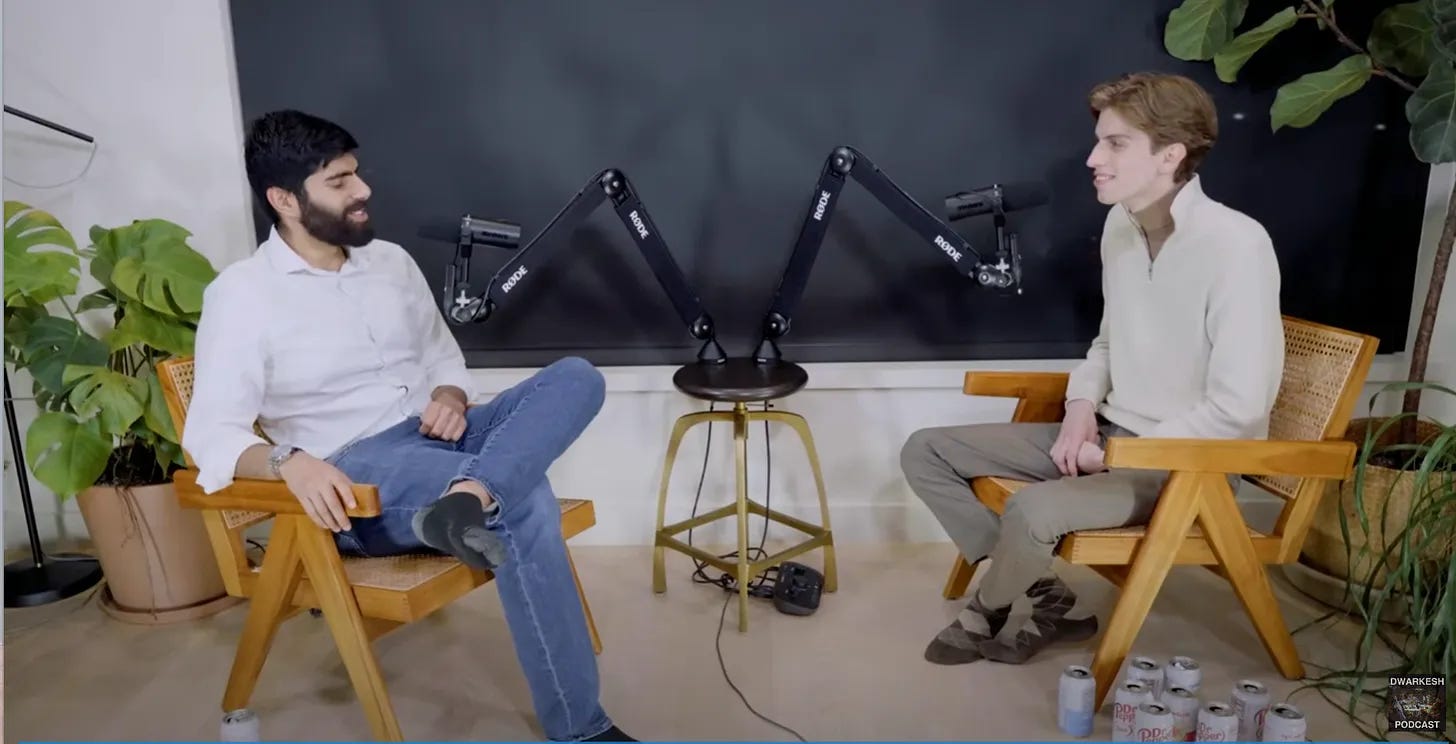
Dwarkesh who interviewed Leopold just over two years ago here before he had blown up as a YouTube Creator also with powerful connections. At least Dwarkesh has fairly stimulating debates and develops sophisticated positions. He isn’t just an AI booster. Leopold talking about AGI with insider Anthropic connections had good timing to seduce a lot of Tech boosting investors in a fairly significant AI bubble. But that was just his first act. He knew a lot of the right people, the same people who understood the AI bubble is engineered. How it’s manufactured to create more demand.
In a July 24 letter to investors, the fund described the tech rout as a buying opportunity and pointed to a potential Anthropic IPO as a forward catalyst for the sector, the FT reported. It’s barely a hiccup, Leopold Aschenbrenner’s July 24 investor letter for Situational Awareness reported a 439% net gain for H1 2026 despite severe losses from a July tech sell-off, prompting a capital raise for August 1, 2026. The letter also invited investors to commit additional capital from 1 August.
No big deal, it happens. The Nasdaq 100 has declined about 10% in July that is highly unusual to say the least, while South Korea’s Kospi has lost roughly one-third of its value, according to the Financial Times. Aschenbrenner told investors that several potential industry catalysts, including a widely anticipated initial public offering by AI company Anthropic, could support a recovery in AI-related equities during the second half of the year.
Geniuses build from Billionaire friends in the new America it would seem. Regulatory filings indicate the fund operates with a relatively small investment team, employing just four investment professionals despite managing billions of dollars in assets. The firm also relies on leverage provided by several major Wall Street prime brokers to increase exposure to AI-related investments. When you’ve made people this much money, they don’t care if you stumble.
But the leverage is so crazy AI optimistic it’s almost irrational. Situational Awareness’s March 31 Form 13F reported $13.68 billion across 42 entries. Approximately $8.46 billion, or 62% of the filing value, consisted of put-option exposure tied to semiconductor and technology securities. The story was one of the most cited AI stories around the web on Thursday late afternoon, July 30th, 2026.
CNBC’s David Faber on Situational Awareness
“Then July happened. His four largest US holdings each fell more than 35% in a month. The software shorts ripped against him at the same time. A book built to win in two directions lost in both at once,”
The story went so viral even Emily Sundberg wrote about it. The analyst Uttam Dey wrote a fascinating note on it.
“The Situational Awareness letter to shareholders addresses and accepts the mistake.
But blaming it on short-sellers and characterizing the ‘margin-call’ as a “bank-run”???
SA did very well to catch the right names: the fund is still 80%, despite the 67% drawdown. They should have just said a simple “We’re sorry. We’ll do better next time” and move on.”
CNBC’s Jim Cramer said the forced unwind of AI-focused hedge fund Situational Awareness shows how borrowing money can quickly magnify losses and trigger forced selling. It seems every Fintwit pundit had a tidbit about the volatility and the golden child of the market.
Citadel’s role in the story is also being analyzed, though I won’t get too much into that. It appears they were betting on a rate hike this week.
The firm’s rapid ascent has put it in the same neighborhood as hedge fund heavyweights such as Bill Ackman’s Pershing Square and Dan Loeb’s Third Point, according to the Journal. Leopold’s connection to Anthropic and Jane Street are just fascinating at a time when both are the leaders in their respective industries. Jane Street, the quantitative trading giant, is among the investors in Aschenbrenner’s hedge fund, according to the Wall Street Journal and there could be more to that story as well.
One of the major stories of the Semiconductor trade has been just how volatile stocks have been in places like South Korea’s KOSPI and Taiwan’s stock market where concentration in a few names like SK Hynix or TSMC is so leveraged. To call it bipolar would be an understatement, South Korea’s stock market staged its sharpest reversal on record on Friday, capping a month of wild swings. The benchmark Kospi was on track for its largest one-day jump, data from LSEG showed. Earlier in the week the KOSPI down as much as 12.6%. Leopold was especially over-leveraged there. As American financial whales are making South Korea and Taiwan’s stock market way more volatile than usual.
SK Hynix is the leader in HBM memory at about 60 percent global marketshare where recent Earnings showed a 257% year on year in the quarter ending in June from a year earlier, while operating profit soared nearly 557% year on year. The HBM leverage just three companies have and the margins they have after raising prices due to demand outstripping supply means SK Hynix, Micron and Samsung can set the prices they like.
The lessons for the Hedge Fund industry never truly end but that Leopold can make such a huge mistake and be fine is a testimony to how backed he is by very powerful and rich people. What remains is a roughly $5 billion stake in Anthropic and a handful of private holdings. The fund built to trade the AGI transition is now, functionally, a holding company. The AI exaggeration led to a valuable lesson but there’s no apology here.
TBPN, the Media company owned by OpenAI even had Martin Shkreli on to analyze the story. Ken Griffin keeps a $10 plaque behind his desk stating that if everyone is going to eat, someone has to sell, a blunt reminder that every part of running a firm, hiring, raising capital, winning clients, is fundamentally a sales process. When you exaggerate AGI and compute scaling do you become the ultimate AI profiteer where you can do risky leverage like this? Apparently that indeed is enough if you are Leopold Aschenbrenner, a genius, and the one true Nostradamus of AI.
A lot of people are making money on the AI bubble and the rise of Generative AI, even as the tech struggles to demonstrate value and become adopted by businesses in a meaningful way, and it’s not clear when the frenzy will end. Demand for HBM Memory chips isn’t going away anytime soon and neither is Capex being scaled back anytime soon so far as this week’s Earnings by BigTech or Semiconductor names shows. The market typically will become more volatile like this in the months or years before a major pull back.
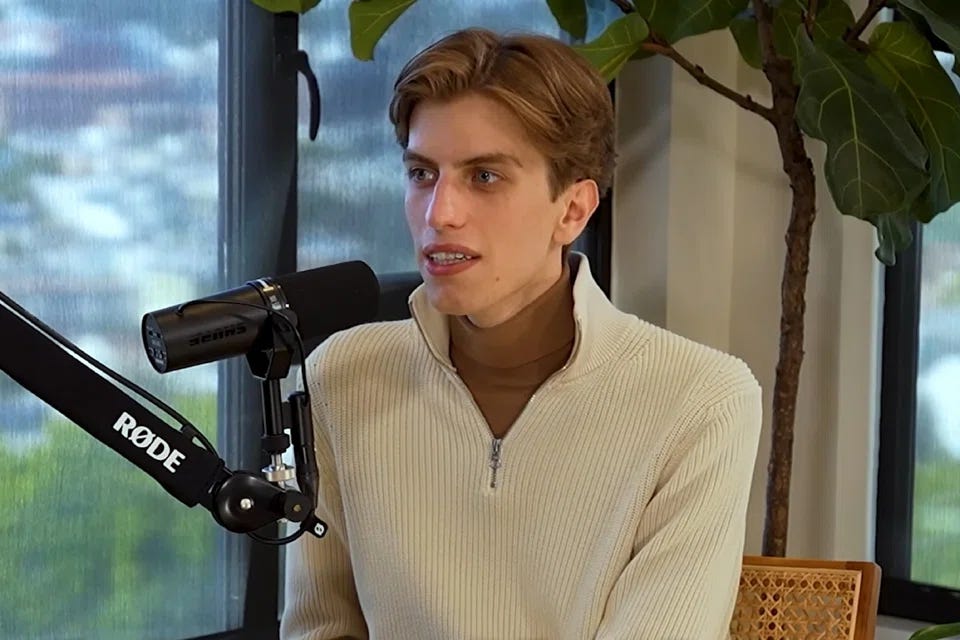
Leopold Aschenbrenner is now officially the GenZ poster boy of AI of 2026. There’s a Situational Awareness in the scaling laws of compute, rise of Neo Clouds and generational semiconductor returns we are seeing, and this isn’t the fall of Leopold, it’s only the beginning. The AGI prince and former FTX Future Fund intern has his thinking cap on and his heart of synthetic gold open for more investors. Let’s do AI business, and don’t forget to build in public like Leo.
Addendum
-
Read more about this story on Subsack.
-
Read more about this story on X.
-
Leopold on Wikipedia, last updated 4 hours ago.
-
View the Leopold Stock Tracker X profile.
-
Citadel Buyout of Portfolio Trending on X (July 31st, 2026)
I may add more material and tidbits here TBA.
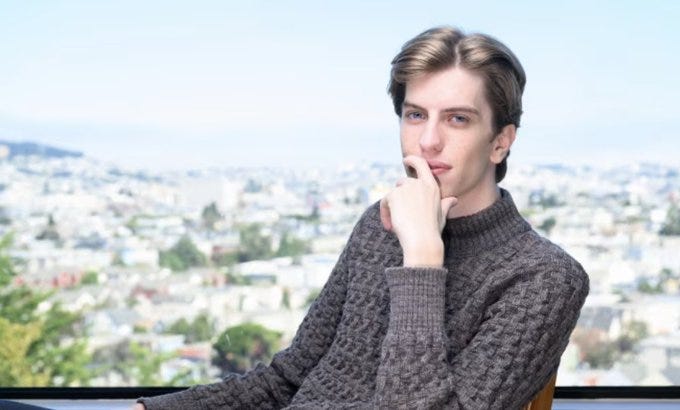
Commentary
July 28: Citadel “predicted” a surprise Fed rate hike, which historically tanks the market
July 29: Market sells off. Situational Awareness gets margin called. Fed left rates unchanged
July 30: Citadel acquires Leopold’s entire portfolio
July 31: Neo Clouds and Semiconductor names have a huge rally
Does it Pay to be Unwaveringly Optimistic about AI?

The AI bubble has significantly attracted more global investors and retail traders into the stock market at a time of higher inflation and a morbid affordability crisis. The K-shaped economy with elements of AI on GDP (not sustainable) while most consumers have been harmed by the technology is truly one of the weirdest moments in American history.
In reality GenZ are some of the most impacted by AI in entry level job opportunities, in Education and in an internet filled with damaging degrees of AI slop. But if you are an insider in the Anthropic Pantheon by marriage, you might have a golden future ahead. Generations collide in Technological euphoria and disruption.
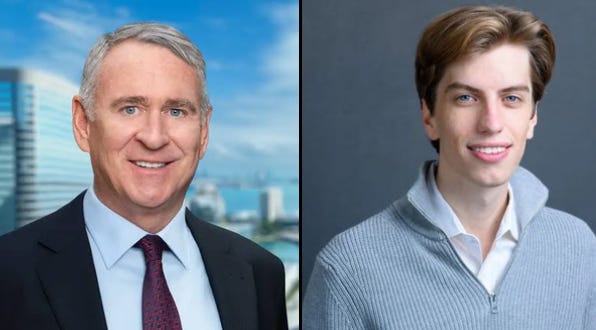
A market that ignores the bond market while focusing on this story is not a normal market. For Ken Griffin this is not the first time this has happend. There’s winners and losers in the Hedge Funds around AI too.
Let’s try to be aware of the situation out there. The moment the Fed hikes rates, it could be a very different market. You don’t need to have an HQ in San Francisco, popularize online gambling and rely on powerful friends to understand the AI reality.
Read More in AI Supremacy