[[{“value”:”
Hey AI Breakers 👋
You bought three courses this year. You finished none of them. And the one you did finish taught you something your job never asked for.
Today, you’ll build an AI Curriculum Engine and package it as an installable Claude Skill called skill-up, so it runs your learning plan every week without you rebuilding it.
-
✅ A Skill Gap Report showing what your role actually demands versus what you have
-
✅ A 6-week curriculum built entirely from free sources
-
✅ A real Claude Skill that Claude builds for you, with no folders or zip files
-
✅ Weekly sessions that teach, test, and apply the skill to your actual work
-
✅ A proof trail your manager can see at review time
-
✅ A quarterly re-scan so the plan never goes stale
Let’s build it 👇

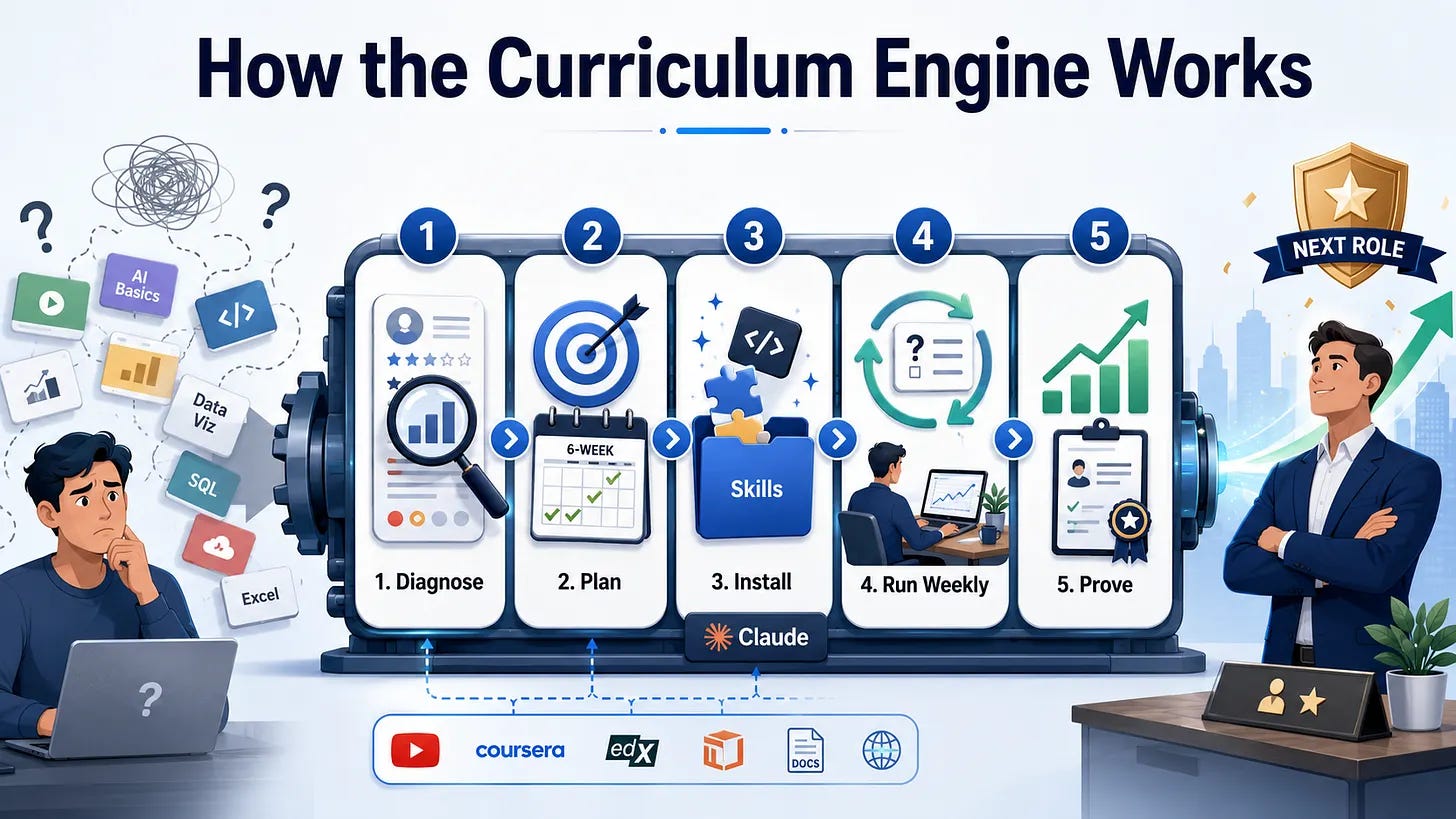
🧠 How the Curriculum Engine Works
Most course spending is guesswork. You buy the thing that looked interesting, not the thing your next promotion requires.
This flips the order:
-
🔎 Diagnose first. Find the gap between your current skills and the job above yours.
-
🎯 Then build the plan. One gap, six weeks, free sources only.
-
🧱 Then make it permanent. Bake the plan into a Claude Skill so it loads itself.
-
🧪 Then run it weekly. Teach, quiz, apply to something real on your desk.
-
📊 Then prove it. Turn learning into visible evidence at work.
The old way: $2,000 a year on courses, plus a Sunday afternoon planning what to learn, plus a 4% completion rate.
The AI way: 45 minutes to build it, then 30 minutes a week that runs itself.
💸 First, The Actual Math
The $2K is not a made-up number. It’s a normal year of professional development:
-
📚 Coursera Plus or similar annual subscription: ~$400
-
🎓 One certification, exam plus prep materials: ~$700
-
🎟️ One industry conference ticket: ~$600
-
🛒 Two or three one-off courses you bought at 2am: ~$300
🧠 Tip: Add up what you actually spent last year before you start. That number is your motivation for the next 45 minutes.
🏗️ PART 1: Build It (Once, About 45 Minutes)
Three things to run, in order. Then you never run them again.
—
🔎 Prompt #1 → The Gap Finder (What Your Job Actually Demands)
Everything downstream depends on this. You’re not asking what’s trendy, you’re asking what the job one level above yours requires that you can’t yet do.
The goal:
-
An honest inventory of your current skills
-
The specific gaps between you and the next role
-
Those gaps ranked by leverage, not by interest
✅ Use this to stop buying courses for skills nobody is asking you for.
Prompt:
You are a career development strategist who has audited skill gaps for hundreds of professionals across industries. You are direct and you do not flatter.

Here is my situation:
- Current role: [YOUR JOB TITLE]
- Industry: [YOUR INDUSTRY]
- Company size: [SIZE, e.g. 200-person SaaS company]
- Years in this role: [NUMBER]
- What I actually do all week: [3-5 BULLETS OF YOUR REAL TASKS]
- Where I want to be in 18 months: [TARGET ROLE OR OUTCOME]
- Tools I use daily: [LIST]

Here are 3 job descriptions for the role I want next:
[PASTE 3 REAL JOB DESCRIPTIONS FROM LINKEDIN OR INDEED]

Do the following:

1. Extract every skill, tool, and competency that appears across those 3 job descriptions. Mark each as APPEARS IN ALL 3, APPEARS IN 2, or APPEARS IN 1.

2. Score me on each one using only what I told you above: HAVE IT, PARTIAL, or MISSING. Where you are guessing, say so.

3. Build a Skill Gap Report table with these columns: Skill | Demand Level | My Level | Gap Size | Leverage Score (1-10).

Leverage Score = how much closing this specific gap would change how I am seen at work in the next 6 months. A skill that is rare, visible, and immediately usable scores high. A skill that is common or invisible scores low.

4. Name my TOP 3 GAPS ranked by Leverage Score, with one sentence each on why that gap is costing me right now.

5. Name 2 skills I am currently investing in that are NOT worth the time based on this analysis, and say plainly why.

End with a single line: "PRIORITY GAP: [skill name]"
💡 Tip: Pull the 3 job descriptions from companies you’d genuinely move to, not just your own company’s internal ladder. Internal job descriptions are usually years out of date. External ones tell you what the market is pricing right now.
🎯 Prompt #2 → The Curriculum Architect (Six Weeks, Zero Dollars)
Now you turn one gap into a real plan. The constraint that makes this work: free sources only, and every week ends with something applied to your actual job.
The goal:
-
A 6-week curriculum for your single highest-leverage gap
-
Free sources only, with named alternatives in case a link dies
-
A real work deliverable attached to every week
✅ Use this to replace the $400 course you were about to buy.
Prompt:
You are a curriculum designer who builds practical learning plans for working professionals with limited time. You believe skills are proven by output, not by hours watched.

Here is my Skill Gap Report:
[PASTE FULL OUTPUT FROM PROMPT #1]

Build me a 6-week curriculum for my PRIORITY GAP only. Ignore the other gaps for now.

Constraints:
- I have 3 hours per week, total. Not more.
- Free sources only: official documentation, YouTube, free tiers, open courseware, public repos, free trials. If you recommend anything paid, you must justify why nothing free is adequate.
- Every week must end with a deliverable I can use at my actual job.

For each of the 6 weeks, give me:

1. WEEK THEME: one line
2. LEARNING OBJECTIVE: what I can do by Friday that I cannot do today, stated as a verb
3. SOURCES: 2-3 specific free resources. Give the exact title and creator or organization so I can search for it. Do not invent URLs. If you are not confident a resource exists, say "search for:" and give me the search terms instead.
4. THE 3 HOURS: how to split the time across the week
5. WORK APPLICATION: a specific thing at my job where I apply this skill this week
6. PROOF ARTIFACT: what I will have created that someone else could look at

Then add:

7. A "COMPETENCE CHECKPOINT" for week 3 and week 6: five questions I should be able to answer, and one task I should be able to complete unaided. These are the tests, not quizzes for fun.

8. A "DROP THIS IF" line: the honest signal that tells me this skill is not paying off and I should stop.

Keep it concrete. No filler weeks.
🧠 Tip: That last instruction about not inventing URLs matters. AI models are confident about links that don’t exist. Asking for the creator name plus search terms gets you to the real resource without the dead link detour.
🧱 The Build → The Skill Builder (The Prompt That Creates the Skill)
This is the one that matters, and it is a different animal from the two above. Prompts #1 and #2 gave you raw material. This one turns it into a thing that exists.
Important: you are not making folders or zipping anything. You describe the skill, Claude builds it.
The goal:
-
Your gap report and curriculum baked in as permanent context
-
All three weekly routines living inside the skill, not in a doc you have to keep
-
Something you trigger with a sentence instead of rebuilding every Monday
✅ Use this to stop re-explaining your career situation at the start of every session.
Skill Prompt:
“}]] Read More in The AI Break