
[[{“value”:”
Hey AI Breakers 👋
You’re the bottleneck. Every decision, every fire, every “quick” task still routes through you, and the work that actually grows the business keeps sliding to “later.”
Today, you’ll build an AI Delegation Engine that audits your real week and hands you a clear plan for the 10+ hours you should never be doing again.
Here’s what you’ll walk away with:
-
✅ A brutally honest map of where your week actually goes
-
✅ A filtered list of the few tasks that genuinely need you
-
✅ Every other task sorted into Delegate, Automate, Kill, or Keep
-
✅ A ranked order of what to offload first (by hours, cost, and pain)
-
✅ A plug-and-play handoff brief for each task you let go
-
✅ A weekly ritual that protects your reclaimed hours from creeping back
Let’s build it 👇

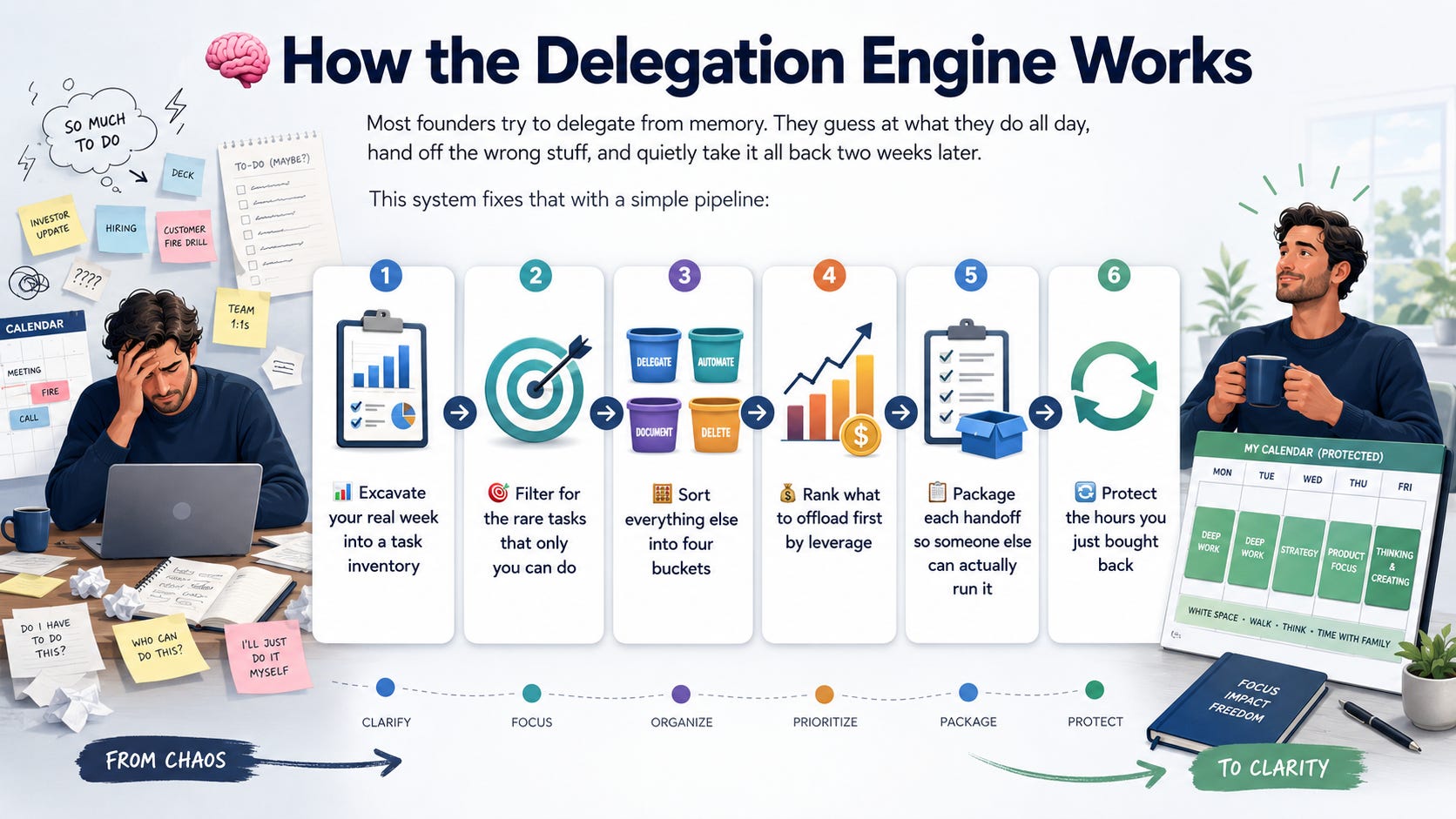
🧠 How the Delegation Engine Works
Most founders try to delegate from memory. They guess at what they do all day, hand off the wrong stuff, and quietly take it all back two weeks later.
This system fixes that with a simple pipeline:
-
📊 Excavate your real week into a task inventory
-
🎯 Filter for the rare tasks that only you can do
-
🧮 Sort everything else into four buckets
-
💰 Rank what to offload first by leverage
-
📋 Package each handoff so someone else can actually run it
-
🔁 Protect the hours you just bought back
Old way: a vague “I should delegate more” that never happens.
AI way: a finished, ranked delegation plan in about 45 minutes.
📊 Prompt #1 → The Time Excavator (Map Where Your Week Actually Goes)
You can’t delegate what you can’t see. This prompt rebuilds your real week into an honest task inventory before you decide anything.
The goal:
-
Capture every recurring task you touch, not just the obvious ones
-
Estimate honest hours per week for each
-
Flag the invisible work (context-switching, “quick” interruptions, rework)
✅ Use this to get the raw inventory every other prompt builds on.
Prompt:
You are an elite operations consultant and time-and-motion analyst who has
helped hundreds of founders escape the day-to-day of their business.

My context:
- My role: [YOUR TITLE, e.g. solo founder / CEO of a 6-person team]
- My business: [WHAT YOU DO + STAGE, e.g. B2B SaaS, ~$30K MRR]
- Team I can lean on: [WHO YOU HAVE, e.g. 1 VA, 1 contractor, or "just me"]

Your job is to interview me and rebuild a realistic picture of my week.

Do this:
1. Ask me to walk through a typical week, day by day, in plain language.
   Prompt me for the boring and invisible stuff too: email, Slack, approvals,
   "quick questions," meetings, rework, and context-switching.
2. Then turn my answers into a TASK INVENTORY table with these columns:
   Task | Category (Sales / Marketing / Ops / Finance / Product / Admin / People)
   | Est. hours per week | How often | Energy drain (Low/Med/High)
3. Add a row for anything I clearly forgot based on a business like mine.
4. Total my hours at the bottom and tell me honestly: does this look like a
   sustainable week or a founder heading for burnout?

Ask me your interview questions first. Do not build the table until I answer.
💡 Tip: Answer the interview like you’re venting to a friend, not writing a report. The messier and more honest your brain-dump, the sharper the inventory. Save the final table. You’ll paste it into every prompt below.
🎯 Prompt #2 → The Only-You Filter (Find What Truly Needs the Founder)
Founders cling to tasks they feel are essential. This prompt separates the handful of things only you can do from the pile you’ve just never let go of.
The goal:
-
Pressure-test every task against a strict “only the founder” standard
-
Expose the tasks you keep out of habit, ego, or fear, not necessity
-
Protect the few genuinely irreplaceable ones
✅ Use this to stop confusing “I’m good at this” with “only I can do this.”
Prompt:
You are a no-nonsense founder coach who has scaled and sold companies.
You are allergic to founders hoarding work that others could do.

Here is my task inventory from Prompt #1:
[PASTE YOUR TASK INVENTORY FROM PROMPT #1]

Go through every task and label each one with an OWNERSHIP VERDICT:
- ONLY-YOU: genuinely requires the founder (key relationships, vision,
  high-stakes decisions, things only your judgment or face can carry).
- COULD-BE-YOU: you do it well, but a trained person or tool could do 80%+.
- SHOULD-NOT-BE-YOU: you are actively the wrong person to be doing this.

Rules:
1. Be strict. Default to COULD-BE-YOU unless the task clearly fails the
   "would this damage the business if a capable other person did it?" test.
2. For every ONLY-YOU task, write one sentence on WHY it truly needs you.
   If you can't make a strong case, downgrade it.
3. Call out my top 3 "comfort hostages": tasks I'm clinging to for ego or
   habit that are quietly capping my growth.
4. Tell me what % of my weekly hours are currently ONLY-YOU work. If it's
   under 30%, explain what that means for me as a founder.
6. For each COULD-BE-YOU and SHOULD-NOT-BE-YOU task, name the single biggest
   reason I've probably avoided handing it off so far (fear of quality drop,
   no time to train, "nobody does it like me," or cost) so I can see my own
   blind spots before I try to delegate.
🧠 Tip: If the model is too soft on you, add “be harsher, assume I’m overrating my own importance.” Founders almost always overestimate how much is truly “only you.”
🧮 Prompt #3 → The Four-Bucket Sorter (Delegate / Automate / Kill / Keep)
Now every non-essential task gets a destination. This is the core of the engine: no task survives without a clear next move.
The goal:
-
Route every task into one of four buckets with a reason
-
Separate “hand to a human” from “hand to a tool” from “stop doing entirely”
-
Surface the tasks that shouldn’t exist at all
✅ Use this to turn a vague task list into concrete decisions.
Prompt:
You are an operations strategist who designs delegation systems for
time-strapped founders.

Here is my task inventory from Prompt #1:
[PASTE YOUR TASK INVENTORY FROM PROMPT #1]

And my ownership verdicts from Prompt #2:
[PASTE YOUR OWNERSHIP VERDICTS FROM PROMPT #2]

Sort EVERY task that is not ONLY-YOU into exactly one bucket:
- DELEGATE: hand to a person (VA, contractor, hire, or teammate).
- AUTOMATE: a tool, template, or simple workflow could do it (note the
  type of tool, e.g. scheduler, AI assistant, form, autoresponder).
- KILL: low value, busywork, or a task that only exists out of habit.
  Stop doing it entirely.
- KEEP (for now): leave with me temporarily, with a clear trigger for when
  it should move (e.g. "delegate once we hit X revenue / next hire").

For each task, output: Task | Bucket | One-line reason | If DELEGATE, who is
the cheapest capable owner (VA / contractor / specialist / existing teammate).

End with a quick tally: how many tasks and weekly hours land in each bucket,
and which single bucket would free the most time fastest.
💡 Tip: The KILL bucket is where the magic hides. Most founders can delete 3 to 5 recurring tasks outright and nobody notices. Be ruthless here before you spend money delegating anything.
💰 Prompt #4 → The Leverage Calculator (Rank What to Offload First)
You can’t offload everything at once. This prompt ranks your Delegate and Automate tasks so you start with the highest-leverage wins.
The goal:
-
Score each task by hours saved, cost to offload, and how much it drains you
-
Find the quick wins you can offload this week for almost nothing
-
Calculate the real value of the time you’re buying back
✅ Use this to build an offload order you can actually act on.
Prompt:
“}]] Read More in The AI Break