[[{“value”:”
Hey AI Breakers 👋
You drop Claude Code into a project, and it has no idea who you are, what you sell, or how you write.
Every session starts from zero, and you waste 15 minutes re-explaining your business before any real work happens.
Today, you’ll build an AI Context Foundation that loads your business permanently into Claude Code. One file. Five prompts. It survives across every session.
-
✅ A structured Business Snapshot that captures who you are, what you sell, and how you operate
-
✅ A clean, copy-paste CLAUDE.md file tailored to your role (founder, creator, or agency)
-
✅ A reference folder plan that pulls past content, brand voice, and key decisions into context
-
✅ Three starter slash commands wired to your real workflows
-
✅ A smoke test that proves Claude actually knows your business
-
✅ A quarterly refresh prompt so your context never goes stale
Let’s build it 👇

🧠 How the AI Context Foundation Works
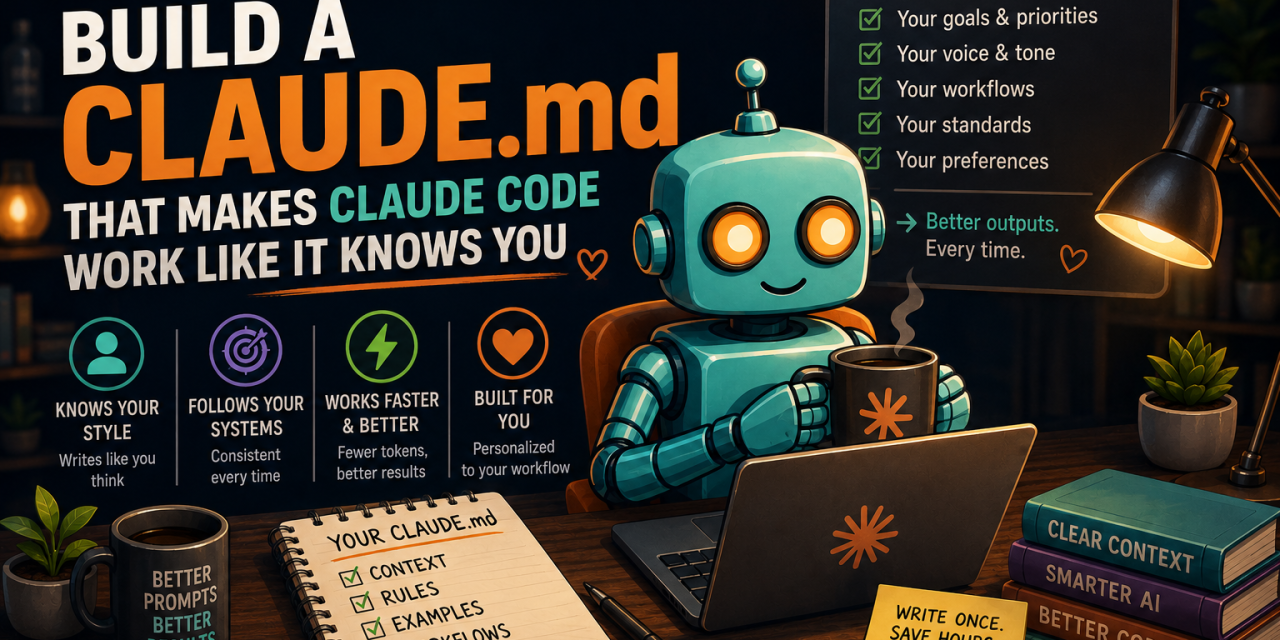
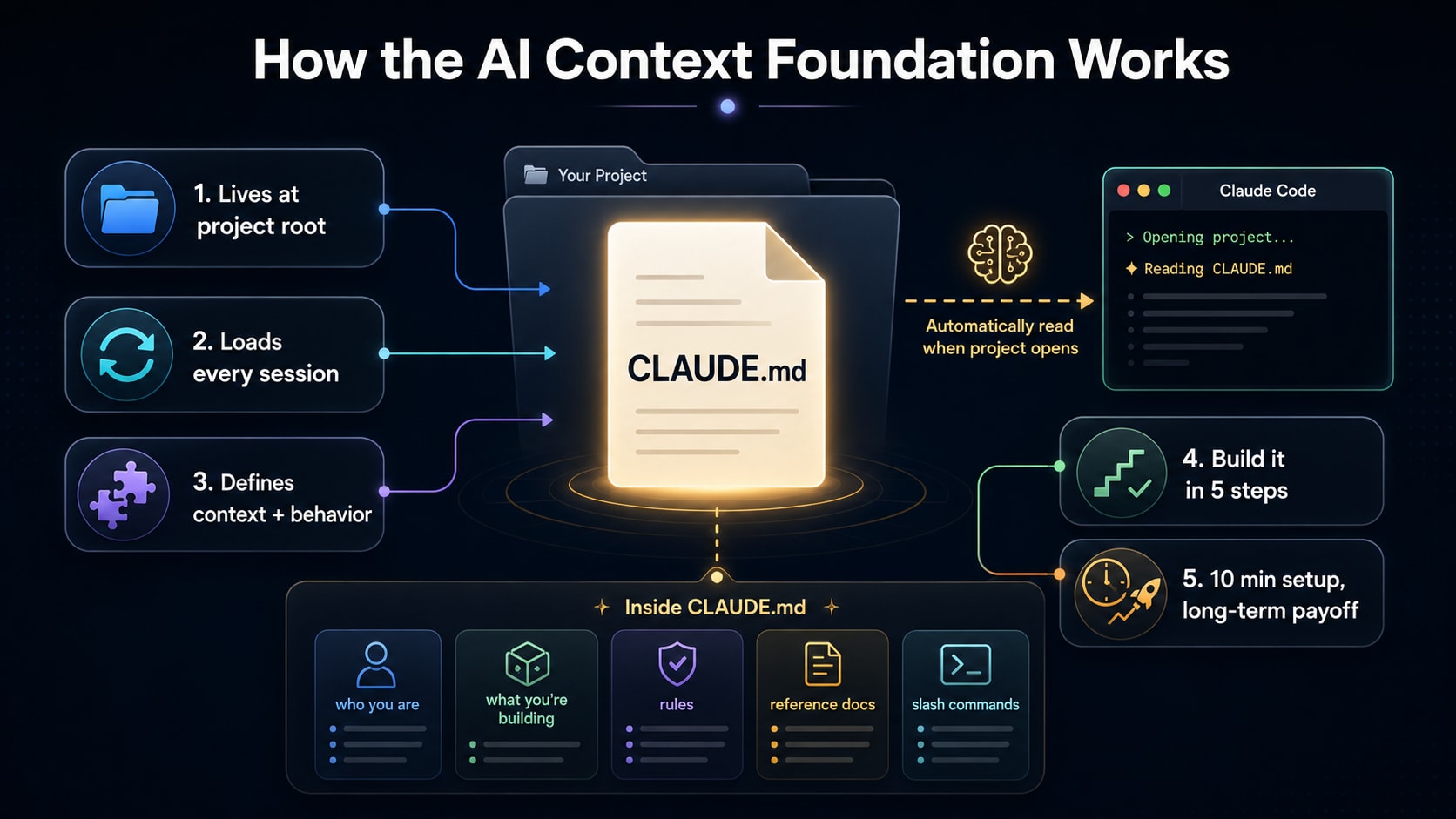
The whole system runs on one file Claude Code, which reads automatically every time you open a project: CLAUDE.md.
-
📍 Where it lives: at the root of your project folder
-
🔄 When it loads: every single session, automatically, no setup
-
🧩 What it does: tells Claude who you are, what you’re working on, and how you want it to behave
-
🪜 How we’ll build it: interview yourself, generate the file, add reference docs, seed slash commands, then stress-test it
-
⏱️ How long: about 10 minutes of focused work, then permanent payoff
🧱 Prompt #1 → The Business Snapshot Generator (Interview Yourself in Plain English)
Before we write a single line of CLAUDE.md, Claude needs to actually understand your business. This prompt runs a structured interview, then turns your answers into a clean profile.
Goals for this step:
-
Capture what you sell, who you sell it to, and how you make money
-
Surface your tone, your no-go zones, and your operating constraints
-
Produce one tidy “Business Snapshot” you’ll feed into every later prompt
✅ Use this to create a single source of truth about your business that Claude can reference forever.
Prompt:
You are a senior business analyst who specializes in extracting clear, structured business profiles from founders and operators in under 10 minutes.

I want you to interview me about my business so we can build a permanent context file for Claude Code. Ask me ONE question at a time. Wait for my answer before moving to the next.

Cover these areas in order:
1. Identity: my name, role, company name, and one-line description of what we do
2. Offer: what I sell, price points, and how customers buy
3. Audience: who my ideal customer is in plain language
4. Channels: where my customers come from (newsletter, social, ads, referrals)
5. Voice: 3 words that describe how I write or speak to customers
6. No-gos: topics, claims, or styles I never want Claude to produce
7. Tools and stack: the main tools I use day-to-day
8. Current focus: the #1 thing I'm working on this quarter

After I answer all 8 questions, output a clean "Business Snapshot" in this exact structure:

# Business Snapshot
## Who I Am
## What I Sell
## Who I Sell To
## Where Customers Come From
## Voice and Tone
## Hard No-Gos
## Stack
## This Quarter's Focus

Keep each section to 2-4 short bullets. No fluff. Save it as my single source of truth.

My role is: [FOUNDER / CONTENT CREATOR / AGENCY OPERATOR / OTHER]
My industry is: [YOUR INDUSTRY]

Start with question 1.
💡 Tip: Answer like you’re texting a smart friend, not writing a pitch deck. Short, honest, specific. The messier and more real your answers, the sharper the snapshot.
📐 Prompt #2 → The CLAUDE.md Architect (Turn Your Snapshot Into the Real File)
Now we convert that Business Snapshot into an actual CLAUDE.md file Claude Code will auto-load. This is the core artifact of the whole system.
Goals for this step:
-
Generate a clean, well-structured CLAUDE.md with the right sections
-
Match the file to your role (founder, creator, or agency)
-
Keep it under 200 lines so Claude reads it fast every session
✅ Use this to produce the actual file that goes at the root of your project folder.
Prompt:
You are a Claude Code power user who has set up dozens of CLAUDE.md files for solo operators and small teams. You know exactly what context Claude needs to behave like a true team member instead of a generic assistant.

Here is my Business Snapshot:

[paste output from Prompt #1]

Write a complete CLAUDE.md file for me. Use this structure:

1. # About This Project (1 paragraph: what this folder is, why Claude is here)
2. ## Who I Am (3-5 bullets from my snapshot)
3. ## What I Sell (offers, prices, audience)
4. ## My Voice (do's and don'ts, with 2-3 example phrases I'd actually use)
5. ## Hard Rules (things Claude must never do, in bullet form)
6. ## Default Behavior (when I ask for X, do Y)
7. ## Working Style (how I want Claude to communicate: brevity, format, when to ask vs. assume)
8. ## Reference Files (placeholder list, we'll fill it in next)

Rules:
- Keep the whole file under 200 lines
- Use second person where Claude is the subject ("You write in...", "You never...")
- Be specific, not generic. "Punchy and casual" beats "professional"
- End with a one-line reminder: "When in doubt, ask. Don't guess about the business."

Output the full markdown ready to paste into a file called CLAUDE.md.
💡 Tip: Don’t accept generic output. If a section reads like it could belong to any business, push back: “Rewrite section 4 with examples specific to my snapshot.” Claude will tighten fast.
Here are 3 real-feeling templates to anchor what good output looks like. Pick the one closest to your role and use it as a sanity check against what Claude generates.
—
Template A: Solo Founder (SaaS / digital product)
# About This Project
This is the working folder for Acme Analytics, a $39/mo SaaS that helps Shopify stores spot churn 30 days before it happens. Claude Code helps me ship features, write copy, and run small ops tasks.

## Who I Am
- Sara, solo technical founder
- 4 years building, 1 year on Acme
- Background: data engineering at a Series B retailer
- I work alone but ship like a team of 5

## What I Sell
- Acme Analytics: $39/mo, $390/yr
- ICP: Shopify stores doing $50K-$500K MRR
- Customers buy after a 14-day free trial, no card upfront

## My Voice
- Direct, warm, never salesy
- Use "you" and "I", never "we" (I'm solo)
- Examples: "Here's what's actually happening in your data."
- Avoid: "synergy", "leverage", "best-in-class"

## Hard Rules
- Never invent customer quotes or case studies
- Never claim a feature exists if it isn't shipped
- Never write in third person about Acme

## Default Behavior
- When I ask for copy, give me 3 punchy variations, not one polished draft
- When I ask for code, prefer simple Python over fancy abstractions
- When I ask "what should I do", ask 2 clarifying questions first

## Working Style
- Be concise. Bullets over paragraphs.
- Push back when my idea is weak. I'd rather hear "this won't work because..." than a polite yes.
- Always show your reasoning when changing more than 20 lines of code.

## Reference Files
- @docs/customer-interviews.md
- @docs/pricing-decisions.md
- @docs/landing-page-copy.md

When in doubt, ask. Don't guess about the business.
—
Template B: Content Creator (newsletter / course / community)
“}]] Read More in The AI Break