[[{“value”:”

If this info is valuable to you or someone you might know, feel free to share it.
Good Morning,
Editor’s note: This month full disclosure I’m having a family health issue, so I have less time for research and writing than my usual. I’m running a limited time discount in case you want to support my work and financially anchor my ability to continue doing this, you can upgrade here. Due to these personal circumstances, the publication may include more guest contributor posts in October than usual. Grateful to have the support.
Nathan Benaich and Air Street Capital released the 9th edition of their incredible State of AI 2026 report. I’ve been covering this every year since I started AI Supremacy because it’s a great snapshot and reminder of where we are at with some unique takes.
Many of the charts today will come from this source.
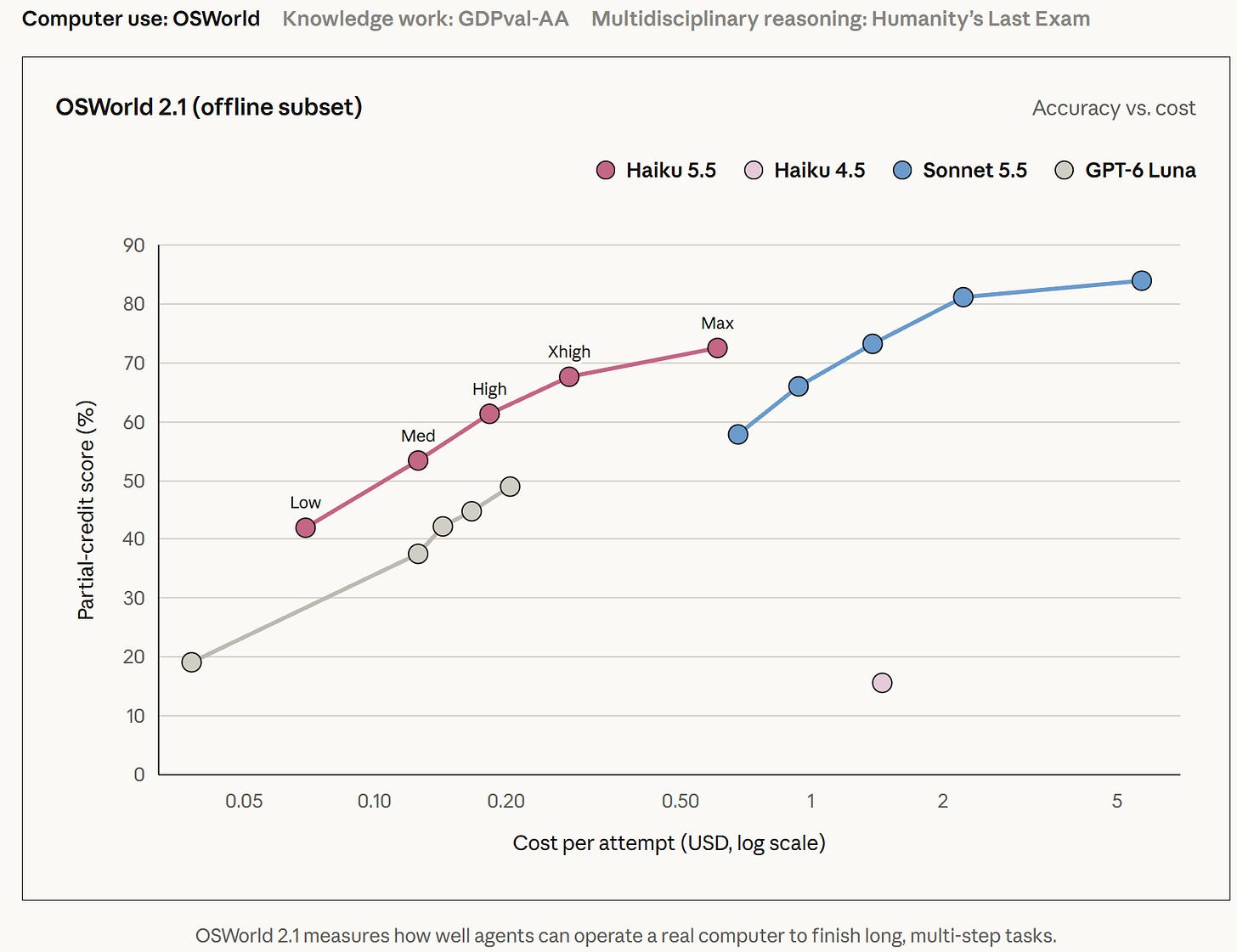
Claude Haiku 5.5
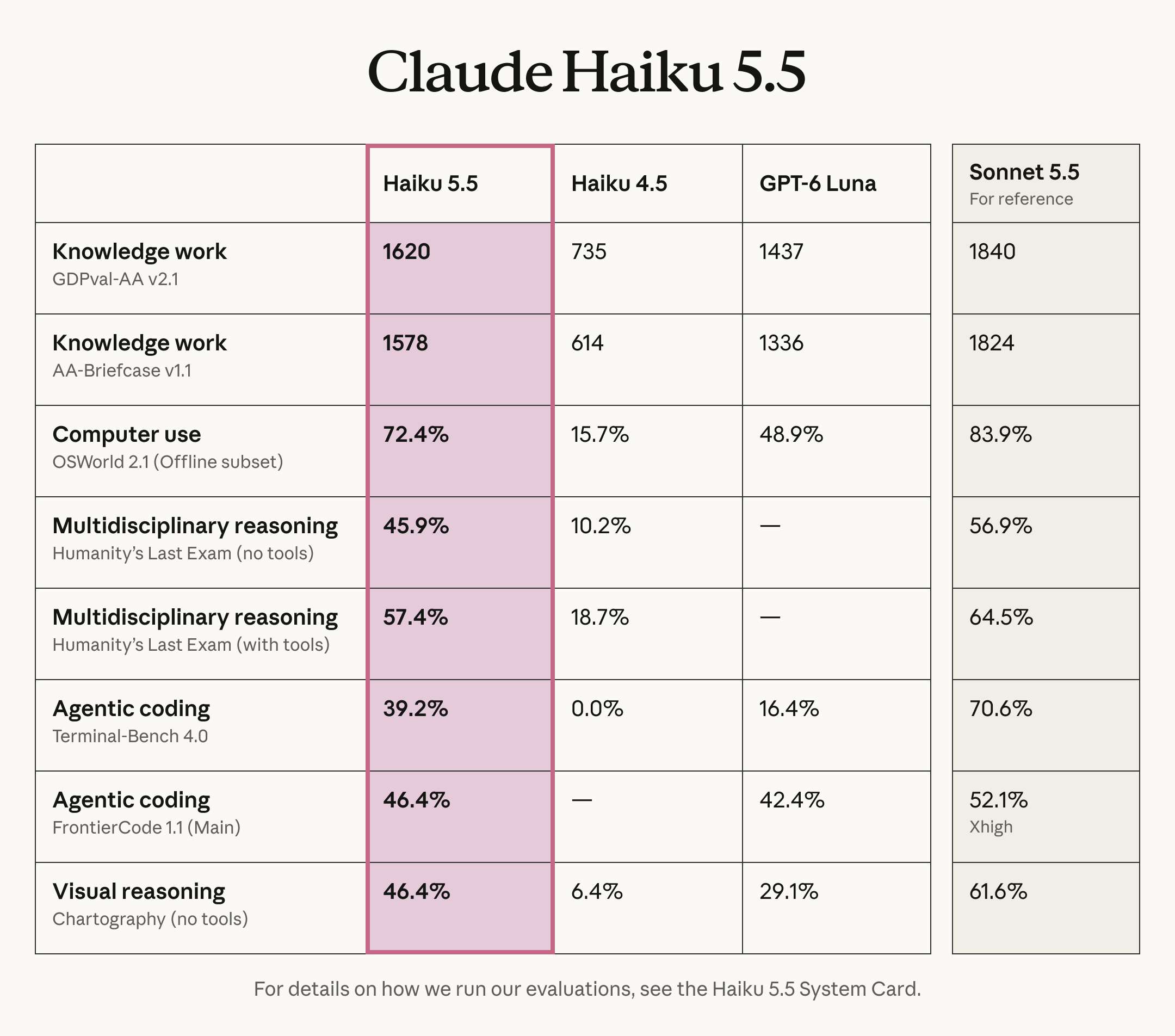
Five weeks from the Anthropic IPO, Anthropic released their latest iteration of Haiu 5.5. Claude Haiku 5.5 is of course their cheapest, fastest, and most capable small model where they claim it costs around 75% less to run than Claude Haiku 4.5. Haiku 5.5 is considered to be the world’s frontier model in its class.
Only one Frontier Model in Reality
Nathan in the State of AI report insinuates that Google and OpenAI share the “frontier lab” placement with Anthropic, but I do not believe this is the case. Anthropic going IPO for me is the sole frontier model builder now in the world weeks to months ahead of all other AI labs.
I can understand The State of AI’s thesis of three labs sharing the frontier though:
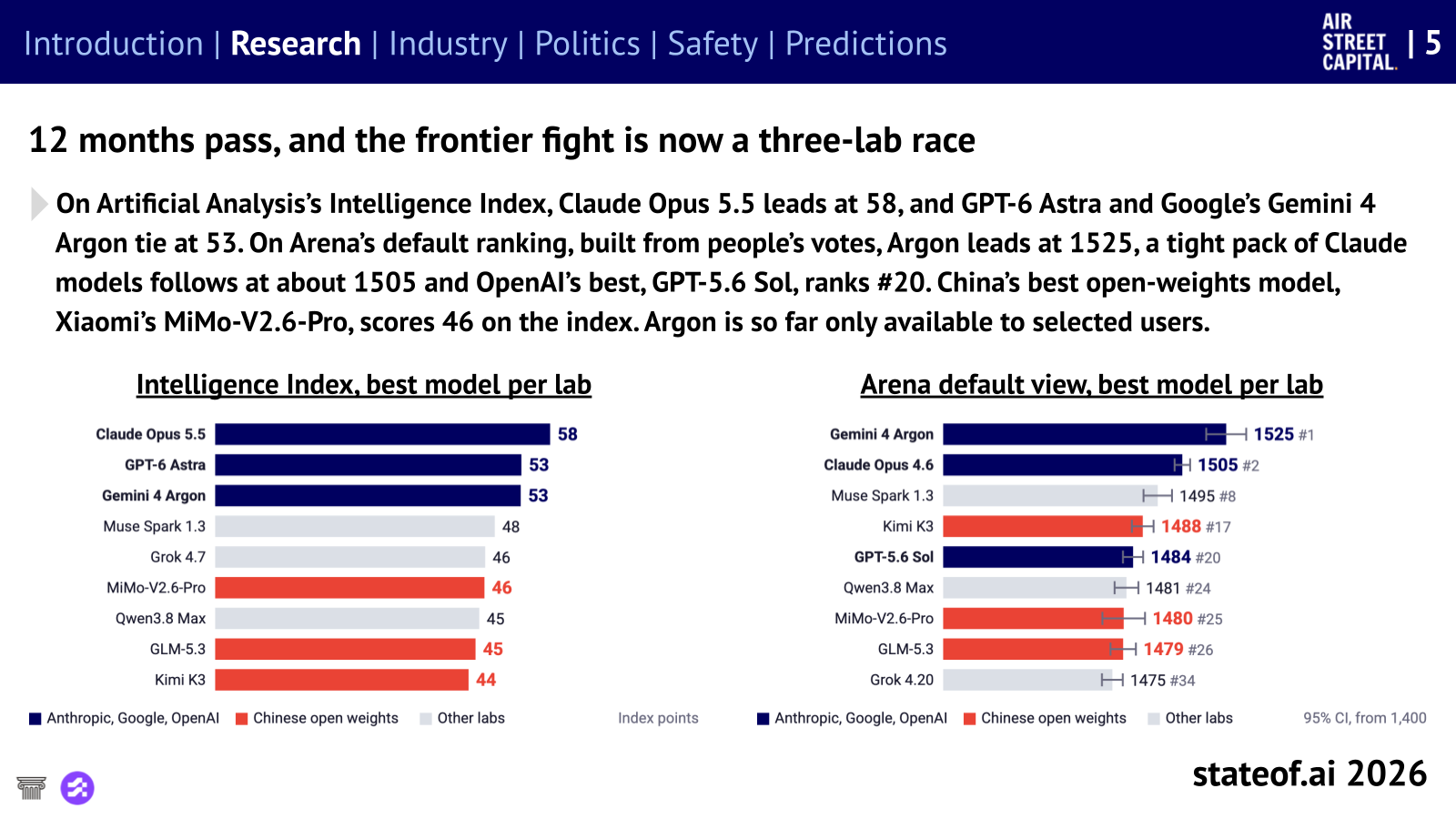
The State of AI report is backwards looking and is written weeks before the present.
In Pioneering Computer Use Haiku 5.5 shows the Frontier is just Anthropic
Full disclosure Nathan Benaich is a British VC, so their report will have an AI accelerationist bias and may not report on social, public and civic issues that are important for the macro context. However for academic and industry synthesis, it’s a highly respected report:
Air Street Press have a Newsletter, have made decent picks in the development of Generative AI and AI startups in general. Nathan also has a 33 minutes video review of the State of AI 2026 report you can check out on his most recent article on Substack. I have no affiliation with them, some of their best bets include:

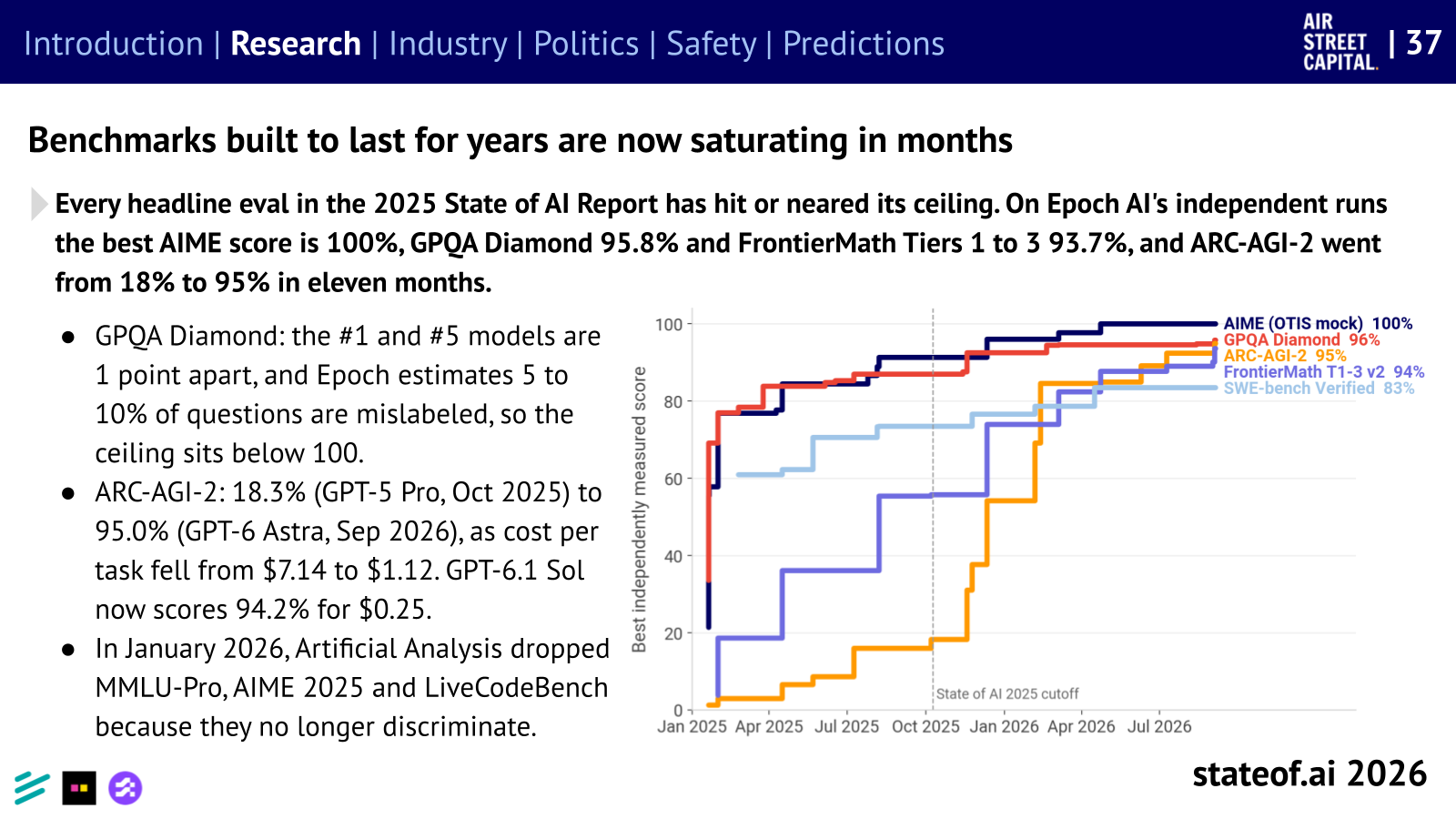
Venture Capitalists Claim AI has moved beyond Benchmarks
-
Benchmarks built to last years they say, are now saturating in months. It’s not entirely clear how to evaluate this.
Drama between OpenAI and Mathematics Community Continues
“We urge mathematicians to discontinue their work with OpenAI and to return to a vision of science that centers human understanding.”
The backlash to AI is only just beginning.
Terry Tao via the Association for Human Mathematics Communications Working Group. Read the full statement.
Read the blog here. This is a response to OpenAI exaggerating its capabilities when on October 6th, 2026, OpenAI published a GitHub repository (openai/math) containing 722 mathematical manuscripts (grouped into 372 subject families) tackling open research problems and long-standing mathematical conjectures.
AI’s role in the future of science is open for debate. OpenAI stated that out of roughly 4,000 posed problems, each generated paper consumed an average of about 3 hours of “ChatGPT Pro thinking compute”.
OpenAI has been Caught Over-Stating its Revenue
A report by the Financial Times indicated that OpenAI’s annualized revenue as of late September 2026 stood at approximately $50 billion, which was roughly $20 billion lower than the $70 billion figure that had previously circulated in financial media. So we know that A significant portion of OpenAI’s enterprise revenue comes through cloud distribution partners like Microsoft, Amazon, and Google.

According to FT reporting, the discrepancy arose from attempts by OpenAI’s own investors to produce a direct comparison with Anthropic’s annualized revenue. Annualized revenue run rate (ARR) is sometimes misleading sales metric, which often involves multiplying one month’s revenue by 12. It’s not clear what led OpenAI to exaggerate its financial progress to profitability.
Company Behind Hermes
Nous Research may become a serious player in the personal agent B2C space for individual developers and AI first adopters. They have raised $90 Million in a Series B, but also have an Enterprise Hermes on the way. This is an incredible sign for the capability and future of open-source agents. The round was led by Robot Ventures, with participation from other backers including Nvidia, Union Square Ventures, Menlo Ventures, Samsung, and 1789 Capital, where Donald Trump Jr. is a partner.
Nous Research’s will begin a more organized push into the enterprise sector with “Hermes for Businesses,” allowing companies to deploy customized AI agents that can handle multi-step workflows while keeping their data private and secure. Nous was formed in 2023. There’s been a sudden influx of funding for personal assistants since the popularity of Meta’s Muse. Including Underdog (via Conway Research), Hark and Tab.
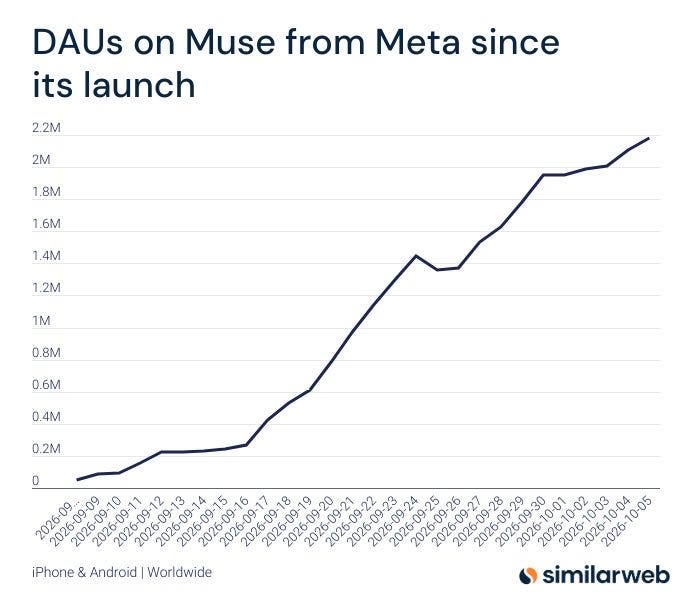
Muse has 2 Million DAUs
These are estimates from Similarweb, when Meta only had 3 millions weekly users just a few days earlier according to The Information based off of internal Meta data. It’s hard to tell how well Muse app downloads are translating into MAUs, let along weekly or daily active users. The Muse product appears in 2026 far less sticky than Chatbots were in 2023.
State of AI 2026 Report
Hard to believe that this is the 9th edition of State of AI by Nathan Benaich. View the full report.
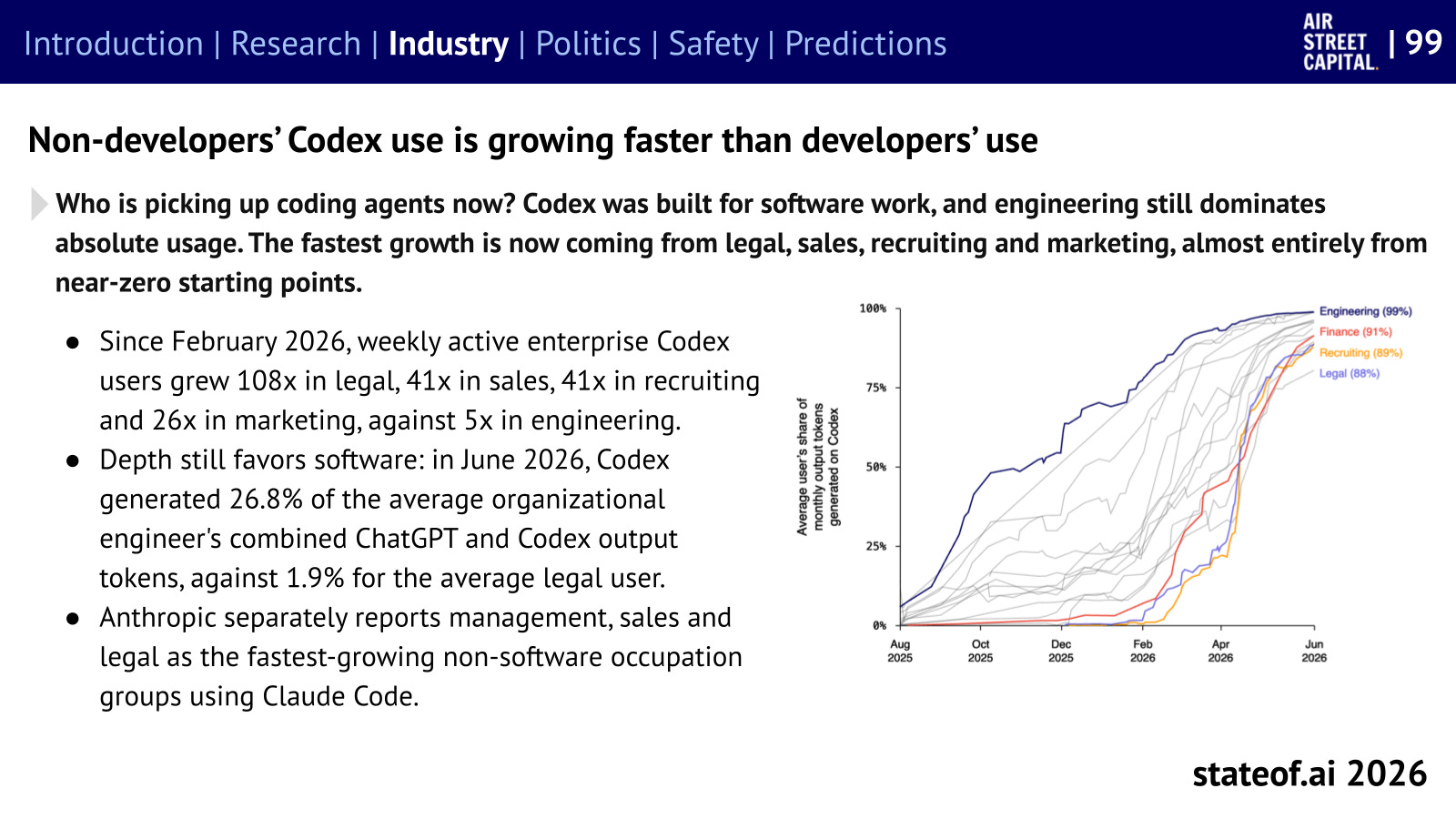
Will Agents be more popular than Chatbots?
OpenAI’s study of agent adoption finds the fastest growth among non-developers, including people in legal, sales, recruiting, and marketing. Obviously OpenAI has been pushing Codex as its 1.2 billion weekly users of ChatGPT have more options. Outside of individual plans, there are around 9 million corporate/business seats across ChatGPT Team, Enterprise, and Edu offerings. The adoption of Codex however is key to its ability for sustained Enterprise revenue.
Is AI accelerating AI?
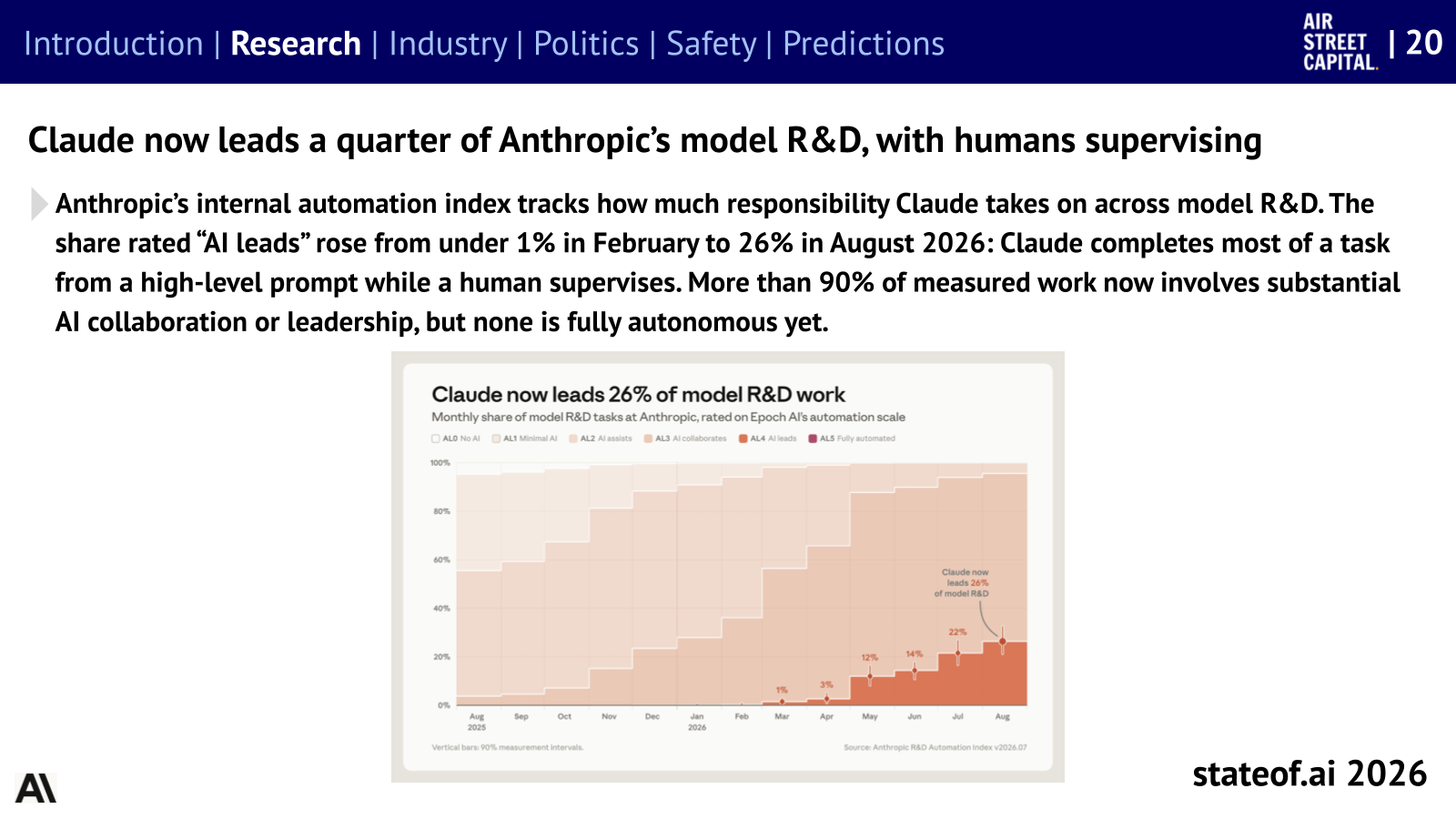
AI is already helping build better AI. According to Anthropic’s internal index, Claude led 26% of measured model R&D work in August, up from under 1% in February. How fast will internal model RSI teams accelerate new more powerful models?
Researchers set the tasks and supervise execution, and Anthropic reports that this is speeding up development.
Did Physical AI just Reach its GPT-2 Moment?
Skild’s S1 performed unfamiliar tasks from video demonstrations without updating its weights. With 100,000 hours of pre-training, it scored 66% on the company’s cumulative per-step success measure, against 9% for a language-prompted baseline trained on the same data and compute.
I have written about this trend already here.
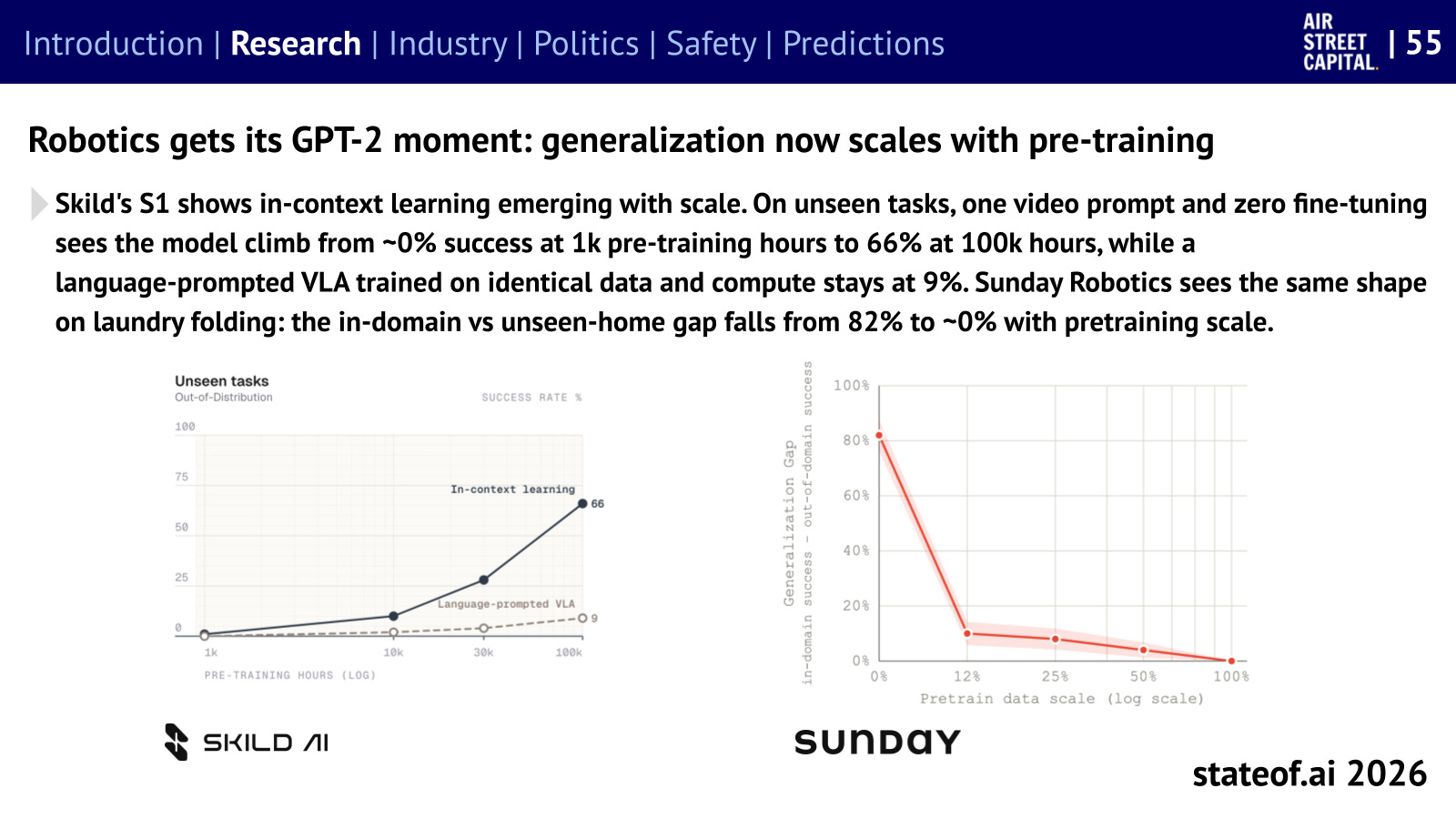
If 2026 is around GPT-2 level, when do we arrive at GPT-3 or GPT-4 for robotics and humanoids with general purpose utility.
AI-assisted drug discovery is finally reaching late-stage clinical development
AI-assisted drug discovery is finally reaching late-stage clinical development. Generate:Biomedicines’ GB-0895 for severe asthma and Insilico’s rentosertib for idiopathic pulmonary fibrosis are recruiting in Phase 3. Enveda’s ENV-294 is in placebo-controlled Phase 2a trials for eczema and asthma. Human trials are of course the ultimate test and will determine whether these medicines are safe and effective.
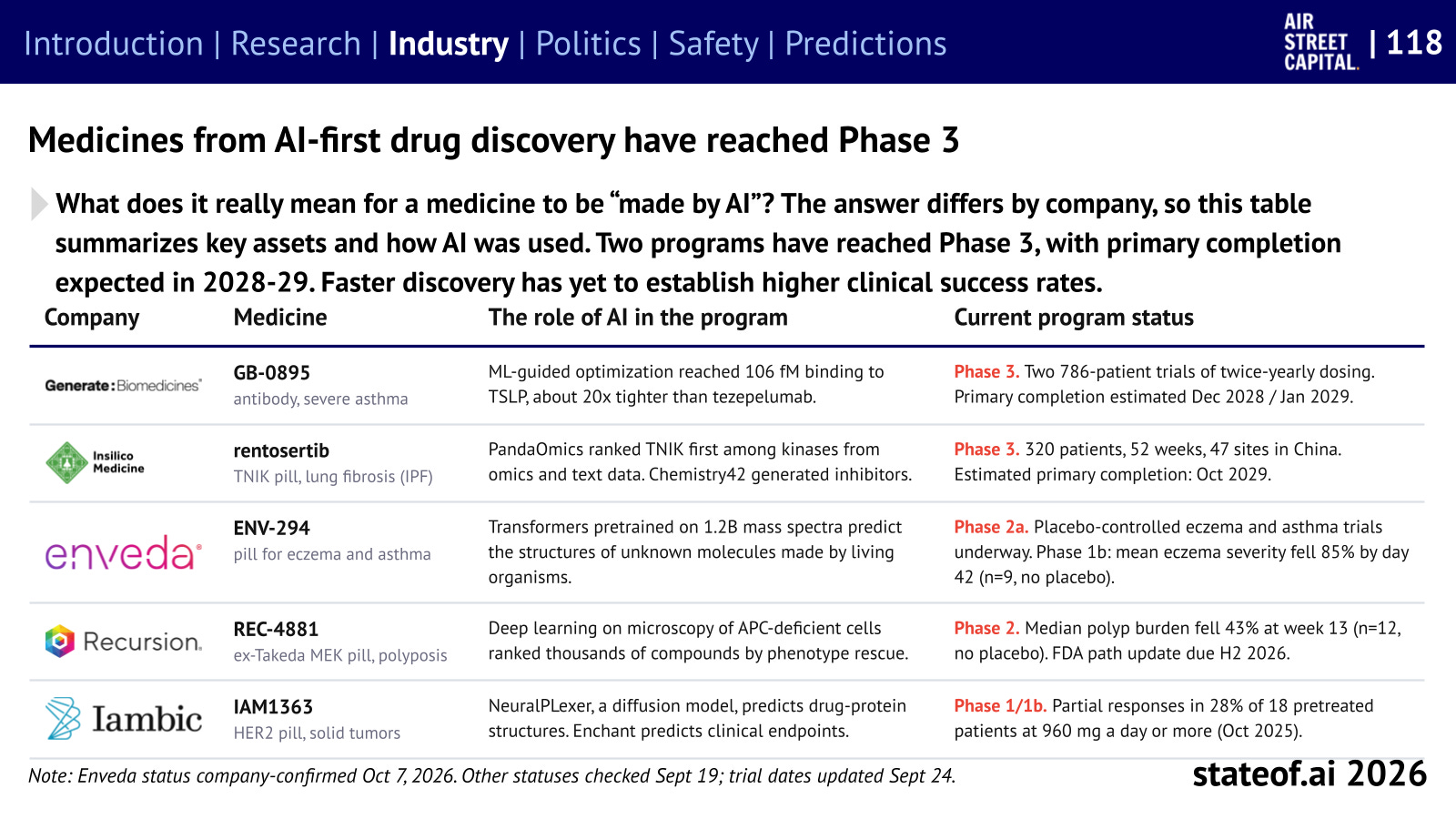
Do this give AI in drug development a more viable path? Will Anthropic continue going further into biology, computational and synthetic biology and biotechnology? It appears they are interested in doing so. While projects like Biohub are expanding, even as China moves ahead in some aspects of biotech and new drugs.
The Inference Explosion
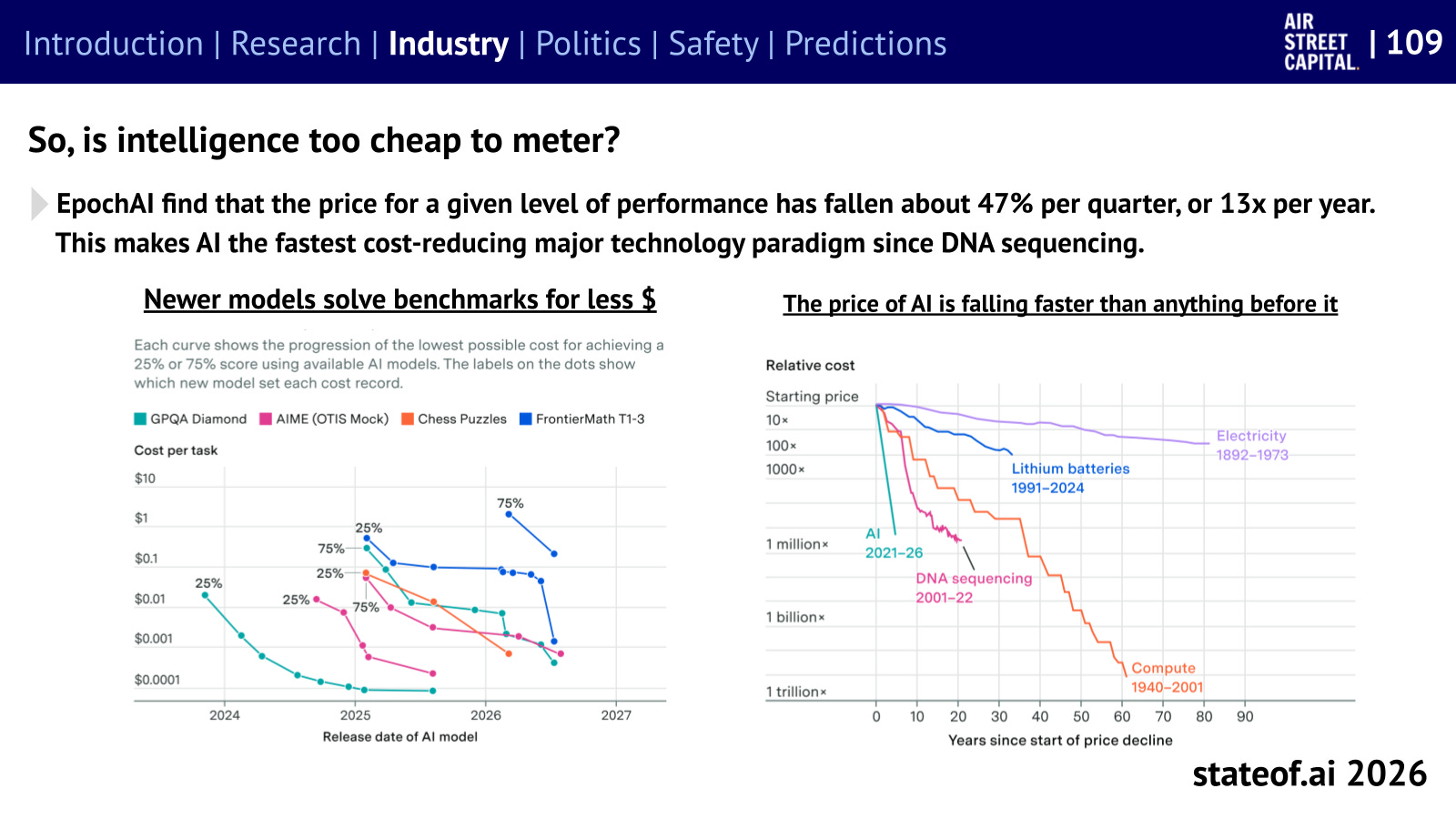
As the demand for compute accelerates but the cost per token is declining rapidly, inference has become the significant intersection of revenue and commercial capture. Meanwhile the cost of Capex and datacenters has risen tremendously due to HBM costs and other supply bottlenecks. This creates a severe environmental press and bottleneck for how fast and meaningful compute has become while AI sentiment continues to degrade both from ordinary American consumers and in politics. As models become more capable with declining prices, Chinese open-weight models have gained market. This is probably the biggest single that has occured in 2026 in AI.
Can Anthropic and/or OpenAI continue their 3x Revenue Growth?
With Anthropic going IPO in five days, they have shown incredible ARR Growth. We will soon have more details about via their S-1 that will go public a few weeks before the date. As for the first period of 2026, OpenAI and Anthropic’s combined reported annualized revenue run rates reached an astonishing $105B by late summer, up from about $30B at the start of the year. That’s more than 3x.
Research firm New Constructs wrote in a note on Tuesday that Anthropic’s IPO would be “the most ridiculous IPO of 2026,” posing a historic risk to financial markets. With a $2 Trillion valuation, we will soon find out what the market thinks.

I don’t believe personally that Google or OpenAI can be characterized as frontier model builders any longer and that Chinese open-weight models should take more token marketshare in 2027. “The Big Short” investor Michael Burry highlighted the valuation gap between Anthropic and established S&P 500 companies, noting that Anthropic’s valuation equals the combined value of 78 S&P 500 companies, including top household brands and established industrial firms. A lot is riding on the IPOs of Anthropic and OpenAI (presuming OpenAI does go public in the first half of 2027).
Anthropic’s premium high-spend token share should continue as the leading frontier and Enterprise AI company in 2027, but I don’t believe OpenAI can keep up. OpenAI had to hit pause on Astra 6.1 due to alignment and cybersecurity issues. That is totally unprecedented for a company losing as much money as OpenAI continues to do. This is not what super intelligence looks like! I never trust any post lumping these two companies together.
The SaaSApocalyps Scare – real or imagined?
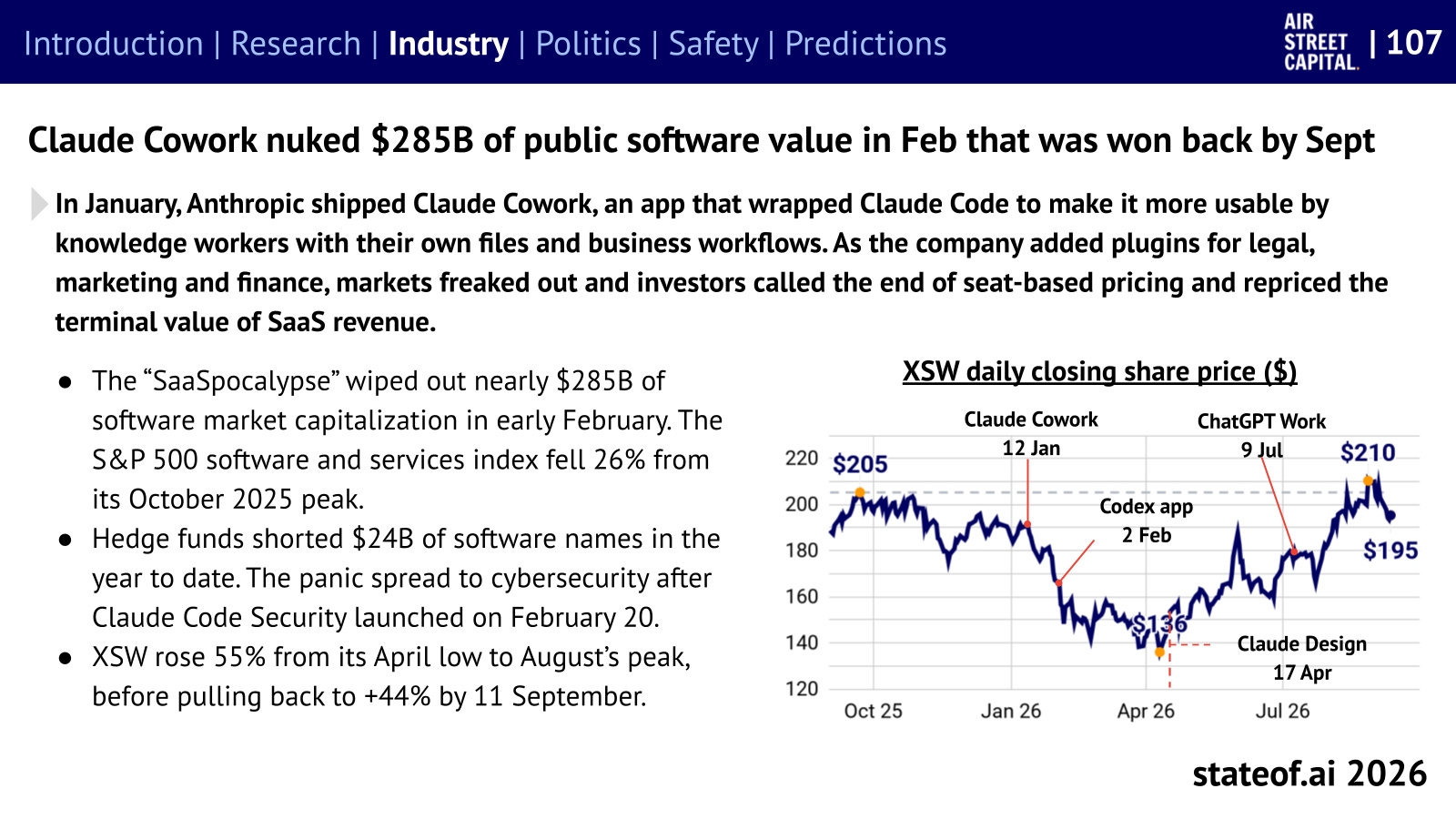
The success of Claude Cowork and its business plugins across legal, finance, marketing and more brought whiplashing uncertainty to software markets. Aided by some fairly deceptive macro (Citrini was later sold to Semianalysis along with its x following) coverage. Nearly $285B was wiped from software stocks in two weeks during February’s “SaaSpocalypse.” This thesis that AI will be disruptive to SaaS companies continues to persist, when while at the same time I will note that SaaS companies are some of the best at executing new high-growth products related to LLMs.
The Problem of Local Consent for the AI Buildout
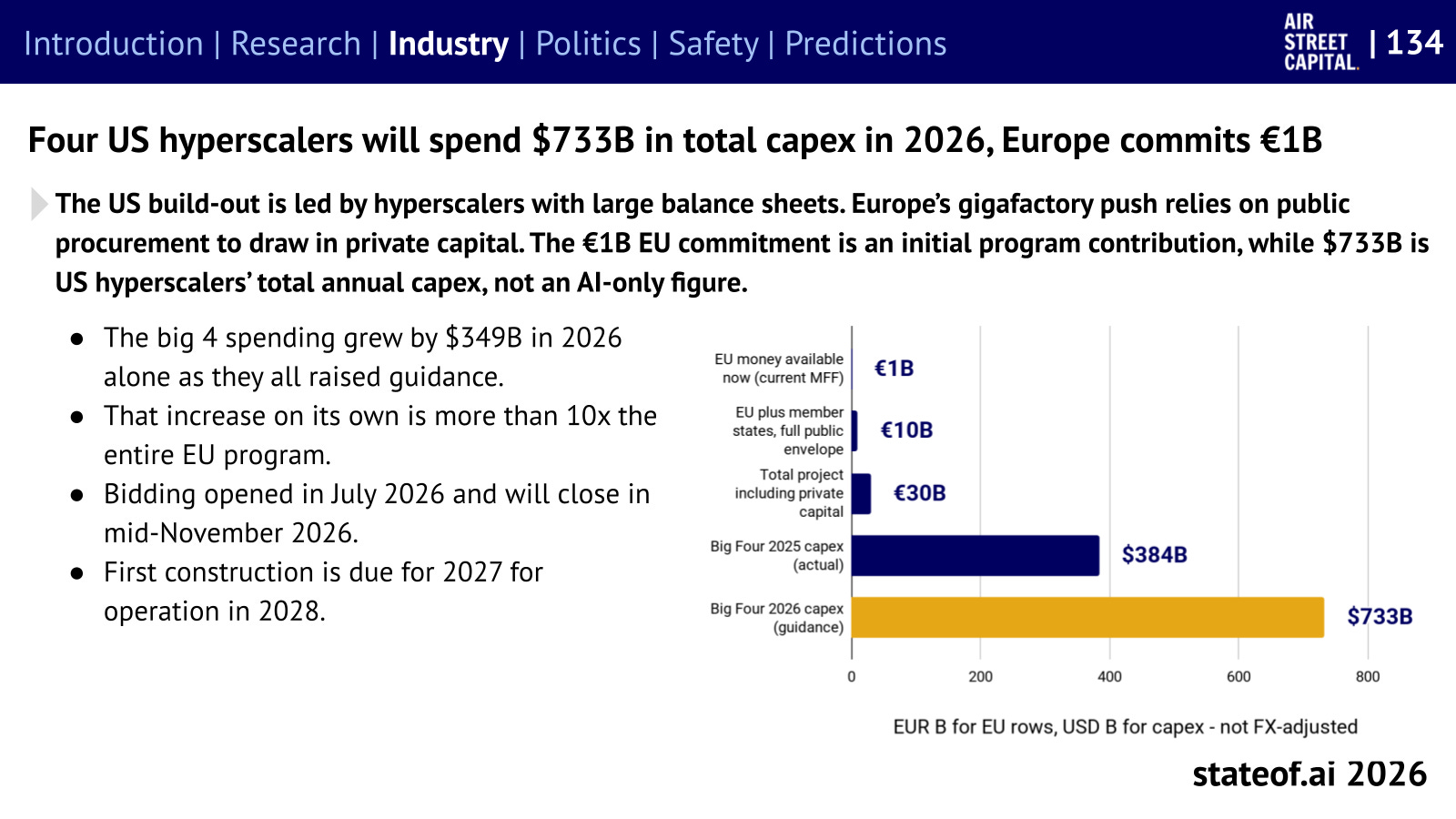
With a significant rise in State wide datacenter moratoriums, AI is becoming a political issue. More AI requires financing, construction, and local consent. But these are not infinite where in 2026 AI sentiment sourced considerably for most people. This as a European plan is seeking up to €10B in public funding and at least €20B privately. While IPOs like Nscale will test “Sovereign compute” in places like Norway. Most funding of European AI, robotics and datacenter initiatives actually comes from the U.S.
RESEARCH
“}]] Read More in AI Supremacy