[[{“value”:”
Hey AI Breakers 👋
Every company says AI is a priority. On most teams, nobody has actually shipped anything with it.
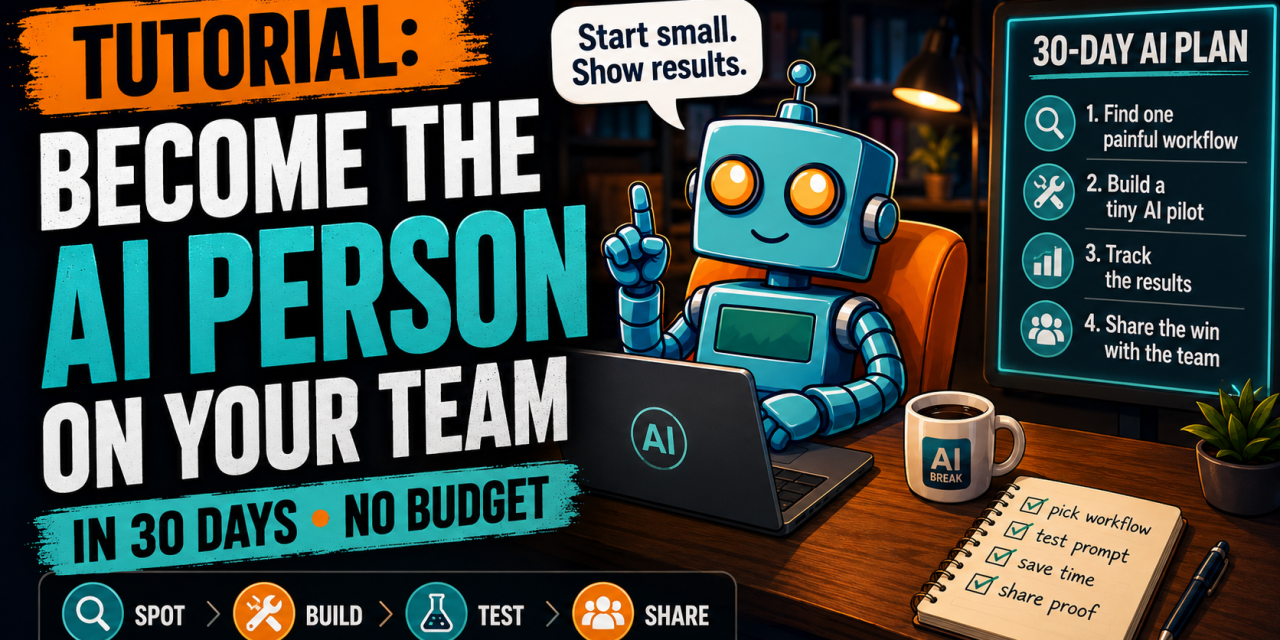
That gap is the opening. Today you’ll build an AI Champion System: a 30-day plan that turns one boring task on your desk into visible, provable proof that you are the person who makes AI work here.
Let’s build it 👇

🧠 How the AI Champion System Works
Most people try to become “the AI person” by talking. They mention AI in a meeting, get told there’s no budget, and nothing happens.
This system does the opposite. You build first, quietly, on your own work. Then you show a result nobody can argue with.
The 30 days break down like this:
-
📅 Week 1 → Scan your team’s pain, pick one pilot, write the baseline
-
🛠️ Week 2 → Build it and test it on your own tasks only
-
📊 Week 3 → Run it live, log results, catch the failures
-
🎤 Week 4 → Package the proof and have the conversation
The old way: pitch an idea, get asked for a business case you can’t build, lose momentum.
This way: arrive with the business case already finished, built on real numbers from your own desk.
One rule before we start. Check your company’s AI policy first. Whatever it says is the boundary for everything below.

🔍 Prompt #1 → The Team Scan (Finding Where the Pain Actually Is)
You can’t automate what you haven’t named. This prompt builds a Team Profile you’ll paste into every prompt that follows.
The goal:
-
A written snapshot of your team, your role, and what you’re allowed to use
-
Ten recurring pains, with rough time cost attached to each
-
Answers that are specific to your job, not generic AI advice
✅ Use this to stop guessing which problem is worth solving.
Prompt:
You are an operations analyst who specializes in finding automatable work
inside teams. You are practical and skeptical, not enthusiastic.

Before you answer anything, ask me these questions one at a time and wait
for my answer before moving to the next:

1. What is your job title and what does your team actually do?
2. How many people are on the team and what does each of them do?
3. What tools do you use daily? (email, spreadsheets, CRM, project tool, etc.)
4. What AI tools are you allowed to use at work? If you are not sure, say so.
5. What kinds of data are you NOT allowed to paste into an outside tool?
6. Walk me through a normal week. What do you do on repeat?
7. What does your team complain about most often?
8. What does your manager get asked about by THEIR boss?

Once I have answered all eight, produce two things.

FIRST, a block titled "TEAM PROFILE" that summarises my answers in under
200 words. Write it so it can be pasted into a fresh chat and give full
context. Include a line called CONSTRAINTS listing my tool and data limits.

SECOND, a table titled "PAIN LIST" with 10 recurring problems on my team.
For each one give me:
- The task or problem in one line
- Who currently does it
- How often it happens (daily / weekly / monthly)
- Rough time cost per occurrence
- Whether the pain is felt by me only, the team, or my manager's boss

Rank the list by total time burned per month. Use my own words where you can.
Do not include anything that would require buying software.
💡 Tip: Save the TEAM PROFILE block somewhere you can find it. Every prompt after this one starts by pasting it in. That’s what makes the outputs specific instead of generic.
🎯 Prompt #2 → The Pilot Picker (Choosing the One That Wins)
Ten problems is nine too many. The right first pilot is boring, frequent, and low risk if it goes wrong.
The goal:
-
Every candidate scored on the same criteria
-
One clear pick, with the reasoning written down
-
A do-not-start list so you don’t get tempted later
✅ Use this to pick the pilot that produces proof fastest.
Prompt:
You are the same operations analyst. Here is my context.

[PASTE YOUR TEAM PROFILE FROM PROMPT #1]

Here is my pain list.

[PASTE THE PAIN LIST FROM PROMPT #1]

Score all 10 candidates from 1 to 5 on each of these criteria:

- FREQUENCY: how often it happens (5 = daily)
- TIME COST: hours burned per month (5 = many hours)
- VISIBILITY: would my manager notice if this got faster? (5 = highly visible)
- SAFETY: how bad is it if the AI gets it wrong? (5 = harmless, easy to catch)
- DATA READY: is the input already text or a file I can legally use? (5 = yes)
- EFFORT: how quickly could one person build this alone? (5 = under 2 hours)

Weight SAFETY and DATA READY double. A pilot that leaks data or causes real
damage ends my credibility, so those matter more than upside.

Output:

1. A ranked table with all scores and a weighted total.
2. THE PICK: the single highest scorer, with a paragraph on why it wins and
   what specifically I will be able to show at the end of 30 days.
3. THE RUNNER-UP: one line on what would have to change for it to win.
4. DO NOT START: the three lowest scorers, with one line each on why they are
   traps for a first pilot.

Be blunt. If nothing on the list is a good first pilot, say so and tell me
what kind of task I should look for instead.
🧠 Tip: If the winner feels unimpressive, you’ve probably picked correctly. Boring and frequent beats impressive and rare, every time.
📏 Prompt #3 → The Baseline (Your “Before” Photo)
Without a written before, your after is just a claim. This is the step almost everyone skips, and it’s the one that makes the whole thing credible.
The goal:
-
Two or three numbers that describe how the task works today
-
A simple way to actually measure them this week
-
An honest note on what you can’t measure
✅ Use this to make your results impossible to wave away.
“}]] Read More in The AI Break