[[{“value”:”
Hey AI Breakers 👋
Your buyers don’t Google anymore. They ask ChatGPT, Claude, or Perplexity “who’s the best [your category]?” and trust the answer.
If you’re not in those answers, you don’t exist.
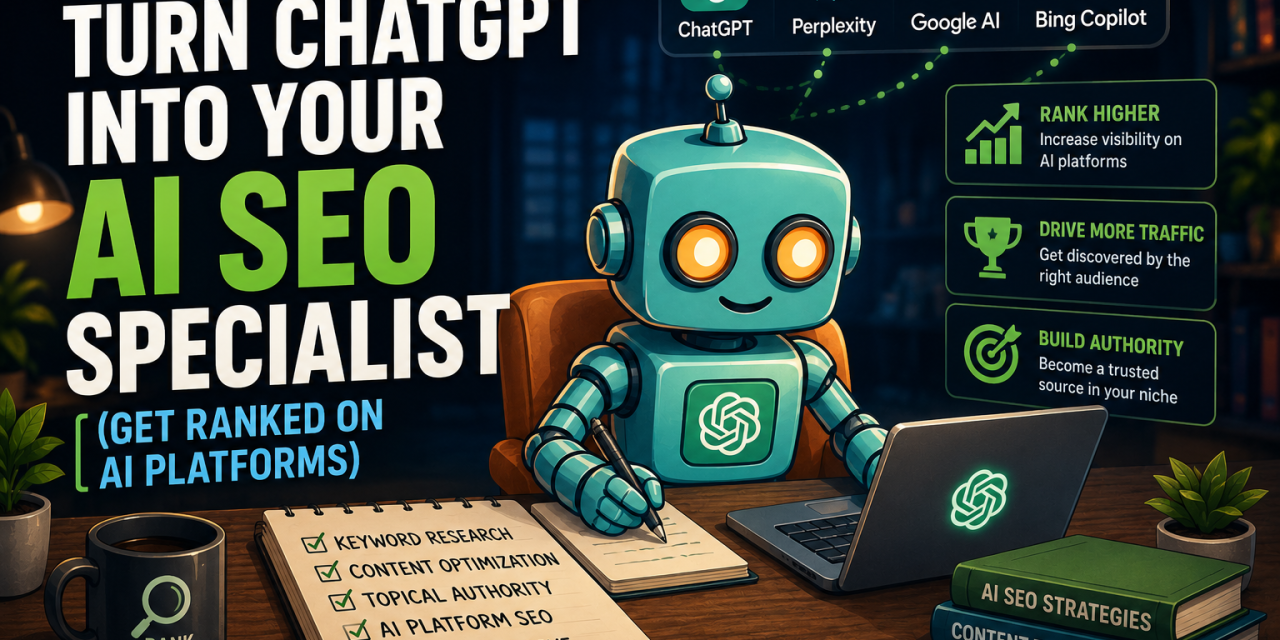
Today, you’ll build an AI AEO Engine that audits how AI assistants describe you, finds your recommendation gaps, and ships a 90-day plan to win the answer slot.
Here’s what you’ll walk away with:
-
✅ A visibility audit of how ChatGPT, Claude, and Perplexity describe you today
-
✅ The top 5 buyer questions you need to show up in
-
✅ A gap map comparing your surface area vs. your top 3 competitors
-
✅ A 90-day AEO content plan with priority order
-
✅ A complete editorial brief for your highest-leverage piece
-
✅ A monthly scorecard to track AI recommendations over time
Let’s build it 👇

🧠 How the AEO Engine Works
AEO stands for Answer Engine Optimization. It’s the new SEO, but for AI assistants instead of Google.
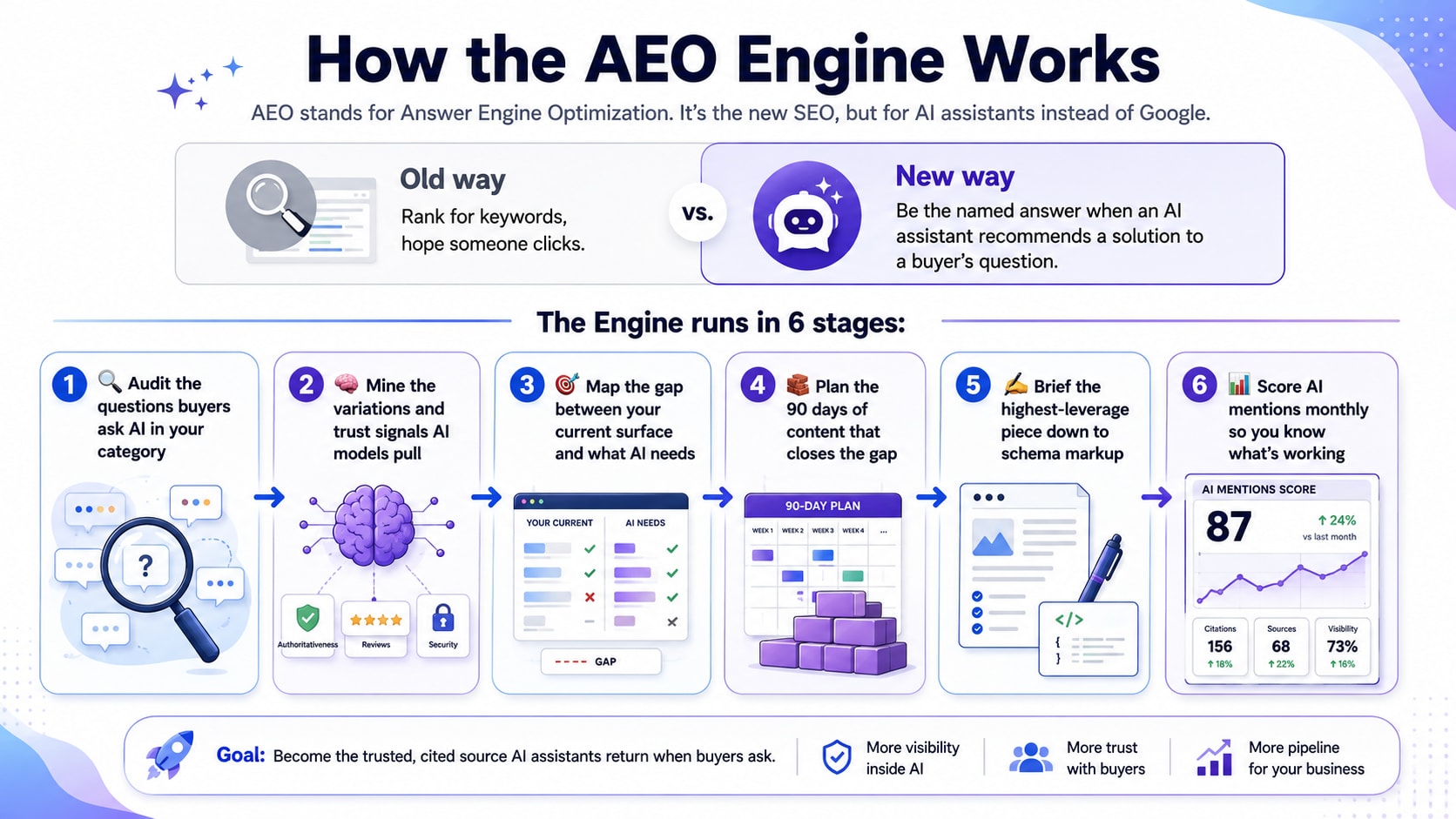
Old way: rank for keywords, hope someone clicks.
New way: be the named answer when an AI assistant recommends a solution to a buyer’s question.
The Engine runs in 6 stages:
-
🔎 Audit the questions buyers ask AI in your category
-
🧠 Mine the variations and trust signals AI models pull
-
🎯 Map the gap between your current surface and what AI needs
-
🧱 Plan the 90 days of content that closes the gap
-
✍️ Brief the highest-leverage piece down to schema markup
-
📊 Score AI mentions monthly so you know what’s working
Old way: 6 months of SEO consultants and $5K invoices.
AI way: 60 minutes of chained prompts and a quarterly content plan you can run yourself.
🔎 Prompt #1 → The Visibility Auditor (Find Where AI Currently Mentions You)
Before you optimize, you need to know what AI is already saying about you (or not).
The goal of this prompt:
-
Surface the 10 questions buyers in your category ask AI
-
Predict the kind of answer AI gives today
-
Rank the 5 highest-intent questions
✅ Use this to: get a clear baseline of where AI sits today before you spend a minute on content.
Prompt:
You are an AEO (Answer Engine Optimization) specialist who audits how AI assistants represent businesses in their responses.

I am running a visibility audit on my business. Here are the inputs:

Business name: [YOUR BUSINESS]
Category: [YOUR CATEGORY, e.g., "AI consulting in Lisbon", "B2B SaaS for HR teams"]
Target buyer: [YOUR ICP]
Top 3 competitors: [LIST 3]
Website: [URL]

Your job:
1. List the 10 questions a buyer in my category is most likely to ask ChatGPT, Claude, or Perplexity when researching solutions like mine.
2. For each question, predict the type of answer the AI will give (e.g., named recommendations, generic advice, no specific business).
3. Identify which 5 of those 10 questions are most likely to lead a buyer to actually purchase if I show up in the answer.
4. Rank those 5 questions by buyer intent (high to low).

Output as a numbered list with: Question | Likely Answer Type | Buyer Intent (1-10) | Why It Matters
💡 Tip: Run each of the top 5 questions in ChatGPT, Claude, and Perplexity yourself. Screenshot the real-world answers. That’s your starting line.
🧠 Prompt #2 → The Query Miner (Find the Variations AI Actually Answers)
Buyers rarely type the exact same question. AI assistants pull from variations and conversational follow-ups.
The goal:
-
Expand each high-intent question into 5 conversational variations
-
Surface what info AI needs to recommend a specific business
-
Identify the trust signals AI pulls from the open web
✅ Use this to: understand the full surface area you need to win, not just one keyword.
Prompt:
You are an AEO researcher specializing in conversational search behavior.

I have a list of 5 high-intent buyer questions in my category:

[paste the top 5 questions from Prompt #1]

For each of these 5 questions, do the following:
1. Generate 5 conversational variations a real buyer would phrase the question (more specific, with context, with constraints, or as follow-ups).
2. Identify what information the AI needs to recommend a specific business (e.g., named credentials, social proof, location, pricing transparency, integrations).
3. List the 3 signals AI models pull from the open web to make recommendations (e.g., review sites, comparison articles, podcast mentions, third-party citations).

Output:
Question 1: [original]
Variations: 5 reworded versions
Required Info: what the AI needs to recommend a business
Trust Signals: top 3 sources AI uses

Repeat for all 5 questions.
🧠 Tip: The variations matter most. AI doesn’t always answer the question you typed. It answers the question it thinks you meant.
🎯 Prompt #3 → The Gap Mapper (Compare Your Surface to What AI Needs)
Now you know what AI needs. Time to score how ready you are right now and see where competitors are eating your lunch.
The goal:
-
Score your current surface area on every high-intent question
-
Identify the top 3 gaps holding you back
-
See exactly where competitors beat you
✅ Use this to: stop guessing what to fix and get a prioritized punch list.
Prompt:
“}]] Read More in The AI Break