
Hello Engineering Leaders and AI Enthusiasts!
This newsletter brings you the latest AI updates in a crisp manner! Dive in for a quick recap of everything important that happened around AI in the past two weeks.
And a huge shoutout to our amazing readers. We appreciate you😊
In today’s edition:
🧠 ChatGPT enters personal health AI
🌍 Microsoft maps the global AI adoption gap
🩺 ChatGPT becomes a health helpdesk
🧬 Anthropic rolls out Claude for healthcare
💰 DeepSeek hints at cheaper AI training
🚗 Nvidia open-sources AI for self-driving
💡 Knowledge Nugget: Code Review in the Age of AI by Addy Osmani
Let’s go!
ChatGPT enters personal health AI
OpenAI introduced ChatGPT Health, a new private mode that lets users connect medical records and fitness data to have more personalized health conversations. Instead of generic advice, ChatGPT can now reference information from apps like Apple Health, MyFitnessPal, and Peloton, with U.S. users also able to import provider records via b.well.
Health chats run in an isolated environment with stronger encryption, and OpenAI says this data won’t be used to train its models. The move follows internal data showing over 40 million people already use ChatGPT daily for health-related questions. A waitlist opens now, with broader web and iOS access expected soon.
Why does this matter?
OpenAI is pushing deeper into another major vertical, following education and shopping, but healthcare carries far higher stakes. ChatGPT Health arrives as AI moves closer to regulated workflows, intensifying questions around trust, privacy, and where AI’s role in healthcare should stop.
Microsoft maps the global AI adoption gap
A new report from Microsoft’s AI Economy Institute shows global AI adoption hit 16.3% by late 2025, but growth isn’t evenly distributed. The UAE leads the world with 64% adoption among working-age adults, while the U.S. ranks just 24th despite hosting much of the world’s AI infrastructure and model development.
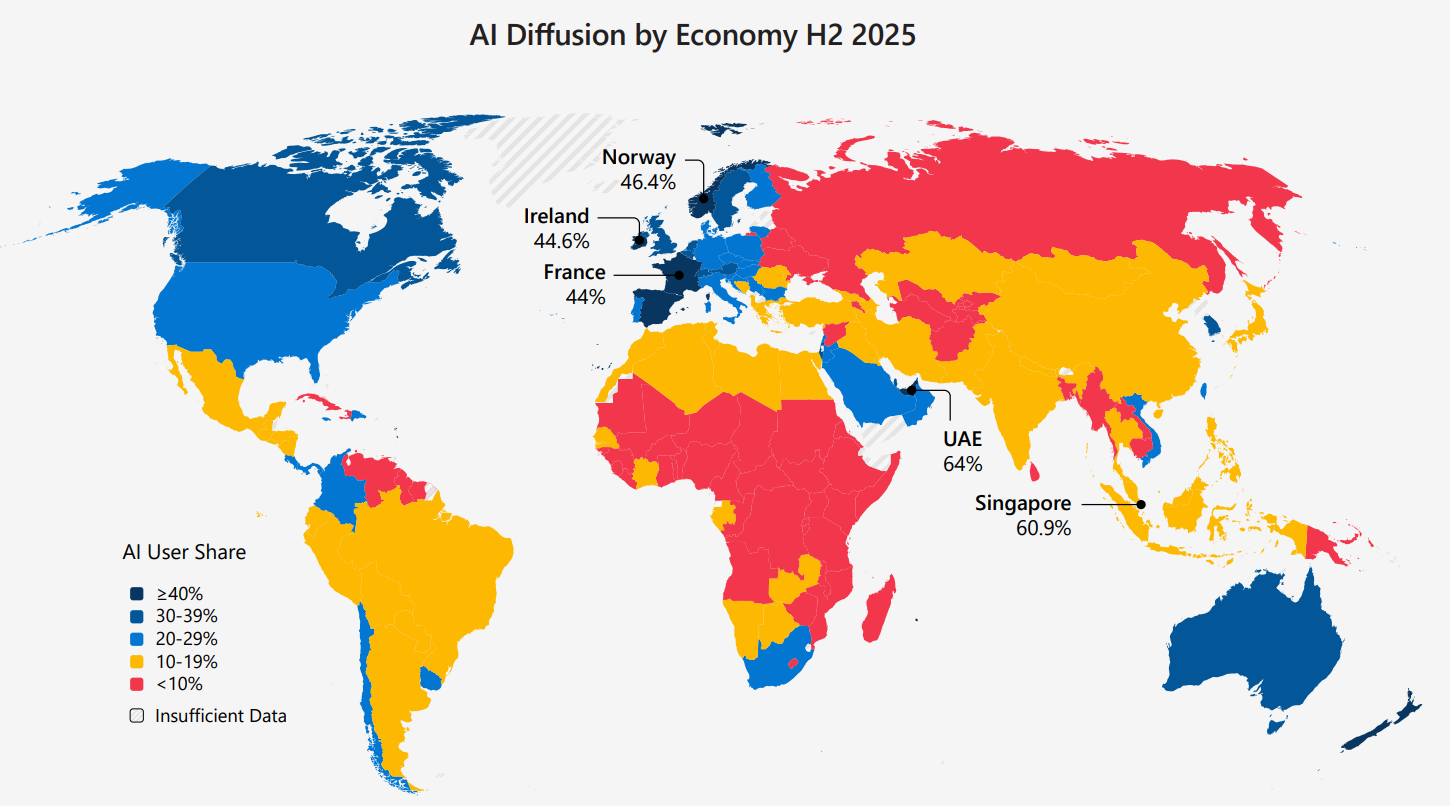
The gap between developed and developing economies is widening fast. Wealthier nations now adopt AI at nearly double the rate of the Global South, creating a 10.6% adoption gap. Meanwhile, DeepSeek models are gaining traction in underserved regions, with usage 2–4× higher in parts of Africa, helped by free access, open-source availability, and Huawei-backed distribution.
Why does it matter?
The U.S. ranking underscores how innovation and nationwide adoption are very different problems. The steady rise of DeepSeek in underserved regions also stands out, showing that accessibility and distribution can matter just as much as raw model capability.
ChatGPT becomes a health helpdesk
A new OpenAI report shows more than 40 million people now use ChatGPT daily for health-related questions, accounting for over 5% of all messages on the platform. Users commonly rely on it for symptom checks, decoding medical jargon, spotting billing errors, and preparing questions before seeing a doctor.
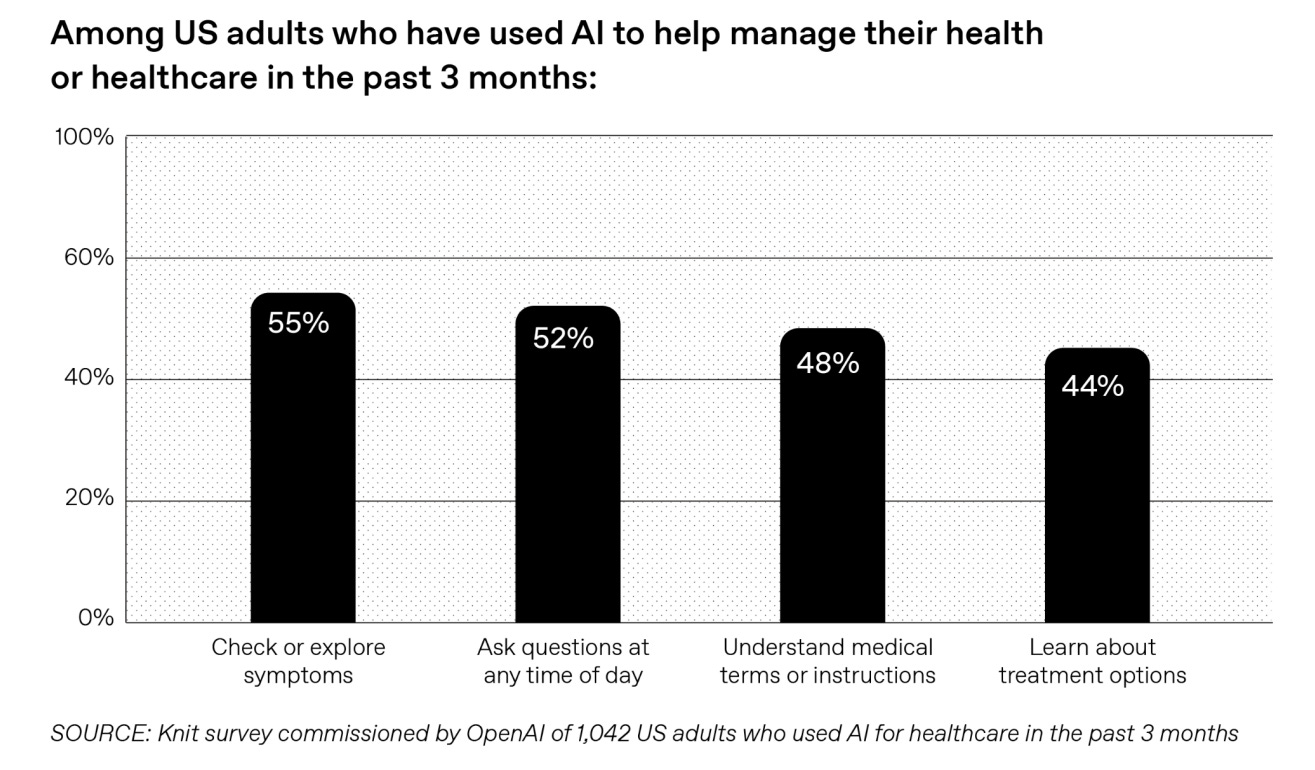
The usage patterns are telling. Around 70% of health chats happen outside normal clinic hours, with roughly 600,000 weekly messages coming from rural or underserved areas. Health insurance questions alone generate up to 1.9 million messages each week, covering everything from plan comparisons to billing disputes. The report also calls on regulators to clarify approval paths for AI-powered medical tools.
Why does it matter?
Healthcare is already one of AI’s largest real-world use cases, and usage patterns show it extending beyond advice into navigation and decision support. With OpenAI pushing for clearer FDA pathways, the report points toward a future where ChatGPT’s health insights begin to resemble a front-line digital care assistant.
Anthropic rolls out Claude for healthcare
Anthropic just launched Claude for Healthcare, a version of its AI assistant designed specifically for medical and life sciences workflows. Unlike consumer-facing chatbots, the tool is built to operate inside regulated healthcare environments, supporting tasks like insurance verification, prior authorization, clinical documentation review, and medical coding using standards such as ICD-10, CMS guidelines, and provider registries.
The company is also positioning Claude as a patient-facing support layer. With user consent, it can connect to digital health platforms and personal health records to help explain lab results, medical terms, and treatment plans in plain language.
Why does it matter?
Healthcare is quickly becoming the most competitive vertical in applied AI, and Anthropic’s focus on enterprise workflows contrasts with OpenAI’s consumer-first approach. As AI moves deeper into regulated systems, the real differentiator may be who can reduce admin burden and integrate safely at scale.
DeepSeek hints at cheaper AI training
DeepSeek just dropped new research hinting at how it plans to squeeze more performance out of large AI models without ballooning costs. The paper introduces mHC, a training technique designed to stabilize neural networks at scale while adding only minimal extra compute, a key pain point as models continue to grow.
Tests across mid-to-large models showed consistent gains, particularly on reasoning benchmarks. Notably, DeepSeek CEO Liang Wenfeng personally co-authored and uploaded the paper, continuing the company’s pattern of using research releases as early signals ahead of major model launches.
Why does it matter?
DeepSeek’s earlier gains showed that frontier-level performance doesn’t require frontier-level spending, and this research suggests there’s still more efficiency to unlock. Combined with improving access to advanced AI chips, these kinds of breakthroughs point to Chinese AI models becoming even more competitive in 2026.
Nvidia open-sources AI for self-driving
At CES 2026, Nvidia unveiled Alpamayo, a new open-source AI model family built to help autonomous vehicles reason through complex driving scenarios. The flagship model, Alpamayo 1, uses chain-of-thought reasoning to break problems into steps, allowing it to handle rare edge cases that fall outside standard training data.
Unlike traditional driving models that output actions alone, Alpamayo also generates reasoning traces alongside driving trajectories, showing why each decision was made. Nvidia is pairing the release with AlpaSim, an open-source simulation framework, and more than 1,700 hours of real-world driving data to support training and validation.
Why does it matter?
Waymo and Tesla have shown that self-driving systems can work, but their massive, closed R&D efforts are hard to replicate. By open-sourcing Alpamayo, Nvidia lowers the barrier for automakers and startups to build reasoning-based autonomy without starting from scratch.
Enjoying the latest AI updates?
Refer your pals to subscribe to our newsletter and get exclusive access to 400+ game-changing AI tools.
When you use the referral link above or the “Share” button on any post, you’ll get the credit for any new subscribers. All you need to do is send the link via text or email, or share it on social media with friends.
Knowledge Nugget: Code Review in the Age of AI
In this article, Addy Osmani examines how widespread AI-generated code changes where effort is required in software development. As more developers rely on AI to draft features, the act of writing code becomes less time-consuming, while verification takes center stage. AI performs well at producing functional drafts, but logic flaws, security gaps, and edge cases remain common, making review and validation essential.
These dynamics show up differently across workflows. Solo developers often rely on automated tests and targeted manual checks to validate AI-written code before shipping.
In team environments, AI is increasingly used for preliminary reviews, while human reviewers focus on intent, security, and long-term maintainability. In both cases, code review serves as a mechanism for accountability and shared understanding, rather than exhaustive line-by-line inspection.
Why does it matter?
AI increases code output, but without verification, failures simply appear later in production. Pull requests that lack test results or manual validation shift risk instead of reducing effort. In AI-assisted development, speed only holds value when it is backed by proof that the code works.
What Else Is Happening❗
🧬 UK startup Basecamp Research launched Eden, an AI model family trained on evolutionary data from 1M species to design new gene therapies and antibiotics for resistant diseases.
🗣️ Amazon launched Alexa.com, bringing its AI-powered Alexa+ assistant to the web with agentic features for research, planning, and real-world services.
🎮 Razer unveiled Project AVA, a Grok-powered hologram AI assistant for gaming and creativity, featuring a physical avatar that can watch screens and offer real-time guidance.
😴 Stanford researchers introduced SleepFM, an AI model that predicts 130+ health conditions from a single night of sleep, flagging risks like dementia, Parkinson’s, and heart disease.
📧 Google rolled out Gemini upgrades to Gmail, letting users query their inbox in natural language, get AI summaries, and take proactive actions like to-dos and reminders.
🛒 Google launched the Universal Commerce Protocol, an open-source framework enabling AI agents to handle end-to-end shopping, from discovery to checkout, with major retailers onboard.
🗂️ Anthropic released Cowork, a macOS tool that brings Claude’s agentic abilities to everyday tasks like file organization, reporting, and expense management.
🏗️ Microsoft launched Community-First AI Infrastructure, pledging data centers that won’t raise local power prices, will replenish water use, and invest in local jobs and training.
New to the newsletter?
The AI Edge keeps engineering leaders & AI enthusiasts like you on the cutting edge of AI. From machine learning to ChatGPT to generative AI and large language models, we break down the latest AI developments and how you can apply them in your work.
Thanks for reading, and see you next week! 😊
Read More in The AI Edge


