[[{“value”:”
Good Morning,
Is it the end of an era for OpenAI as we approach 2026?
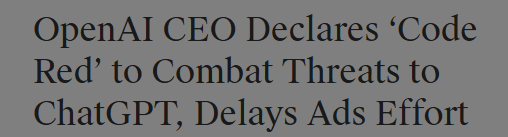
I really want to get the pulse of OpenAI, because ChatGPT used to be symbolic of the potential of Generative AI. This week as I’m sure you’ve heard – as first reported by the Wall Street Journal, Sam Altman sent an internal memo on Monday declaring a company-wide emergency.
“OpenAI’s code red” is an internal directive. It was issued by CEO Sam Altman. The directive prioritizes improvements to ChatGPT. It also combats rising competition, mainly from Google’s Gemini models. The directive signals an urgent effort within the company to maintain its market lead.
Let’s frame this.
On November 30, 2022, OpenAI introduced a new product to the world, ChatGPT. In late 2022 and early 2023 we all marveled at its capabilities. It was a brave new world and OpenAI felt like the promising pioneer. Fast forward three years and there are chatbots like Gemini, Grok, Claude, Qwen, Perplexity, Genspark, DeepSeek, and at least a half dozen others worth using for specific kinds of tasks.
Signs of a slow down in AI adoption, like the tightening labor market or lower consumer sentiment in the U.S. economy, are very real for millions of Americans and users all over the world. AI Bubble debates raging around ROI and AI Infrastructure debt or the capex around AI appear to have coincided with less adoption or a material slowing in adoption of AI products like ChatGPT. Recently according to Ramp AI Index, paid AI growth actually declined in September, 2025 by almost a full percent at 0.7%.
“There are now more businesses than I ever remember before that struggle to explain how their unit economics are ever going to make sense. It usually requires an explanation on the order of infinite retention, a massive reduction in costs, a claim that eventually the company can stop buying users, or something even less plausible…” – Sam Altman 1
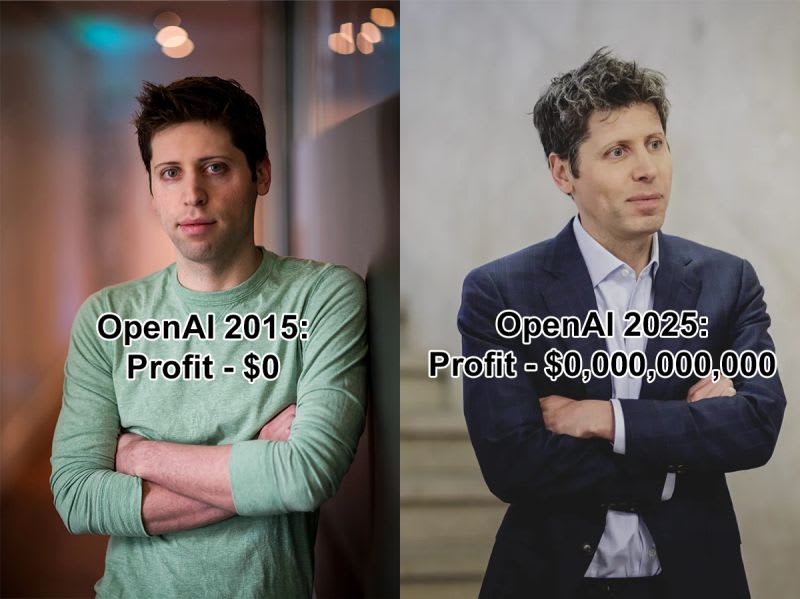
OpenAI’s Pivot into a Product Company is not going well
Meanwhile OpenAI’s supposed pivot to a product company and an apps ecosystem definitely feeling off or stalled in development as they overhired, appear disorganized and also fairly slow. With the arrival of Gemini 3 and Anthropic’s success in AI coding and Enterprise AI, it almost feels as if the internet is cheering for OpenAI to fail. The initial catalyst of early Generative AI in late 2023 had gone from icon, to first-mover flop. OpenAI’s supposed “Code Red” status thus feels a bit late to the party.
So what happend? A disastrous GPT-5 launch was the first real sign that everything was not quite right at OpenAI. Then there was a Sora app that flopped, badly. Delays in OpenAI’s hardware device progress. Unrealistic partner deals in AI Infrastructure it might never be able to afford to pay for. OpenAI has an incredible cash-burn of up to $12 Billion while making head-scratching acquisitions without major product launches in a timely fashion in 2025. OpenAI partners have amassed nearly $100 Billion in debt to cover speculative AI Infrastructure projects far into the future, with allegations of circular financing and vendor financing tie-ins.
Anthropic Likely to Beat OpenAI to an IPO
Now it appears Anthropic will beat OpenAI to an IPO, just months from now in 2026. The truth is, OpenAI was in code red trouble long before the triumphant Google Gemini 3 launch of November 18th, 2025. Meta had poached several Chinese born Engineers at OpenAI over the summer. OpenAI’s so-called entry into Search or Ads, never really materialized in a big way like some thought it might. It’s been a crazy year for OpenAI, and not in a good way. Feature bloat in ChatGPT itself has disguised a rather underwhelming ability to execute on big plans within the company.
Who are going to be the New Guard of the next era of the Internet?
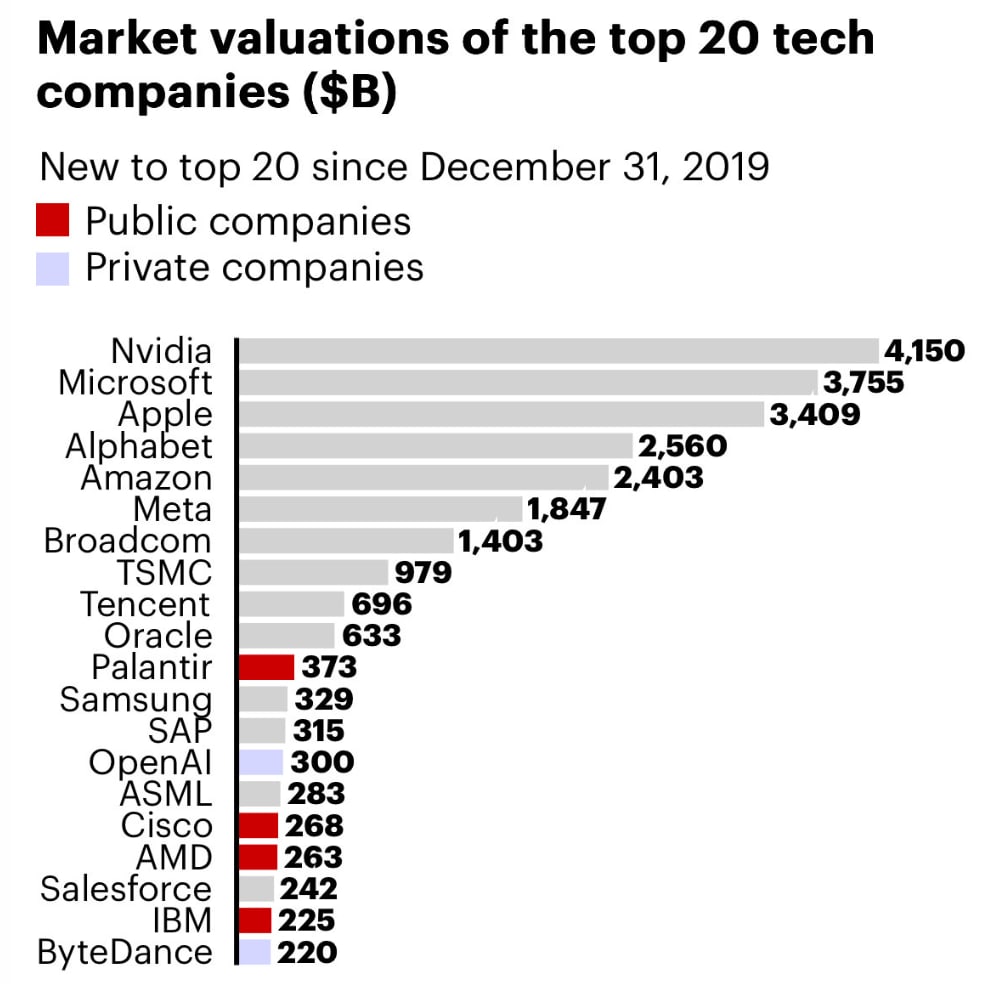
Prediction: Anthropic and OpenAI become AI Hyperscalers
I predict Anthropic and OpenAI will become Cloud players following ByteDance’s example. ByteDance has become a significant cloud player, primarily through its cloud computing business unit, Volcano Engine. It is a major competitor in the Chinese market and is actively expanding its offerings, particularly in the realm of artificial intelligence (AI) cloud services. Only a matter of time before the Big Three in the U.S. will have to contend with Anthropic Cloud and OpenAI Cloud. This isn’t mere speculation either, OpenAI is actively considering ways to become an “AI cloud” provider and directly sell compute capacity to other companies and individuals. In China, ByteDance is on a trajectory to compete with Alibaba Cloud one day. The model-as-a-service (MaaS) tactic is the perfect entry to become a Cloud Computing hyperscaler in tandem with making your own AI chip to reduce costs.
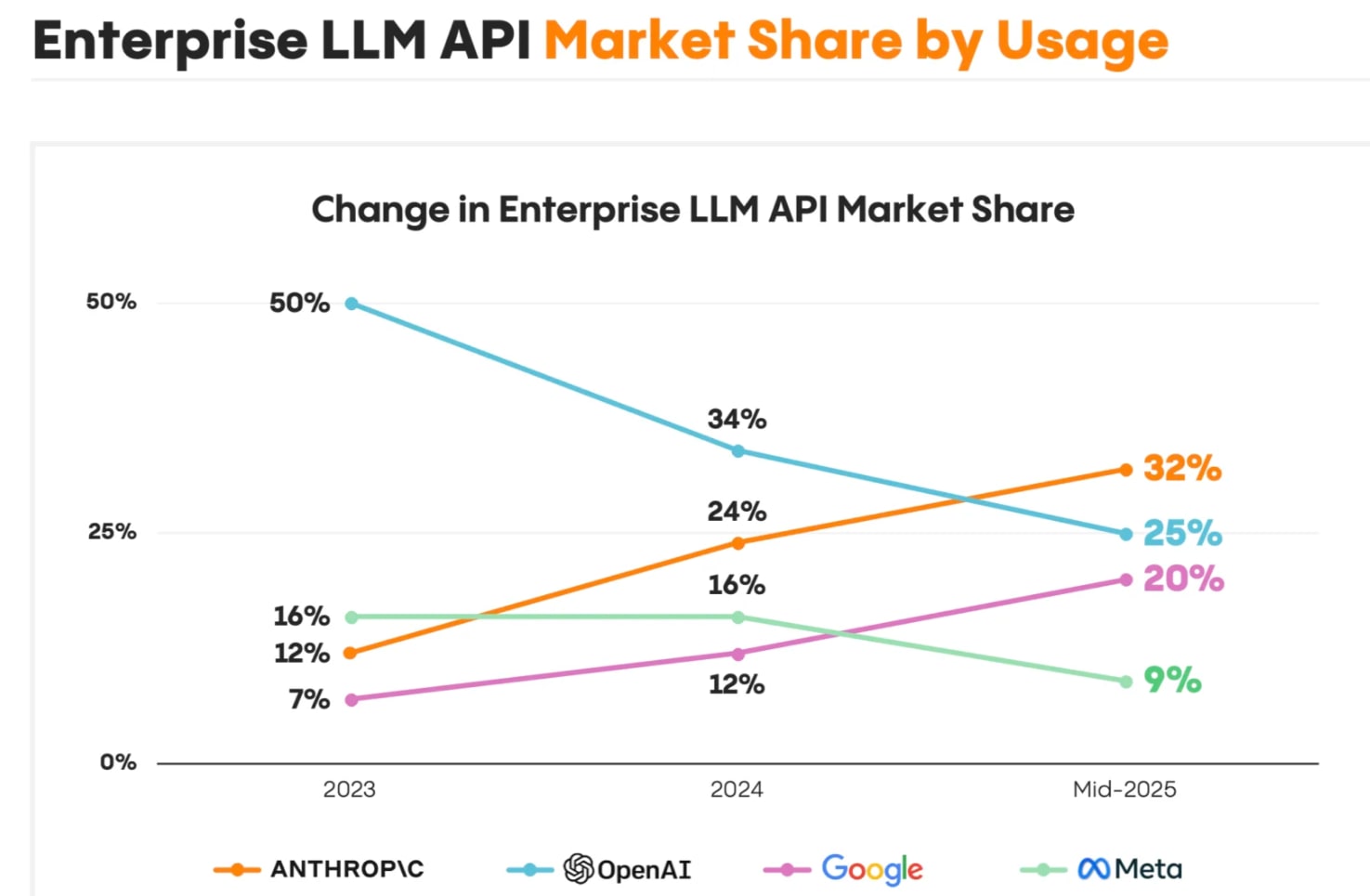
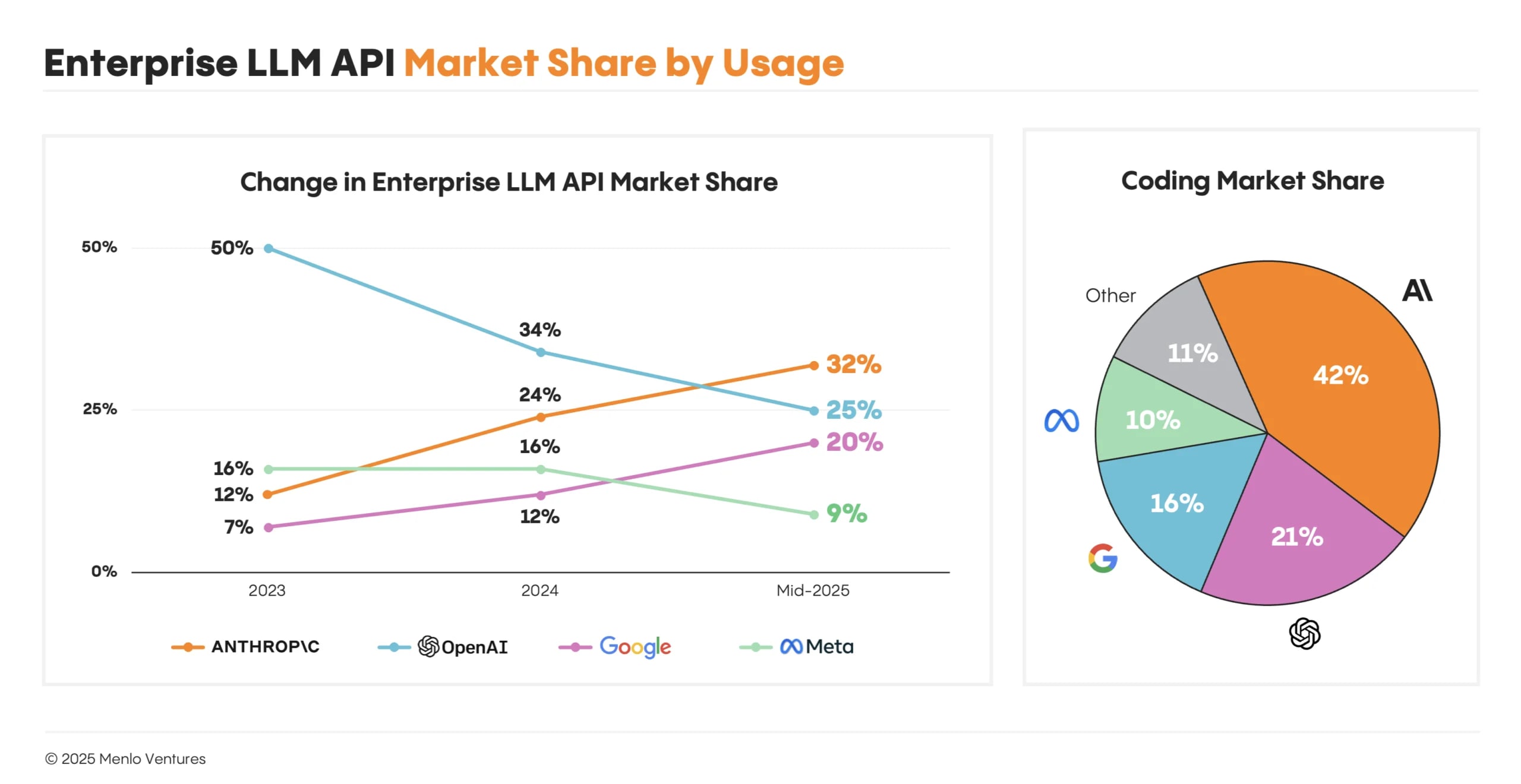
OpenAI Lost Significant API Market Share of Developers and Enterprise AI to Anthropic and Google in 2025
So what is the evidence that OpenAI really slipped up in 2025? It’s not just GPT-5. We are likely due for another Menlo report soon, but we found out earlier this year that OpenAI had lost major API marketshare in 2025.
Anthropic CEO, Dario Amodei recently2:
“There are some players who are YOLOing… Let’s say you’re a person who just kind of constitutionally wants to YOLO things or just likes big numbers, then you may turn the dial too far” (assumed to be about Sam Altman).
Dario Amodei took the stage at the DealBook Summit, and that quote really stood out this week.
AGI Evangelism created an Untrustworthy Brand for OpenAI
As we head into 2026 soon, Generative AI is getting a bit more competitive and it doesn’t appear like OpenAI has great prospects moving forwards. OpenAI has “already grown more powerful than pretty much any nation-state in the world”, according to Karen Hao, but already seems in “code red” against more successful competitors. It would be hard to argue that post GPT-5 OpenAI is even a state-of-the-art (SOTA) AI research lab any longer unless the pull a drastically new model from the hat. Given the GPT-5 models, rumor of their “garlic” model doesn’t excited me even as much as what DeepSeek-R2 could be, or any number of other LLM makers. They say AI moves fast, but who knew the ChatGPT maker will turn out like this. It might take the general public another six months to come to this conclusion.
OpenAI’s Code Red is a thing to watch in AI in 2026
This is and all even before Meta’s new AI initiatives have ramped up or xAI are growing at full-capacity. Alibaba’s Qwen recently launched a new app and AR glasses. Meanwhile ChatGPT seems destined for ever increasing sycophantic manipulation of its users that don’t seem to be using Generative AI for let’s say, higher purposes. It’s clear AGI evangelism and Techno-Optimism in some respects, has gone horribly wrong as an OpenAI leading ideology. OpenAI isn’t just no longer leading in the industry, it’s not competing favorably to even keep up with other AI labs.
I recognized being a first-mover had its risks for OpenAI back in 2024, but I didn’t anticipate this kind of strategic meltdown. But if you consider what leadership is prioritising, it’s not entirely surprising.
Sam Altman appears distracted by Venture Capital Projects
Sam Altman seems oddly disconnected with what’s going on with OpenAI on the ground. OpenAI recently took a stake in a Venture fund, Thrive’s spin-off, Thrive who had itself invested in OpenAI earlier, and has ties to the Trump family. Thrive Capital launched Thrive Holdings in April. While Sam Altman makes VC deals with OpenAI’s name, he’s literally losing the race to build great AI products. Sam Altman was and likely still is the owner of the so-called “OpenAI Startup Fund” when it launched in 2021. Here is a CEO and a prominent Board member who clearly doesn’t have great business priorities or leadership chops. Can’t argue with his Venture Capital instincts though – but that’s not how you win this game if you are OpenAI.
The problem in all of this is OpenAI is competing with people with the top AI talent in the world, like Anthropic, and Google that is the full-stack leader in AI with the ability and capital to execute, in addition to Chinese companies with more Engineering talent and capital efficiency how are forced to innovate without the top AI chips. Soon they will have to compete with a motivated Elon Musk and Mark Zuckerberg as well that have far more capital leverage and free-cash flow.
If you are a CEO, you need to be committed to the job and not scattered the way Altman has been, who has manipulated and alienated much of the AI community for the last decade. Furthermore with Microsoft having so much equity in OpenAI’s new structure, OpenAI is tied to a company that can’t even sell AI products well. No real surprise there. It’s tied itself to partners like Oracle and Softbank who don’t exactly have great track records of investing in AI. Softbank Vision Funds are a historical testament to how poorly they (Masayoshi Son) do due diligence. If growth continues to slow at OpenAI and with so much debt tied to their antics and fake promises, we’re going to have to wave the AGI evangelists goodbye. The chatter about OpenAI being the WeWork of AI is going to pick up again in 2026.
AI Chips Keep Getting Better
TPUs, Tranium, and new entries. China’s Nvidia ban could be a catalyst for more competitors to Huawei. ChatGPT has insurmountable odds to face in 2026 and the years ahead to keep staying on top.
“}]] Read More in AI Supremacy